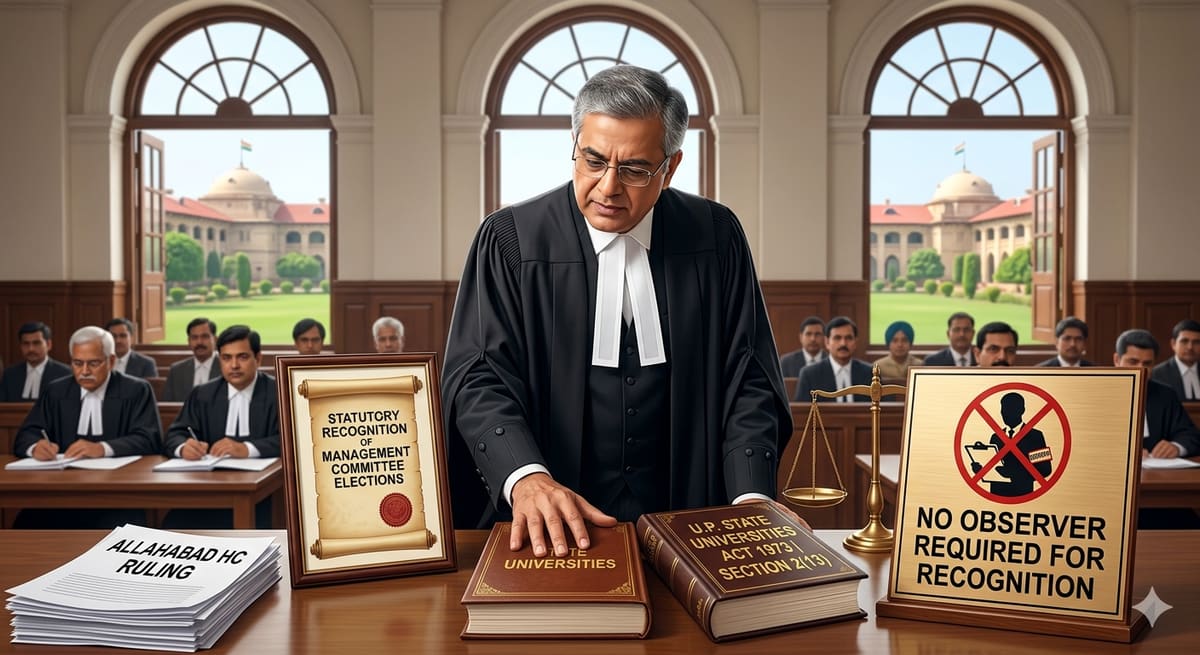
The Allahabad High Court has clarified that universities cannot refuse recognition to a duly elected Committee of Management of an affiliated college merely because an observer was not present during the election. This ruling reinforces the principle that statutory recognition is a ministerial duty, not a discretionary power to impose procedural conditions not mandated by law.
Background & Facts
The Dispute
The Committee of Management of S.M. College, Chandausi, District Sambhal, sought recognition of its election held on 05.10.2025 from the Vice Chancellor of Guru Jambheshwar University, Moradabad. The Vice Chancellor, by order dated 06.01.2026, declined recognition on the ground that the election was conducted without an observer appointed by the University. The petitioner challenged this order through a writ petition before the Allahabad High Court.
Key Facts
The election for the Committee of Management was held on 05.10.2025.
Requests for appointment of an observer were made by the petitioner on 29.09.2025 and again on 04.10.2025.
The University did not appoint an observer prior to the election date.
No rival claimant or member of the General Body challenged the election results.
The University had previously issued an order on 24.08.2025 recommending appointment of an Authorised Controller under Section 58(1) of the Uttar Pradesh State Universities Act, 1973.
The Authorised Controller was formally appointed by an Office Memo dated 14.01.2026, after the election had already taken place.
The appointment of the Authorised Controller was upheld by a Single Bench of this Court in Writ-C No. 5820 of 2026, dated 18.03.2026, though that order is under challenge before the Division Bench.
The petitioner submitted all required documents to the University after the election.
Procedural History
29.09.2025: First request made to University for appointment of observer.
04.10.2025: Second request made for observer.
05.10.2025: Election of Committee of Management conducted in absence of University observer.
06.01.2026: Vice Chancellor issued order refusing recognition of election.
14.01.2026: Authorised Controller appointed by Government of U.P.
18.03.2026: Single Bench upheld appointment of Authorised Controller in Writ-C No. 5820 of 2026.
28.03.2026: Writ Petition (No. 12337 of 2026) filed before Allahabad High Court.
29.04.2026: Case reserved for judgment.
06.05.2026: Judgment delivered.
The Parties' Positions
Petitioner (Committee of Management, S.M. College): Argued that the Act of 1973 imposes no mandatory requirement for an observer to be present during elections. Recognition is a formal duty upon receipt of valid election results, absent any dispute. The refusal was arbitrary and contrary to precedent.
Respondents (State of U.P., University, Vice Chancellor): Contended that the absence of an observer rendered the election procedurally defective. They relied on past practice and the pending appointment of an Authorised Controller as justification for withholding recognition.
Relief Sought
The petitioner sought quashing of the order dated 06.01.2026, a direction to the Vice Chancellor to recognize the Committee of Management elected on 05.10.2025, and costs.
The Legal Issue
The central question was whether the Vice Chancellor of a university under the Uttar Pradesh State Universities Act, 1973, has the legal authority to refuse recognition of a Committee of Management solely on the ground that no observer appointed by the University was present during the election, when no dispute has been raised regarding the election’s validity.
Arguments Presented
For the Petitioner
The petitioner relied on Banaras Hindu University v. Arya Vidya Sabha Kashi (2003) to argue that the Vice Chancellor’s role is limited to verifying the formalities of election and communicating with the elected body. The Act of 1973 does not mandate the presence of an observer. Refusal without a dispute or statutory basis amounts to an abuse of power. The delay in appointing an observer, despite two requests made weeks in advance, was unreasonable and cannot be used to invalidate a lawful election.
For the Respondent
The respondents relied on Committee of Management J.N. Smarak Post Graduate College v. Gorakhpur University (1998) to argue that the petitioner should have invoked the alternative remedy under Section 68 of the Act of 1973. They further contended that the absence of an observer constituted a procedural irregularity, and the petitioner’s haste in conducting the election - despite pending requests for observer appointment - evinced mala fide. The appointment of an Authorised Controller on 14.01.2026, they argued, rendered the election non-compliant with emerging administrative norms.
The Court's Analysis
The Court examined the definition of "Management" under Section 2(13) of the Uttar Pradesh State Universities Act, 1973, which defines it as the Managing Committee "recognised as such by the University." The Court held that recognition is not a discretionary power to impose additional conditions but a statutory obligation triggered upon submission of valid election results.
"The Vice Chancellor can prima facie verify whether elections were proper or not without entering into any dispute except only for purpose to make communication with duly elected Committee of Management."
The Court noted that no provision in the Act mandates the presence of an observer during elections. While such presence may be a customary practice for ensuring fairness, it cannot be elevated to a statutory condition for recognition. The Court emphasized that the absence of any challenge to the election results by any member of the General Body or rival group further negated any basis for refusal.
The Court rejected the argument that the appointment of an Authorised Controller on 14.01.2026 invalidated the October 2025 election, observing that the election occurred months before the Controller’s appointment. The University’s failure to act on the requests made on 29.09.2025 and 04.10.2025, without providing any reason for delay or requesting additional documents, was found to be arbitrary.
The Court distinguished Gorakhpur University (1998), noting that it concerned a challenge to an election result under Section 68, whereas this case involved no dispute at all - only an administrative refusal based on an unmandated procedural norm.
The Verdict
The writ petition was allowed. The impugned order dated 06.01.2026 refusing recognition was set aside. The Vice Chancellor of Guru Jambheshwar University, Moradabad, was directed to recognize the Committee of Management elected on 05.10.2025 within three weeks, provided no other legal impediment exists. The Court awarded costs of Rs. 10,000 to the petitioner.
What This Means For Similar Cases
Recognition Is Ministerial, Not Discretionary
Practitioners must argue that refusal of recognition under the U.P. State Universities Act, 1973, without a dispute or statutory ground, is ultra vires.
Universities cannot impose informal norms (e.g., observer presence) as mandatory conditions for recognition.
The burden lies on the university to show a specific statutory violation, not merely a deviation from practice.
No Observer = No Invalidity, Absent Dispute
If no party challenges the election outcome, the mere absence of a university observer cannot justify non-recognition.
Requests for observers must be acted upon reasonably; delays cannot be weaponized to invalidate elections.
Colleges should document all requests for observers and retain proof of compliance with election rules.
Alternative Remedies Do Not Bar Writ Jurisdiction When Rights Are Clear
While Section 68 provides a remedy for election disputes, it does not apply where no dispute exists.
Writ jurisdiction under Article 226 remains available to enforce statutory rights when administrative action is arbitrary or contrary to law.
Courts will not compel litigants to exhaust alternative remedies where the violation is clear and immediate.