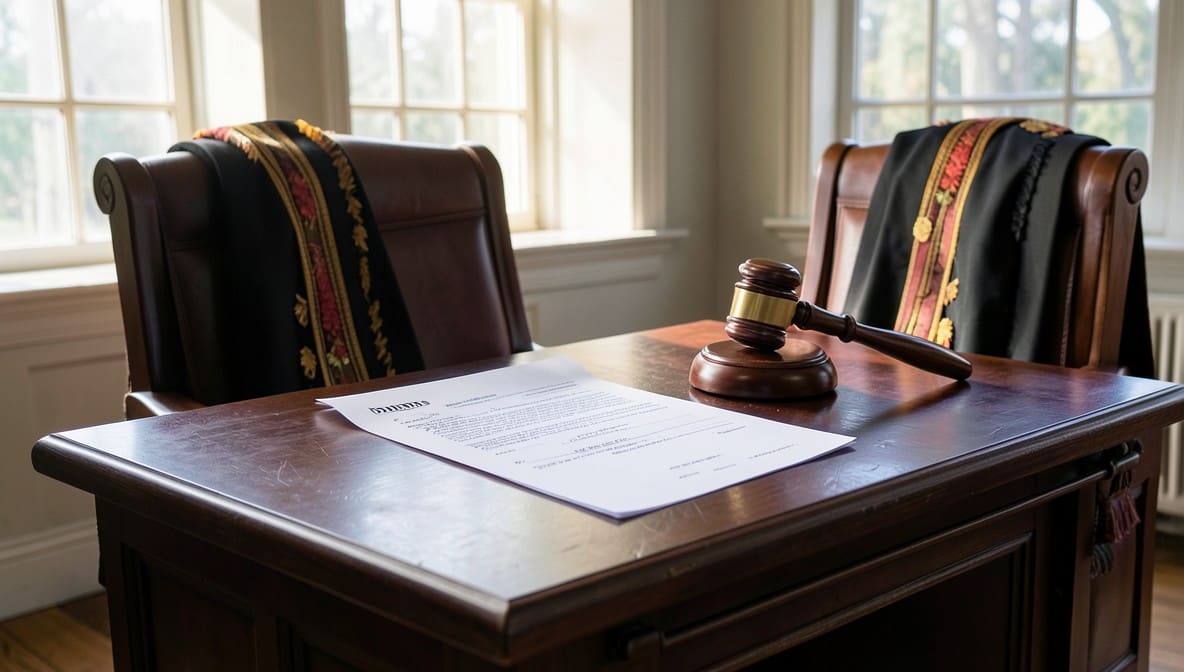
The Allahabad High Court has reaffirmed that a magistrate’s mechanical issuance of a summoning order under Section 138 of the Negotiable Instruments Act, without any independent application of mind, constitutes an abuse of process. This ruling reinforces the procedural safeguards required at the threshold stage of criminal prosecution for dishonored cheques.
Background & Facts
The Dispute
The complainant, Aftab Ahmad Khan, filed a complaint under Section 138 of the Negotiable Instruments Act, 1881 against the applicant, Gaurav Kumar Singh, alleging dishonor of a cheque issued in discharge of a legally enforceable debt. The complaint was registered as Complaint No. 7867 of 2018 before the Additional Court, Room No. 5, Lucknow, under Police Station Gazipur, District Lucknow.
Key Facts
- The alleged cheque was issued on or about 15.08.2018
- The cheque was presented for payment on 20.09.2018 and returned unpaid on 22.09.2018
- A legal notice under Section 138 was sent on 25.09.2018 and received by the applicant on 28.09.2018
- The notice demanded payment within 15 days, which was not complied with
- The complaint was filed on 10.10.2018
Procedural History
- 31.10.2018: Magistrate passed a summoning order in Complaint No. 7867 of 2018
- 17.12.2019: Non-Bailable Warrant was issued against the applicant
- The summoning order and warrant were recorded on a single order sheet, annexed as Annexure 1 to the application
- The applicant challenged the summoning order before the High Court under Section 482 CrPC on grounds of mechanical issuance
- The order sheet revealed that the summoning order was copied verbatim from a printed proforma, with only the case number, names, and date manually filled in
- No reasons were assigned for taking cognizance, no analysis of the complaint or supporting documents was recorded, and no reference was made to the legal requirements under Section 138
Relief Sought
The applicant sought quashing of the summoning order dated 31.10.2018 and the subsequent non-bailable warrant dated 17.12.2019, on the ground that the magistrate failed to apply judicial mind before issuing process, thereby violating principles of natural justice and due process.
The Legal Issue
The central question was whether a summoning order under Section 138 of the NI Act passed on a printed proforma, without any reasoning or application of mind, can be sustained in law.
Arguments Presented
For the Appellant
Learned counsel for the applicant submitted that the summoning order was entirely mechanical, transcribed from a pre-printed template with no independent judicial evaluation of the complaint’s sufficiency. He emphasized that the magistrate did not examine whether the complaint disclosed a prima facie case under Section 138, nor did he consider the legal requirements laid down in K. Srinivas v. K. Srinivas or Dharamvir Singh v. State of Haryana. He relied on Ankit v. State of U.P., where this Court had previously quashed a similar proforma-based summoning order, holding that such orders are void ab initio.
For the Respondent
The Additional Government Advocate for the State did not dispute that the order was passed on a printed proforma. He conceded that the order sheet showed no reasoning or analysis but argued that the complaint itself was legally sufficient and that quashing at this stage would defeat the purpose of the NI Act. He submitted that the applicant could raise substantive defenses during trial.
The Court's Analysis
The Court examined the nature of the summoning order and its compliance with the procedural safeguards mandated under Section 200 CrPC and the settled principles governing cognizance under Section 138 of the NI Act. It noted that while the magistrate is not required to conduct a full trial at the summoning stage, he must apply his judicial mind to determine whether the complaint, read with the accompanying documents, discloses a prima facie case.
"A summoning order passed on a printed proforma, without any reasoning or indication of judicial consideration, is not merely an irregularity - it is a fundamental defect that vitiates the entire proceeding."
The Court relied on its own precedent in Ankit v. State of U.P., where it held that mechanical issuance of process without any analysis of the complaint’s averments amounts to an abuse of process of law. The Court observed that the order sheet in this case contained no reference to the cheque, its presentation, the notice, or the non-payment, nor did it record any satisfaction regarding the existence of a legally enforceable debt. The absence of any reasoning rendered the order non-est in law.
The Court further clarified that the remedy of quashing under Section 482 CrPC is available not merely to correct errors of procedure, but to prevent manifest injustice and abuse of process. The issuance of a non-bailable warrant on the basis of such an order compounded the illegality.
The Verdict
The application was allowed. The summoning order dated 31.10.2018 and the non-bailable warrant dated 17.12.2019 were quashed. The matter was remitted to the concerned Magistrate to reconsider the complaint afresh, applying judicial mind and recording reasons based on the material on record. The Magistrate was directed to pass a fresh order within six weeks from the date of production of a certified copy of this judgment.
What This Means For Similar Cases
Judicial Application of Mind Is Non-Negotiable
- Practitioners must now challenge any summoning order under Section 138 that lacks reasoning, especially if it appears on a proforma
- A bare recital of the complaint’s contents without analysis is insufficient; the magistrate must record why the ingredients of Section 138 are prima facie made out
- This ruling empowers defense counsel to move under Section 482 CrPC at the earliest stage if the order is mechanical
Proforma Orders Are Void, Not Just Irregular
- Orders passed on printed templates without customization of reasoning are not merely defective - they are legally non-existent
- Courts must treat such orders as void ab initio, not merely subject to correction
- This prevents the routine criminalization of civil disputes under Section 138
Remand Is the Correct Remedy, Not Dismissal
- The Court did not dismiss the complaint outright but remanded it for fresh consideration
- This preserves the complainant’s right to pursue the matter lawfully, while ensuring due process
- Practitioners should seek remand, not outright dismissal, when challenging procedural defects at the summoning stage