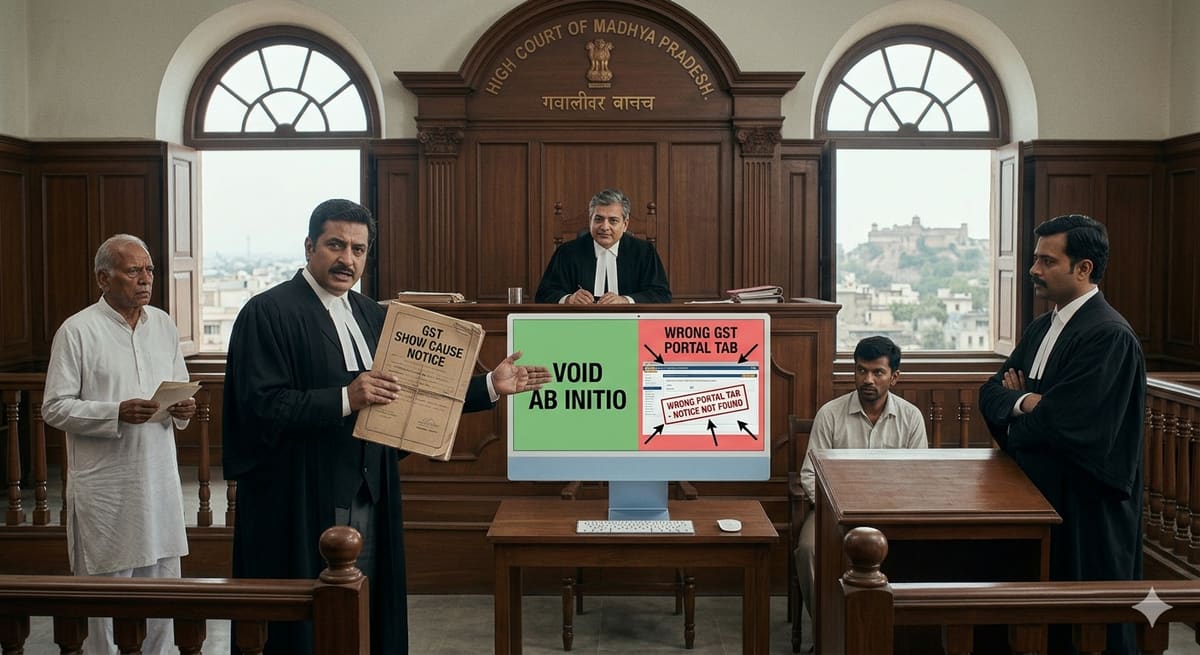
The Uttarakhand High Court has clarified that service of GST notices exclusively through the online portal is invalid when the taxpayer’s registration has been cancelled, as it violates the fundamental principle of audi alteram partem. This judgment reinforces that procedural fairness cannot be sacrificed for administrative convenience, even in fiscal adjudications.
Background & Facts
The Dispute
The petitioner, A.S. Traders, a sole proprietorship engaged in the business of iron scrap, faced ex parte assessment and recovery proceedings under the Uttarakhand Goods and Services Tax Act, 2017 (UKGST Act) for the financial year 2021-22. The proceedings were initiated despite the petitioner’s GST registration having been cancelled effective 31.03.2023, following a voluntary surrender application dated 14.08.2020 during the Covid-19 pandemic, which led to cessation of business operations.
Key Facts
- The petitioner applied for cancellation of GST registration on 14.08.2020 due to business disruption caused by the pandemic.
- A field survey was conducted by the Assessing Officer.
- On 09.05.2023, the petitioner was formally informed that his GST registration was cancelled w.e.f. 31.03.2023.
- After cancellation, the petitioner had no legal obligation to monitor the GST portal.
- On 11.01.2024, the Department issued a show-cause notice under Section 74(5) of the UKGST Act via the GST portal only, alleging tax evasion for AY 2021-22.
- No physical, postal, email, or personal service was attempted.
- On 23.02.2024, an ex parte assessment order was passed under Section 74(9), followed by a recovery certificate issued by the Recovery Officer.
- The petitioner was unaware of these proceedings due to non-receipt of any notice.
Procedural History
- 14.08.2020: Petitioner applied for voluntary cancellation of GST registration.
- 09.05.2023: Registration cancelled w.e.f. 31.03.2023; petitioner notified.
- 11.01.2024: Show-cause notice issued exclusively via GST portal.
- 23.02.2024: Ex parte assessment order passed under Section 74(9).
- 23.02.2024: Recovery certificate issued under Section 79.
- 23.03.2026: Writ Petition (M/B) No.187 of 2026 filed before the Uttarakhand High Court.
Relief Sought
The petitioner sought:
- Quashing of the ex parte assessment order dated 23.02.2024 and the recovery certificate dated 23.02.2024.
- Remand of the matter for fresh adjudication with proper opportunity of hearing under Section 75(4) of the UKGST Act.
The Legal Issue
The central question was whether service of a GST show-cause notice exclusively through the online portal, after cancellation of the taxpayer’s registration, satisfies the statutory requirement of valid service under Section 169 of the CGST Act and the principle of natural justice under Section 75(4).
Arguments Presented
For the Petitioner
The petitioner relied on M/s Ahs Steels v. Commissioner of State Taxes (Writ Tax No.1676 of 2024, Allahabad HC) and M/s Katyal Industries v. State of U.P. (2024:AHC:23697-DB), arguing that:
- Once registration is cancelled, the taxpayer is no longer bound to monitor the GST portal.
- Section 169 of the CGST Act provides multiple modes of service, with portal-based service being only one option, not the exclusive one.
- The Department’s failure to use alternative modes (post, email, personal delivery) rendered service invalid.
- The ex parte order violated Section 75(4), which mandates an opportunity of hearing before an adverse order is passed, as affirmed in Radha Krishan Industries v. State of Himachal Pradesh (2021) 6 SCC 771.
For the Respondent
The State did not contest the factual premise that the notice was served only via the portal. The Brief Holder conceded that the petitioner had no active obligation to monitor the portal post-cancellation but argued that portal service remained legally sufficient under the statutory framework. No independent legal submission was made to justify the absence of alternative service.
The Court's Analysis
The Court observed that the facts were undisputed and squarely aligned with the reasoning in the Allahabad High Court’s judgment in M/s Ahs Steels. It emphasized that Section 169 of the CGST Act explicitly lists multiple modes of service, including direct tender, registered post, courier, email, and publication in newspapers - with portal-based service being merely one permissible method.
"The legislative intent is clear: while making a notice available on the common portal is one permissible method, it is not the exclusive method, and the Department is duty-bound to ensure effective service in a manner that actually communicates the notice to the assessee."
The Court held that imposing a duty on a non-registered person to monitor the portal is legally untenable. The cancellation of registration extinguishes the statutory obligation to access the portal, and the Department cannot rely on a mechanism rendered irrelevant by its own action.
Further, the Court underscored that Section 75(4) of the UKGST Act, which mandates an opportunity of hearing before an adverse order, is not a procedural formality but a substantive safeguard rooted in audi alteram partem. The Supreme Court in Radha Krishan Industries had affirmed that fiscal adjudications must strictly comply with natural justice.
The Court also relied on its own earlier order dated 12.01.2026 in M/s Jaipal Singh v. Commissioner, State GST, which had set aside a similar ex parte order and directed fresh proceedings with personal hearing.
The Verdict
The petition was allowed. The Court quashed the ex parte assessment order dated 23.02.2024 and the recovery certificate dated 23.02.2024. The petitioner is directed to reply to the show-cause notice dated 11.01.2024 within two weeks from today. The Department shall then pass a fresh order after providing the petitioner a personal hearing as mandated under Section 75(4) of the UKGST Act. All pending proceedings arising from the impugned orders are set aside.
What This Means For Similar Cases
Portal Service Is Not Sufficient Post-Cancellation
- Practitioners must challenge any GST notice served solely via the portal if the taxpayer’s registration has been cancelled, surrendered, or lapsed.
- The burden shifts to the Department to prove actual service through alternative modes under Section 169.
Natural Justice Overrides Administrative Efficiency
- Ex parte assessments based on portal-only notices are vulnerable to quashing.
- Courts will not tolerate procedural shortcuts that deprive taxpayers of hearing rights under Section 75(4).
Strategic Implications for Practitioners
- File writ petitions early when portal-only notices are received post-cancellation.
- Cite Ahs Steels and Radha Krishan Industries as binding precedents.
- Demand personal hearing in writing at the earliest opportunity to preserve rights.
- Always verify registration status before responding to any GST notice.