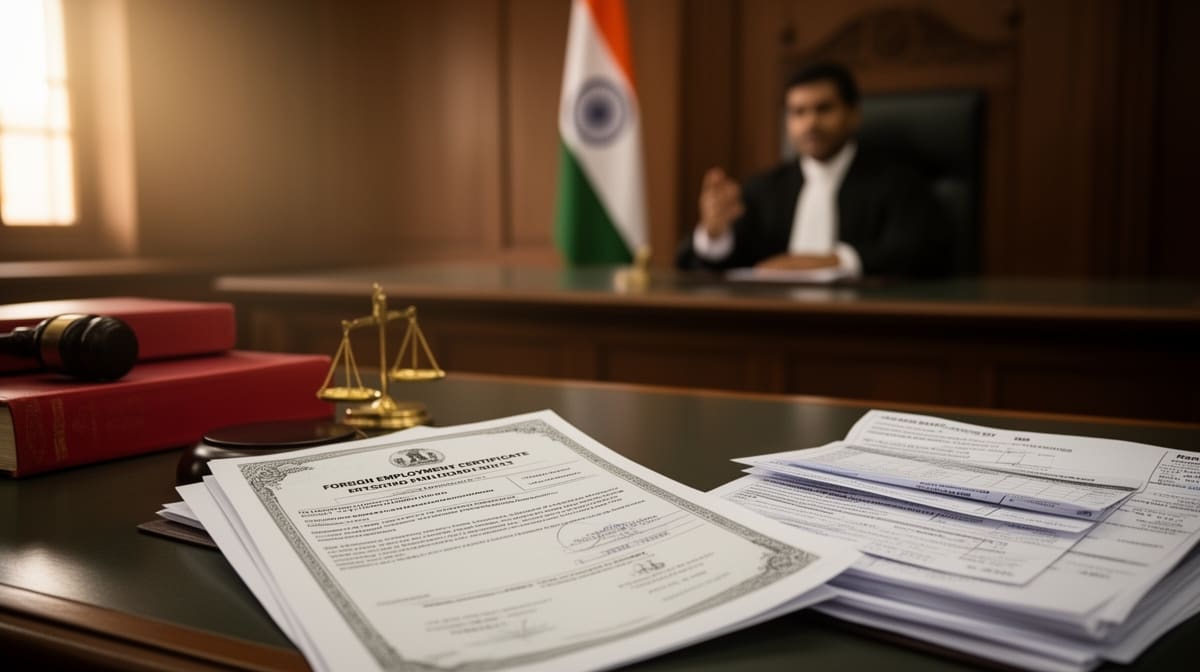
The Punjab & Haryana High Court has reaffirmed that compensation claims under the Motor Vehicles Act cannot rest on unverified, unauthenticated documentary evidence, even when the claimant seeks substantial monetary relief. The judgment underscores the necessity of rigorous evidentiary standards in civil claims involving foreign income assertions, and clarifies the scope of legal representatives entitled to compensation.
Background & Facts
The Dispute
The appellant, Pinki Rani, widow of Rajesh, a 29-year-old man who died in a motor accident on 17.01.2016, sought enhancement of compensation awarded by the Motor Accident Claims Tribunal, Kaithal. The Tribunal had awarded Rs.39,32,600/-, apportioned 80% to the appellant and 10% each to the deceased’s brother and sister. The appellant challenged both the income assessment and the distribution of compensation.
Procedural History
- 20.03.2023: Motor Accident Claims Tribunal awarded compensation of Rs.39,32,600/- in two connected claims.
- 2024: Appellant filed appeal before the High Court, but delayed filing by 402 days.
- 05.03.2026: High Court dismissed the application for condonation of delay and subsequently dismissed the appeal on merits.
Relief Sought
The appellant sought: (1) enhancement of compensation on grounds that the deceased earned Rs.2 lakh per month in Portugal; and (2) deletion of 20% compensation awarded to the deceased’s brother and sister, arguing they were not legal representatives under Section 166 of the Motor Vehicles Act.
The Legal Issue
The central question was whether unverified salary slips translated via Google Translate and unattested by the Indian Embassy can establish foreign income for compensation calculation under the Motor Vehicles Act, and whether siblings of a deceased are entitled to compensation in the absence of proof of dependency.
Arguments Presented
For the Appellant
The appellant relied on salary slips (Ex.P8 to P47) and their translations (Ex.P8/T to P47/T) to prove the deceased’s monthly income of Rs.2 lakh in Portugal. Counsel argued that the Tribunal erred in undervaluing income and in awarding compensation to siblings, who, according to the appellant, are not legal representatives under Section 166. The appellant contended that only spouse, children, and mother are entitled.
For the Respondent
The respondents did not file a written reply, but the Court noted that the brother and sister had earlier claimed in their own petition that the deceased was an agriculturist earning Rs.1 lakh per month - contradicting the appellant’s claim. The Court inferred that the appellant’s evidence lacked credibility and was inconsistent.
The Court's Analysis
The Court conducted a meticulous review of the documentary evidence and found it fundamentally flawed. The translations of the Portuguese salary slips were performed by PW3 Shamsher Singh, who admitted under cross-examination that he was not proficient in Portuguese, had no personal knowledge of the documents, and relied solely on Google Translate. The Court emphasized that documentary evidence of foreign income must be authenticated under the Diplomatic and Consular Offices Oath and Fees Act, 1948, which these documents were not.
"Mere production of the said Salary Slips was not sufficient to prove the alleged employment and income of the deceased."
The Court further noted the absence of corroborating evidence: no appointment letter, no bank statements, no tax returns despite the appellant’s admission that the deceased was an income tax payee. The conflicting averments by the siblings - who claimed the deceased was an agriculturist - further undermined the credibility of the appellant’s claim.
On the issue of legal representation, the Court held that siblings are entitled to compensation under Section 166 if unmarried and dependent, and that the absence of evidence of marriage or independence meant the Tribunal’s apportionment was legally sound. The Court cited State of Haryana v. Jasbir Kaur and General Manager, KSRTC v. Susamma Thomas to affirm that compensation must be just and reasonable, not a windfall.
The Verdict
The appeal was dismissed. The Court held that unauthenticated foreign income documents cannot form the basis for enhanced compensation, and that unmarried siblings may be entitled to compensation if dependency is not disproved. The Tribunal’s award was upheld as fair and legally justified.
What This Means For Similar Cases
Documentary Evidence Must Be Authenticated
- Practitioners must ensure foreign documents are attested by the Indian Embassy or Consulate under the Diplomatic and Consular Offices Oath and Fees Act, 1948.
- Translations by non-experts using automated tools like Google Translate are insufficient and will be rejected.
- Always supplement salary slips with bank statements, employment letters, and tax returns.
Siblings Are Not Automatically Excluded from Compensation
- The burden is on the respondent to prove that siblings are married or financially independent.
- Absent such evidence, Tribunals may award compensation to siblings, especially if they are minors or dependents.
- Do not assume only spouse and children qualify - Section 166 permits broader interpretation of legal representatives.
Income Assessment Requires Corroboration
- Courts will not accept inflated income claims based on single, unverified documents.
- Contradictory statements by co-claimants will be used to discredit the entire claim.
- Future prospects and multipliers must be grounded in credible, documented income, not speculation.