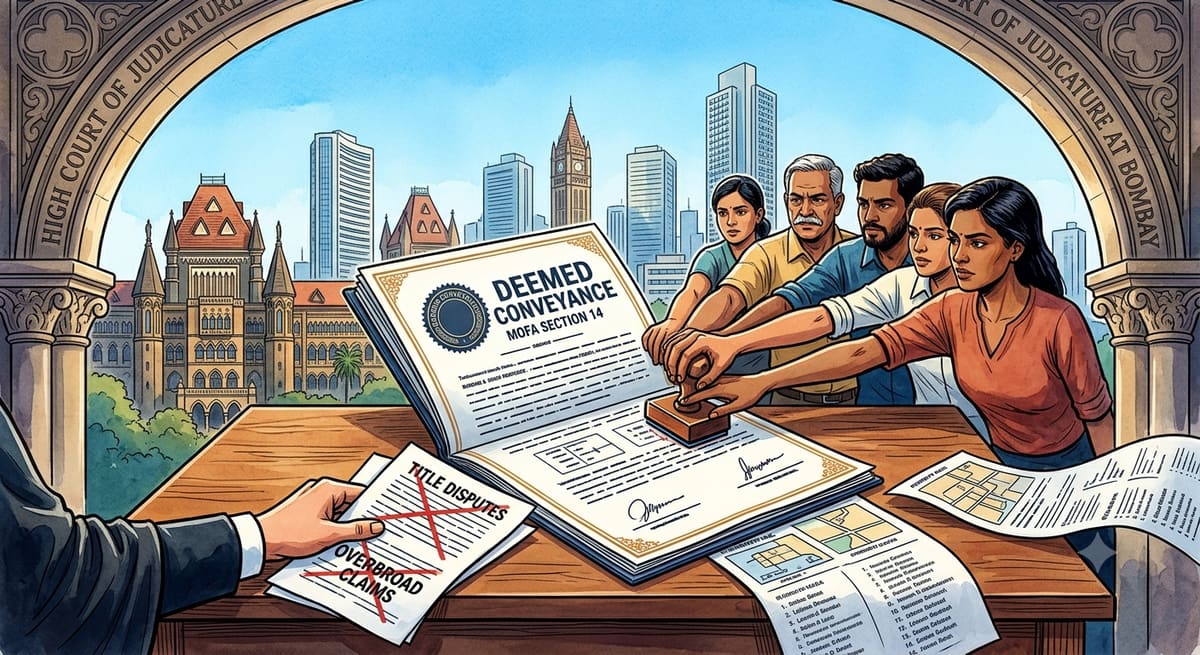
The Bombay High Court has clarified that nomination under the Maharashtra Co-operative Societies Act, 1960, does not confer ownership or automatic membership rights. A registered gift deed executed by a deceased member takes precedence over a nominee's claim, reinforcing the primacy of documented legal transfer over procedural nominations.
Background & Facts
The Dispute
The dispute arises from a contest over membership rights in Flat No.6 of a co-operative housing society in Mumbai. The flat was originally purchased jointly by Govind D. Gadgil and his wife Vijaya Gadgil in or about 1971, and both were admitted as joint members of the society. Upon Govind D. Gadgil’s death, Vijaya Gadgil became the sole member. She continued as the sole member until her death on 25 July 2012. After her demise, the petitioners, Ashok Govind Gadgil and Anr., claimed membership based on a registered gift deed executed by Vijaya Gadgil in their favour. Respondent No.1, Vikas Govind Gadgil, the son of Vijaya Gadgil, claimed joint membership on the basis of nomination allegedly made by his father, Govind D. Gadgil.
Key Facts
- Flat No.6 was purchased jointly by Govind D. Gadgil and Vijaya Gadgil in or about 1971
- Both were admitted as joint members of the society
- Govind D. Gadgil died prior to Vijaya Gadgil; his death did not trigger any formal transfer of membership
- Vijaya Gadgil remained the sole member from Govind’s death until her own death on 25.07.2012
- A registered gift deed dated prior to 25.07.2012 transferred the entire interest in Flat No.6 to the petitioners
- Respondent No.1 claims entitlement based on nomination by his father, Govind D. Gadgil
- No succession certificate, testamentary document, or family arrangement was produced by respondent No.1
- Application for joint membership was filed by respondent No.1 in 2024
Procedural History
- 2024: Respondent No.1 filed application under Section 23(2) of the Maharashtra Co-operative Societies Act, 1960, seeking recognition as joint member
- Date unspecified (prior to 05.05.2026): Competent authority under the Act accepted respondent No.1’s claim and directed society to admit him as joint member
- 12.04.2026: Writ Petition No. 1498 of 2026 filed before the Bombay High Court challenging the order
- 05.05.2026: Judgment delivered by Justice Amit Borkar
Relief Sought
The petitioners sought quashing of the order admitting respondent No.1 as joint member, declaration that they are the sole rightful members under the registered gift deed, and direction to the society to recognize them as members.
The Legal Issue
The central question was whether a nominee under Section 154B(13) of the Maharashtra Co-operative Societies Act, 1960, can claim joint membership in derogation of a registered gift deed executed by the deceased member, and whether the Registrar is empowered to adjudicate disputes over the validity of such a deed.
Arguments Presented
For the Petitioner
The petitioners contended that the registered gift deed executed by Vijaya Gadgil is a valid, enforceable instrument of transfer under the Transfer of Property Act, 1882. They argued that Section 154B(13) mandates that membership be transferred to persons entitled under testamentary documents, succession certificates, or legal heirship documents. A registered gift deed qualifies as such a document. They further argued that the Registrar’s authority under Section 23(2) is limited to verifying the existence of such documents and cannot extend to adjudicating title disputes. They relied on settled law that nomination does not create ownership.
For the Respondent
Respondent No.1 contended that he was nominated by his father, Govind D. Gadgil, as a joint member, and that this nomination entitled him to claim joint membership upon the death of Vijaya Gadgil. He argued that as a legal heir and nominee, he had a legitimate claim to the flat and that the gift deed was invalid due to lack of consent from other heirs. He sought recognition of his status as a joint member based on familial rights and the society’s acceptance of nomination.
The Court's Analysis
The Court undertook a detailed interpretation of Section 154B(13) of the Maharashtra Co-operative Societies Act, 1960. It observed that the provision explicitly provides for transfer of interest to persons entitled under testamentary documents, succession certificates, or legal heirship documents. The Court emphasized that nomination under the first proviso is only a provisional mechanism to maintain continuity of membership pending determination of legal entitlement.
"Nomination does not create ownership, but only enables temporary arrangement. The first proviso to Section 154B(13) indicates that a nominee can be admitted only as a provisional member after the death of the original member, and such provisional status continues only till the actual legal heir or person entitled under law is brought on record as a member."
The Court held that the registered gift deed, being a public document duly registered under the Registration Act, 1908, constitutes a prima facie valid instrument of transfer. The Registrar, acting under Section 23(2), is not a court of competent jurisdiction to examine the validity, genuineness, or enforceability of such a deed. Any challenge to the gift deed must be raised before a Civil Court.
The Court further noted that even if respondent No.1 is a legal heir, his status as such cannot override a registered instrument of transfer unless and until that instrument is set aside by a competent forum. The Court distinguished between procedural nomination and substantive legal title, affirming that the latter prevails.
The Court also clarified that the scope of inquiry under Section 23(2) is strictly limited to verifying the existence of documents that establish legal entitlement. Issues of co-ownership, validity of transfer, or absence of consent are matters requiring evidence, cross-examination, and adjudication beyond the Registrar’s jurisdiction.
The Verdict
The writ petition was allowed. The Court quashed and set aside the order dated prior to 05.05.2026 admitting respondent No.1 as joint member. The society was directed to recognize the petitioners as the sole members of the society in respect of Flat No.6, based on the registered gift deed. The Court clarified that respondent No.1 retains the right to approach a Civil Court to challenge the validity of the gift deed, but such challenge cannot be entertained in proceedings under Section 23(2).
What This Means For Similar Cases
Nomination Is Not a Title-Transferring Instrument
- Practitioners must advise clients that nomination under co-operative society rules creates only provisional membership
- Nominees cannot claim ownership or exclusive membership rights without a valid succession document
- Any claim based solely on nomination must be rejected if a registered instrument of transfer exists
Registrar’s Role Is Limited to Document Verification
- Co-operative society authorities cannot adjudicate title disputes or question the validity of registered deeds
- Challenges to gift deeds, wills, or family arrangements must be raised in Civil Courts
- Applications under Section 23(2) must be decided on the face of the document presented, not on contested factual allegations
Registered Instruments Prevail Over Oral or Familial Claims
- A registered gift deed, even if contested, must be accepted as prima facie valid in society membership proceedings
- Legal heirs must obtain a court declaration before asserting rights against a registered transfer
- Societies must act on documented legal entitlement, not on familial assertions or informal claims