The Bombay High Court has clarified a critical ambiguity in co-operative housing law by holding that liability for society dues is not confined to registered members alone. This judgment establishes that ownership of a flat, coupled with lawful demand under statutory and by-law provisions, is sufficient to trigger recovery mechanisms under the Maharashtra Co-operative Societies Act. The ruling has immediate implications for housing societies, property buyers, and legal practitioners handling recovery proceedings.
Background & Facts
The Dispute
The petitioner challenged a recovery certificate issued under Section 154B(29) of the Maharashtra Co-operative Societies Act (MCS Act), which authorized the society to recover outstanding dues as arrears of land revenue. The petitioner contended that he was not a registered member of the housing society and therefore could not be subjected to such proceedings. He argued that the statutory mechanism under Section 154B(29) was exclusively available against members, and that his status as a flat owner without formal membership rendered the certificate invalid.
Procedural History
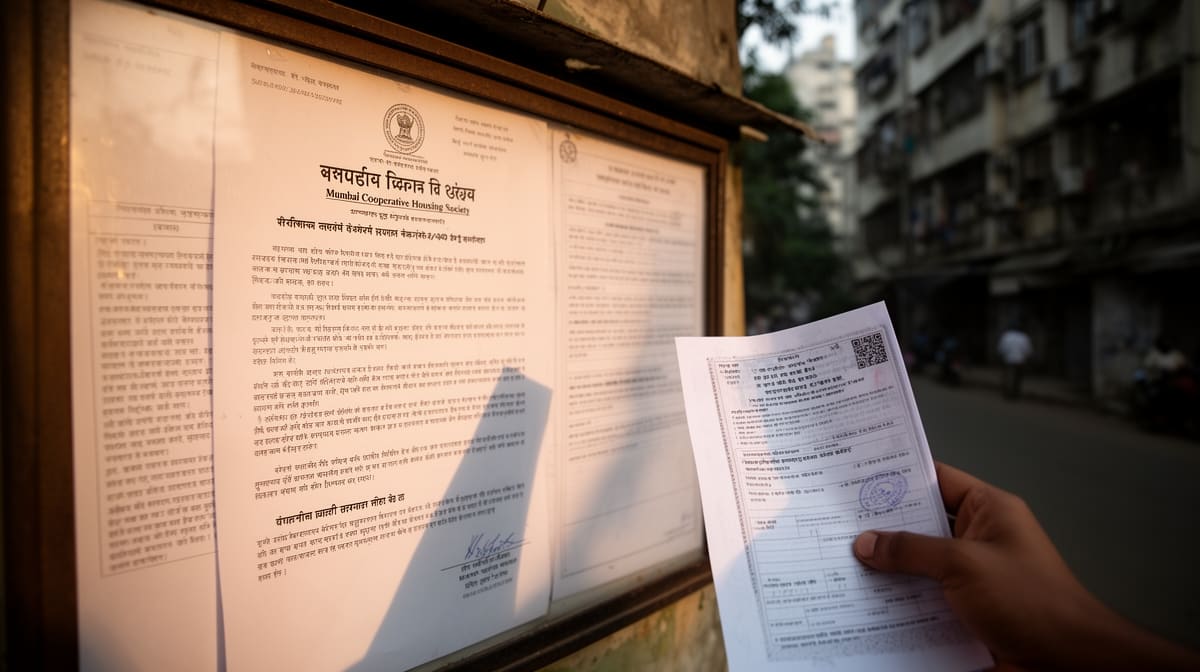
- April 8, 2021: Housing society issued a recovery certificate under Section 154B(29) for unpaid maintenance, service charges, and construction costs.
- August 8, 2024: Revisional Authority upheld the certificate, rejecting the petitioner’s objection on membership grounds.
- 2026: Petitioner filed Writ Petition No. 545 of 2026 before the Bombay High Court seeking quashing of the certificate.
Relief Sought
The petitioner sought quashing of the recovery certificate on the ground that proceedings under Section 154B(29) are not maintainable against non-members. He also sought a declaration that ownership of a flat without formal membership does not attract liability under the MCS Act.
The Legal Issue
The central question was whether Section 154B(29) of the Maharashtra Co-operative Societies Act permits recovery of dues from a person who is not a registered member but is the owner of a flat in the housing society, provided the demand is lawful and grounded in the society’s bye-laws.
Arguments Presented
For the Petitioner
The petitioner’s counsel relied on an unreported judgment from 2014, arguing that recovery proceedings under co-operative statutes are strictly limited to registered members. He contended that the term "member" in Section 154B(29) must be interpreted narrowly, excluding flat owners who have not completed formal transfer of membership. He further argued that allowing recovery against non-members would violate principles of natural justice and due process.
For the Respondent/State
The State contended that the statutory language of Section 154B(29), read with Section 154B-1(12), explicitly includes "flat owner" alongside "member" in the definition of persons liable for dues. The Advocate General emphasized that housing societies function on the principle that financial obligations attach to the property, not merely to formal membership. He argued that the legislative intent was to ensure effective recovery of dues essential for maintenance of common infrastructure, regardless of technical membership status.
The Court's Analysis
The Court undertook a detailed statutory interpretation of Section 154B(29) and Section 154B-1(12). It observed that the definition of "dues" in Section 154B-1(12) expressly refers to amounts payable by "a member or flat owner," thereby expanding the scope of liability beyond formal membership. The Court noted that the phrase "or flat owner" was deliberately inserted to address practical realities of housing societies, where ownership and occupancy often precede or exist independently of formal membership registration.
"The inclusion of the words 'member or flat owner' is significant. The statute does not confine liability only to persons formally enrolled as members. It recognises that in housing societies, financial obligations may attach to the ownership of the flat itself."
The Court further held that the recovery mechanism under Chapter VIII-B was designed as a summary remedy to prevent prolonged litigation, and that restricting it to registered members would defeat its purpose. The petitioner’s reliance on the 2014 judgment was rejected because that case involved proceedings under Section 101, which lacks the explicit inclusion of "flat owner" in its scope. The Court emphasized that Chapter VIII-B, including Section 154B(29), represents a distinct legislative framework with broader applicability.
The Court also affirmed that the demand must be lawful, based on the society’s bye-laws, and communicated through written notice. However, once these conditions are met, the identity of the person as a flat owner is sufficient to trigger liability.
The Verdict
The petition was dismissed. The Court held that Section 154B(29) permits recovery of dues from a flat owner even in the absence of formal membership, provided the demand is lawful, documented, and grounded in the society’s bye-laws. The recovery certificate was upheld as valid and enforceable.
What This Means For Similar Cases
Liability Follows Ownership, Not Just Membership
- Practitioners must now advise housing societies that recovery certificates under Section 154B(29) can be issued against flat owners regardless of membership status.
- Legal notices and demands must clearly identify the flat owner as the liable party, even if their name is not on the membership register.
- Societies should ensure that transfer of flats includes formal acknowledgment of outstanding dues by the new owner.
Statutory Language Trumps Customary Practice
- Courts will prioritize the express statutory text over informal or traditional interpretations of membership.
- Any argument that "only members can be sued" under Chapter VIII-B is now legally untenable.
- Practitioners must review society bye-laws to confirm whether they explicitly link dues to ownership, as this strengthens the enforceability of recovery actions.
Documentation Is Non-Negotiable
- A recovery certificate under Section 154B(29) is only valid if supported by a written bill or notice, as required by Section 154B-1(12).
- Societies must maintain auditable records of all demands, payments, and communications to avoid challenges on procedural grounds.
- Oral demands or informal notices will not suffice, even if the person is a flat owner.