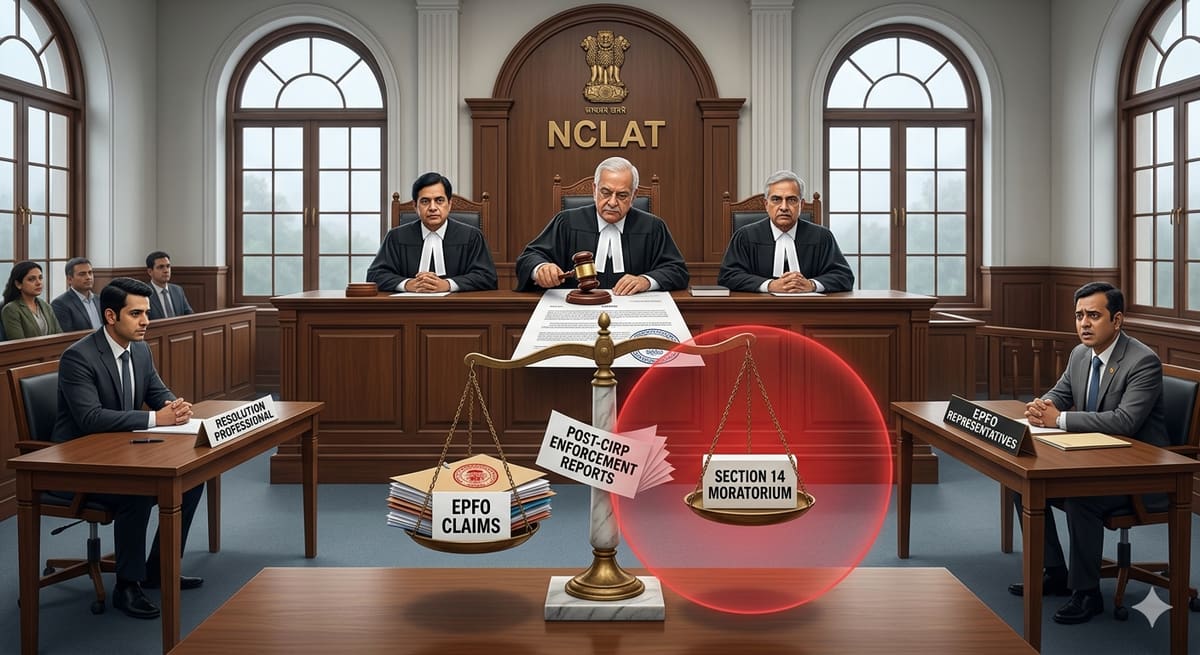
The Supreme Court has reaffirmed the primacy of the insolvency moratorium under the Insolvency and Bankruptcy Code, 2016, holding that operational creditors cannot unilaterally appropriate pre-CIRP security deposits to satisfy pre-CIRP dues. This judgment clarifies the boundaries of creditor self-help during corporate insolvency proceedings and reinforces the pari passu distribution principle.
Background & Facts
The Dispute
The appellant, Central Transmission Utility of India Limited (CTUIL), is a transmission service provider that entered into Bulk Transmission Service Agreements (TSA) with power generation units, including KSK Mahanadi Power Company Limited (KMPCL). KMPCL, the corporate debtor (CD), defaulted on multiple transmission bills prior to the initiation of Corporate Insolvency Resolution Process (CIRP). To secure its payment obligations under the TSA, KMPCL deposited Rs.108.44 crores in cash with CTUIL in lieu of a Letter of Credit (LoC), as directed by the Central Electricity Regulatory Commission (CERC) on 08.02.2019. This deposit was made to comply with the Billing, Collection and Disbursement (BCD) Procedure under the CERC (Sharing of Inter-State Transmission Charges and Losses) Regulations, 2010.
Key Facts
- KMPCL defaulted on six transmission bills issued between 04.07.2019 and 06.09.2019, totaling Rs.85.13 crores (pre-CIRP dues)
- The CIRP was initiated by the National Company Law Tribunal (NCLT) on 03.10.2019 - the Insolvency Commencement Date
- On 28.03.2020, CTUIL unilaterally adjusted Rs.108.44 crores against both pre-CIRP and post-CIRP bills, allocating Rs.85.13 crores to pre-CIRP dues
- Post-CIRP bills (issued on 04.10.2019 and 06.11.2019) totaling Rs.23.31 crores were also adjusted from the same deposit
- The Resolution Professional (RP) objected to this adjustment and filed I.A. No.487 of 2020 before NCLT
- CTUIL submitted claims in Form B on 03.01.2020 (Rs.356.41 crores), 12.10.2020 (Rs.3.76 crores), and 09.07.2021 (Rs.1.71 crores), but never claimed the Rs.108.44 crores as a security interest
- The RP admitted only Rs.96.75 crores of the claimed debt; CTUIL did not challenge this admission
- The balance sheet of KMPCL as of the Insolvency Commencement Date listed Rs.108.44 crores as an asset of the CD
- The Resolution Plan approved on 13.02.2025 and implemented from 06.03.2025 treated the Rs.108.44 crores as part of the CD’s assets
Procedural History
- 04.07.2019 to 06.09.2019: Six pre-CIRP bills issued by CTUIL remain unpaid
- 03.10.2019: NCLT admits CIRP against KMPCL - Insolvency Commencement Date
- 08.02.2019: CERC closes petition after Rs.108.44 crores deposit is made in lieu of LoC
- 28.03.2020: CTUIL unilaterally adjusts Rs.108.44 crores against pre-CIRP and post-CIRP dues
- 03.01.2020: CTUIL files Form B claim for Rs.356.41 crores (includes pre-CIRP dues)
- 18.03.2020: Adjustment of Rs.85.13 crores to pre-CIRP dues completed
- 09.07.2021 & 12.10.2020: CTUIL files subsequent Form B claims without mentioning the deposit as security
- 2020: RP files I.A. No.487 of 2020 before NCLT seeking reversal of adjustment
- 2021: NCLT holds adjustment violative of Section 14 IBC and directs adjustment only to post-CIRP dues
- 2022: NCLAT affirms NCLT’s order
- 2023: CTUIL files Civil Appeals No.2216-2217 of 2025 before Supreme Court
- 23.03.2026: Supreme Court dismisses appeals
The Parties' Positions
Appellant (CTUIL): Argued that the cash deposit was in lieu of LoC, which under banking law is an independent contract. It claimed contractual set-off rights under Bharti Airtel Ltd. v. Aircel Ltd. and asserted that adjustment was permissible under the BCD Regulations. It contended that failure to adjust would result in unjust enrichment of the Resolution Applicant.
Respondent (RP & Creditors): Contended that the deposit was a security mechanism, not a guarantee or BG, and remained the property of the CD until lawfully adjusted. Argued that any adjustment of pre-CIRP dues during moratorium violates Section 14 IBC. Emphasized that CTUIL never claimed the deposit as a security interest and failed to challenge the RP’s limited admission of debt.
Relief Sought
CTUIL sought to set aside the NCLT and NCLAT orders, and to uphold its unilateral adjustment of Rs.85.13 crores against pre-CIRP dues. It also sought recognition of its right to set-off under contract and equity.
The Legal Issue
Can an operational creditor, during the moratorium period under Section 14 of the Insolvency and Bankruptcy Code, unilaterally appropriate a pre-CIRP security deposit made by the corporate debtor to satisfy pre-CIRP dues?
Arguments Presented
For the Appellant
CTUIL relied on Bharti Airtel Ltd. v. Aircel Ltd. (2024) 4 SCC 668 to argue that contractual set-off is permissible if mutual debts exist. It contended that the cash deposit was functionally equivalent to a Letter of Credit, which under Himadri Chemicals Industries Ltd. v. Coal Tar Refining Co. and Standard Chartered Bank v. Heavy Engineering Corporation Limited is an independent contract enforceable even during insolvency. It further argued that the BCD Regulations under CERC permitted such adjustment and that the moratorium under Section 14(2)(b) only prohibits enforcement of guarantees given by third parties, not security deposits held by the creditor.
For the Respondent
The RP and respondents argued that the deposit was not a guarantee or BG but a security mechanism under the TSA, and thus remained the property of the CD until lawfully adjusted. They emphasized that Section 14(1)(c) prohibits any action to enforce a security interest against the CD’s property, and that Section 14(2A) permits appropriation only for post-CIRP dues. They cited Bharti Airtel Ltd. to show that set-off is only permissible for mutual debts arising from the same contract - which was absent here. The failure to claim the deposit as a security interest in Form B and the lack of challenge to the RP’s admission of debt further undermined CTUIL’s position.
The Court's Analysis
The Supreme Court undertook a detailed analysis of the nature of the Rs.108.44 crore deposit, the scope of Section 14 IBC, and the precedents cited by the appellant. The Court held that the deposit was not a Letter of Credit or Bank Guarantee, but a cash security mechanism created under the CERC Regulations to ensure payment of transmission charges. Crucially, the Court observed:
"The deposit made is not a debt due to KMPCL, the CD. As long as the TSA continued, if the bills are paid regularly, KMPCL could not have sought for refund of the money so deposited. On the other hand, in the event of default, the appellant had the authority to apportion the due amounts to the extent of satisfaction of such amounts due on the bills raised."
The Court distinguished Bharti Airtel Ltd. on the ground that in that case, mutual debts arose from interlinked contracts - spectrum purchase and interconnect usage - whereas here, the deposit was a one-way security for bills raised by CTUIL alone. There was no reciprocal obligation owed by CTUIL to KMPCL. The Court further held:
"Set-off of the dues payable by the Corporate Debtor for a period prior to the commencement of the CIRP cannot be made and is not permitted in law from the dues payable to the Corporate Debtor post the commencement of the CIRP."
The Court rejected the argument that the deposit could be treated as a BG/LoC enforceable post-moratorium, noting that Section 14(2)(b) only permits enforcement of guarantees given to the CD, not security held by the creditor. The Court emphasized that the moratorium under Section 14 is not a mere procedural delay but a substantive bar to creditor self-help, designed to preserve the corporate debtor’s estate for pari passu distribution.
The Court also noted that CTUIL had not claimed the deposit as a security interest in any of its Form B claims, nor challenged the RP’s limited admission of debt. The fact that the deposit was listed as an asset of the CD in the Information Memorandum and incorporated into the approved Resolution Plan further confirmed its status as part of the corporate debtor’s estate.
The Court concluded that allowing such unilateral adjustment would undermine the entire structure of the IBC, permitting operational creditors to circumvent the claims adjudication process and gain preferential treatment - a result expressly prohibited under Section 53 and the pari passu principle.
The Verdict
The Supreme Court dismissed the appeals and affirmed the orders of the NCLT and NCLAT. The appellant’s unilateral adjustment of Rs.85.13 crores against pre-CIRP dues is set aside. The entire Rs.108.44 crore deposit must be treated as an asset of the corporate debtor and adjusted only against post-CIRP dues. Pre-CIRP dues must be satisfied through the claims process under the approved Resolution Plan. Book adjustments alone are to be made to reverse the prior appropriation. No monetary compensation or interest is awarded to the appellant. The Resolution Plan implemented from 06.03.2025 remains binding.
What This Means For Similar Cases
Security Deposits Are Part of the Corporate Debtor’s Estate
- Operational creditors must treat cash deposits made by corporate debtors as assets of the estate, not as their own funds
- Any adjustment of such deposits against pre-CIRP dues during moratorium is void under Section 14 IBC
- Creditors must file claims in Form B and await RP’s determination - self-help is prohibited
Contractual Set-Off Is Narrowly Constrained
- Set-off under Bharti Airtel Ltd. applies only where mutual debts arise from the same or interlinked contracts
- A one-sided security deposit, even if contractually permitted, cannot be set off against pre-CIRP dues
- Post-CIRP adjustments are permissible only for dues arising after the insolvency commencement date
Procedural Compliance Is Non-Negotiable
-
Failure to claim a security deposit in Form B waives any later assertion of rights over it
-
Unchallenged admission of debt by the RP binds the creditor - no collateral challenges permitted
-
Resolution Plans approved under Section 30 are final; assets listed therein cannot be reclaimed by creditors post-approval
-
Practitioners must ensure all security interests are formally declared in Form B
-
Avoid unilateral adjustments during CIRP - even if permitted under underlying contracts
-
Always treat pre-CIRP deposits as CD assets until lawfully adjusted post-claims adjudication