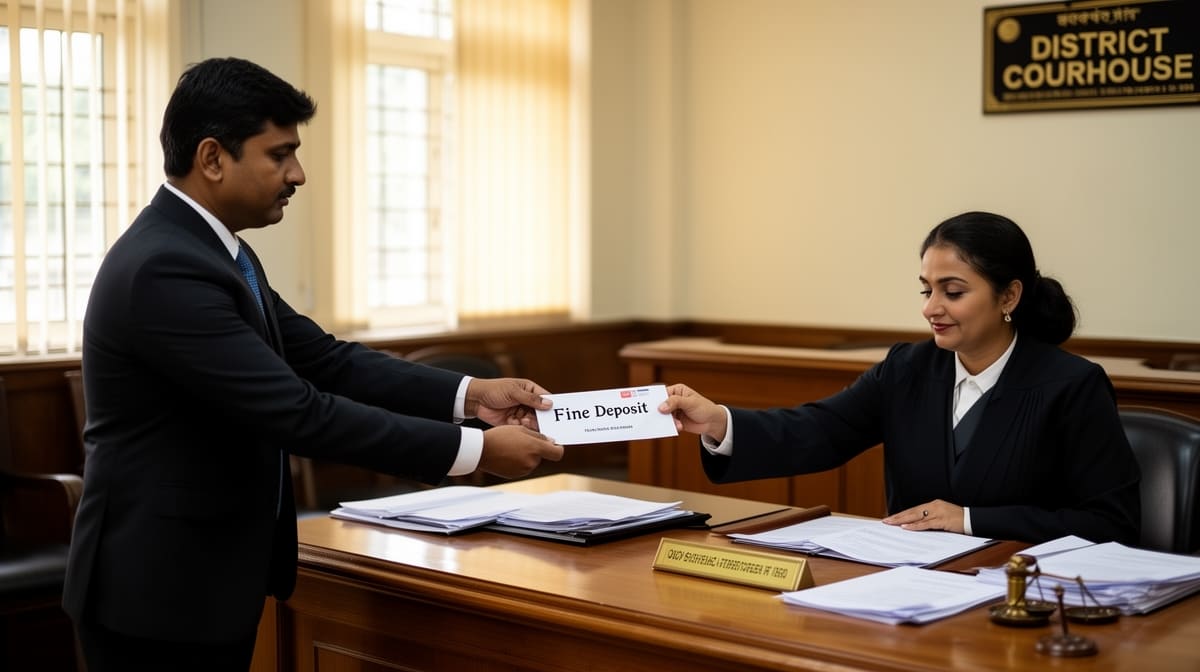
The Rajasthan High Court has intervened in a case under Section 138 of the Negotiable Instruments Act, staying a lower court's order that mandated the deposit of 20% of the fine amount as a precondition for suspending the sentence. The Court relied on a coordinate bench judgment and a Supreme Court precedent to hold that such conditions must be justified with reasons, signaling a stricter standard for imposing financial conditions during sentence suspension.
Background & Facts
The Dispute
The petitioner, Suresh Singh, was convicted under Section 138 of the Negotiable Instruments Act, 1881 (NI Act) by a lower court. The trial court imposed a sentence, including a fine, and the petitioner filed a criminal appeal challenging the conviction. During the appeal, the Additional Sessions Judge No. 01, Nimbahera, District Chittorgarh, passed an order dated 12.06.2026 suspending the sentence but directing the petitioner to deposit 20% of the fine amount as a condition precedent for such suspension.
Key Facts
- The petitioner was convicted under Section 138 NI Act for dishonour of a cheque
- The trial court imposed a sentence, including a fine, the details of which are not specified in the judgment
- The petitioner filed Criminal Appeal No. 15/2026 before the Additional Sessions Judge, Nimbahera
- By order dated 12.06.2026, the Additional Sessions Judge suspended the sentence but imposed a condition requiring the petitioner to deposit 20% of the fine amount
- The petitioner challenged this condition before the Rajasthan High Court
Procedural History
- Conviction: Date not specified, trial court convicted the petitioner under Section 138 NI Act
- 12.06.2026: Additional Sessions Judge passed order suspending sentence subject to deposit of 20% fine
- 13.07.2026: Petitioner filed S.B. Criminal Miscellaneous Petition No. 5441/2026 before Rajasthan High Court
- 13.07.2026: High Court issued notice to respondents and stayed the condition of deposit
- 04.08.2026: Matter listed for further hearing
Relief Sought
The petitioner sought the following reliefs:
- Quashing of the condition imposed by the Additional Sessions Judge requiring deposit of 20% of the fine amount
- Stay on the operation of the impugned order to the extent of the deposit condition
- Any other relief deemed just and proper by the Court
The Legal Issue
The central question before the Court was whether a lower court can impose a condition requiring the deposit of a percentage of the fine amount as a precondition for suspending a sentence under Section 138 NI Act, particularly when such a condition is imposed without assigning any reasons.
Arguments Presented
For the Petitioner
- The petitioner relied on the judgment of a coordinate bench of the Rajasthan High Court in S.B. CRLMP No. 9802/2025, dated 28.04.2026
- The petitioner also cited the Supreme Court judgment in Jamboo Bhandari v. M.P. State Industrial Development Corporation Ltd. & Ors., reported in (2023) 10 SCC 446, to argue that such conditions are not justified unless supported by reasons
- It was contended that the impugned condition was arbitrary and lacked legal basis
For the Respondent
- The respondent-State, represented by the Public Prosecutor, accepted notice but did not present substantive arguments at this stage
- Respondent No. 2 (Nirbhay Singh) was issued notice but no arguments were recorded in the judgment
The Court's Analysis
The Court observed that the Additional Sessions Judge had imposed the condition of depositing 20% of the fine amount without assigning any reasons. This raised concerns about the arbitrariness of the order. The Court relied on the following principles:
-
Precedent of Coordinate Bench: The Court noted that a coordinate bench of the same High Court had already addressed a similar issue in S.B. CRLMP No. 9802/2025 and held that such conditions are not justified without reasons.
-
Supreme Court Guidance: The Court cited Jamboo Bhandari v. M.P. State Industrial Development Corporation Ltd. & Ors., where the Supreme Court emphasized that conditions for suspension of sentence must be reasonable and justified by reasons. The absence of reasons renders such conditions untenable.
-
Judicial Discretion: The Court underscored that while lower courts have discretion to impose conditions for suspending sentences, this discretion must be exercised judiciously and not mechanically. The imposition of financial conditions without reasons defeats the purpose of suspension of sentence, which is to balance the interests of justice and the rights of the accused.
"The judgment in Jamboo Bhandari clearly establishes that conditions imposed for suspension of sentence must be supported by reasons. The impugned order fails to meet this threshold, rendering the condition of depositing 20% of the fine amount arbitrary and unjustified."
The Court further noted that the trial court was free to proceed with the matter, indicating that the stay on the deposit condition did not prejudice the substantive appeal.
The Verdict
The Rajasthan High Court allowed the petition in part by:
- Staying the order dated 12.06.2026 passed by the Additional Sessions Judge, Nimbahera, to the extent of the condition requiring deposit of 20% of the fine amount
- Directing that the trial court may proceed with the appeal without being influenced by the stayed condition
- Listing the matter for further hearing on 04.08.2026
What This Means For Similar Cases
Conditions for Suspension of Sentence Must Be Reasoned
- Courts must assign reasons when imposing conditions for suspension of sentence under Section 138 NI Act or other criminal provisions
- Arbitrary or mechanical imposition of conditions, such as requiring a percentage of fine deposit, will be viewed with skepticism by higher courts
- Practitioners should challenge such conditions if they lack justification, relying on precedents like Jamboo Bhandari
Financial Conditions Are Not Automatic
- The judgment reinforces that financial conditions (e.g., deposit of fine, surety, or bail amounts) cannot be imposed as a matter of course
- Such conditions must be proportionate to the circumstances of the case and supported by cogent reasons
- Lower courts must record reasons for imposing such conditions to avoid judicial review
Precedent Matters in Challenging Arbitrary Orders
- Coordinate bench judgments, even if not binding, carry persuasive value and can be relied upon to challenge similar orders
- Practitioners should scrutinize lower court orders for compliance with higher judicial principles, particularly in matters involving discretionary reliefs like suspension of sentence
- The judgment highlights the importance of citing relevant precedents to ensure uniformity in judicial decisions