The Himachal Pradesh High Court has reaffirmed that the presumption under Section 138 of the Negotiable Instruments Act does not automatically apply when a cheque is issued as a blank instrument for domestic purposes and later misused by a third party. The judgment underscores the necessity of proving the existence of a legally enforceable debt or liability at the time of issuance, particularly in cases involving familial relationships and posthumous misuse of signed instruments.
Background & Facts
The Dispute
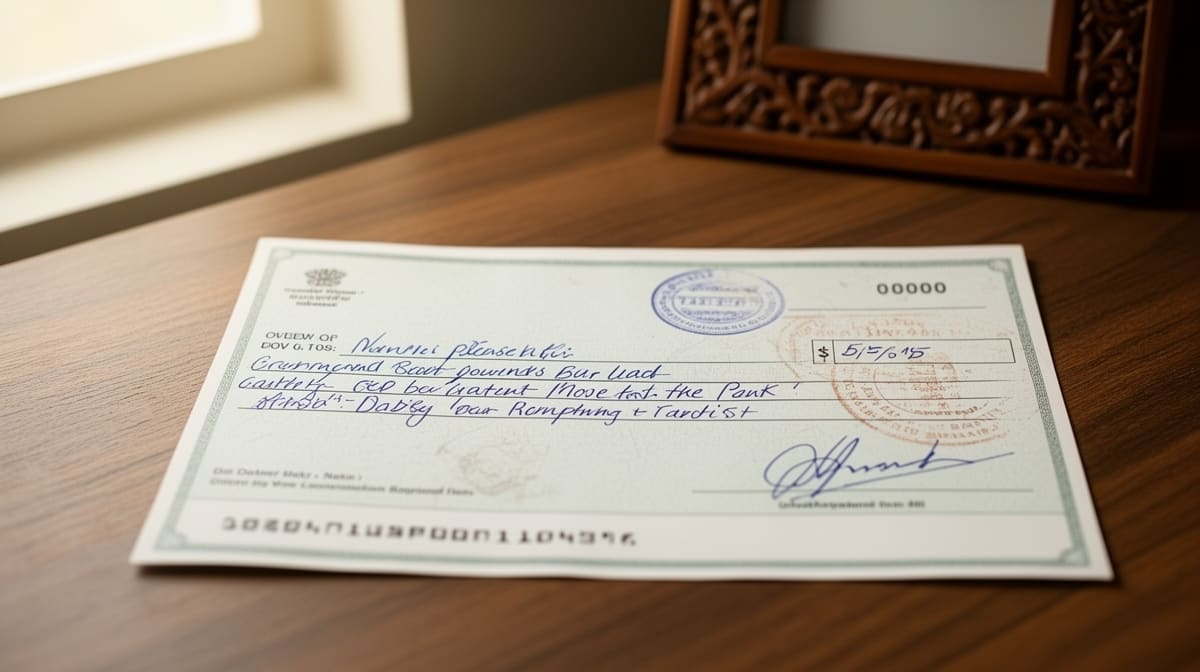
The complainant, Surender Pal Sharma, filed a complaint under Section 138 of the Negotiable Instruments Act against his son-in-law, Virender Kumar, alleging that the accused had issued a post-dated cheque for ₹4,00,000 dated 08.03.2013 drawn on Indian Overseas Bank, Mandi, to discharge a financial liability. The cheque was dishonoured due to insufficient funds. A legal notice was served, and upon no response, a criminal complaint was filed.
Key Facts
- The accused is the son-in-law of the complainant and an agent with the Life Insurance Corporation of India.
- The accused and his wife resided separately: the accused in Chandigarh, the wife with her parents in Mandi.
- The wife committed suicide on 28.01.2013 at her parental home.
- A criminal case under Section 306 IPC (abetment of suicide) was registered against the accused on 05.02.2013.
- The complainant admitted that the wife had been residing with him prior to her death and that he had paid ₹1,30,000 in November 2012, ₹1,40,000 and ₹1,30,000 in January 2013 to the accused.
- The complainant could not recall whether the cheque was issued in 2012 or 2013.
- The accused claimed he had issued blank signed cheques to his wife for household expenses, which the complainant obtained after her death and misused.
- The complainant denied the accused’s version, but offered no evidence of direct handover of cheques or prior demand for repayment.
Procedural History
- 08.03.2013: Cheque issued, dated for presentation on this date.
- 10.03.2013: Cheque presented and dishonoured by bank with endorsement ‘insufficient funds’.
- 15.04.2013: Legal notice sent by complainant demanding payment.
- 25.04.2013: Accused replied denying liability and alleging misuse of blank cheques.
- 10.05.2013: Complaint filed before Additional Chief Judicial Magistrate, Mandi.
- 21.05.2015: Trial Court acquitted the accused, holding the defence of blank cheque misuse highly probable.
- 24.03.2026: Himachal Pradesh High Court dismissed the appeal against acquittal.
The Parties' Positions
Complainant (Appellant): Asserted that the cheque was issued for a legally enforceable debt, and the accused’s admission of signature triggered the statutory presumption under Section 138. Argued that the Trial Court erred in ignoring this presumption and relying on speculative defence.
Accused (Respondent): Contended that the cheque was one of several blank signed instruments given to his wife for household expenses. After her death, the complainant obtained possession of these cheques and forged the liability. Emphasized the timing: cheque dated after the suicide and criminal case registration, making issuance for debt implausible.
Relief Sought
The appellant sought reversal of the acquittal, conviction of the accused under Section 138 NI Act, and imposition of appropriate penalty or compensation.
The Legal Issue
The central question was whether the presumption under Section 138 of the Negotiable Instruments Act arises and applies when a cheque is issued as a blank instrument for domestic purposes, later misused by a third party after the death of the intended recipient, and the accused denies any debt or liability at the time of issuance.
Arguments Presented
For the Appellant
Mr. G.R. Palsra, counsel for the complainant, argued that the accused admitted his signature on the cheque, which triggered the statutory presumption under Section 138 of the NI Act that the instrument was issued for consideration to discharge a debt or liability. He contended that the Trial Court failed to apply this presumption and instead relied on an improbable defence. He cited K. Srinivas v. K. Srinivas and S. Narayana v. S. Raju to assert that once signature is admitted, the burden shifts to the accused to rebut the presumption, which he failed to do conclusively.
For the Respondent
Mr. Sanjeev Kuthiala, Senior Counsel for the accused, submitted that the Trial Court’s finding was not speculative but grounded in the evidence. He emphasized that the wife resided separately, had no independent income, and the accused’s testimony that he issued blank cheques for household expenses was corroborated by his son, DW1. He highlighted the temporal improbability: the cheque dated 08.03.2013 was issued after the wife’s suicide on 28.01.2013 and the registration of a criminal case against the accused on 05.02.2013. It was unreasonable to assume the accused would issue a cheque for debt to the complainant after the latter had triggered a criminal proceeding against him. He relied on Surendra Singh v. State of Uttarakhand and P. Somaraju v. State of A.P. to argue that appellate courts must not interfere with acquittals unless the view is perverse or based on misreading of evidence.
The Court's Analysis
The Court began by reaffirming the settled legal principle that an appeal against acquittal is not an ordinary appeal. Interference is warranted only if the judgment is patently perverse, based on misreading or omission of material evidence, or if no reasonable person could have reached the conclusion of acquittal. The Court cited Surendra Singh v. State of Uttarakhand and P. Somaraju v. State of A.P. to emphasize that where two reasonable views are possible, the acquittal must be upheld.
The Court noted that the complainant admitted the accused and his wife lived separately, that the wife had no known source of income, and that the accused had no obligation to pay him directly. The complainant’s own testimony that he paid money to the accused in November - December 2012 and January 2013 contradicted his claim that the cheque was issued to discharge a pre-existing debt. The cheque was dated 08.03.2013 - after the wife’s suicide and the registration of a criminal case against the accused. The Court observed:
"It was highly unlikely that the accused would have issued a cheque of ₹4,00,000/- in favour of the complainant after the registration of the case against him at the instance of the complainant."
The testimony of DW1, the accused’s son, who was present with his mother at the time of her death, was found credible. The Court held that the accused’s version - that blank cheques were given to his wife for household expenses - was not only plausible but the most reasonable explanation for the presence of the cheque in the complainant’s possession. The Trial Court’s acceptance of this defence was neither perverse nor based on a misreading of evidence.
The Court further clarified that Section 138 NI Act requires proof of a legally enforceable debt or liability existing at the time of issuance. The presumption under the section is rebuttable and cannot override direct evidence of misuse or lack of consideration. The complainant failed to establish any transaction, demand, or acknowledgment of debt prior to the cheque’s issuance. The mere presence of a signature does not create liability where the underlying transaction is negated by credible evidence.
The Verdict
The appeal was dismissed. The High Court upheld the acquittal of the accused under Section 138 of the Negotiable Instruments Act. The Court directed the respondent to furnish bail bonds in the sum of ₹25,000/- with one surety of like amount to the satisfaction of the Trial Court within four weeks. The bail bond shall remain effective for six months, with the stipulation that if a Special Leave Petition is filed against this judgment or leave is granted, the accused shall appear before the Supreme Court upon receipt of notice.
What This Means For Similar Cases
Blank Cheques for Domestic Use Can Rebut Section 138 Presumption
- Practitioners must now argue that Section 138 NI Act requires proof of a debt existing at the time of issuance - not merely the presence of a signed instrument.
- Where a cheque is issued as a blank instrument for household purposes and later misused, the burden shifts to the complainant to prove the existence of a debt, not just the signature.
- Evidence of familial separation, lack of income of the recipient, and timing of cheque issuance relative to a traumatic event (e.g., suicide) are critical to rebutting the presumption.
Timing and Circumstantial Evidence Are Decisive
- A cheque issued after the death of the intended recipient and after a criminal case is registered against the accused is inherently suspect.
- Courts will weigh the plausibility of the defence in context - especially when the complainant is a close relative with access to the instrument.
- The absence of prior correspondence, demand letters, or acknowledgment of debt before issuance weakens the complainant’s case significantly.
Appellate Courts Must Respect Reasonable Acquittals
- This judgment reinforces that appellate courts cannot substitute their view for that of the Trial Court merely because another interpretation is possible.
- The doctrine of "two reasonable views" must be strictly applied in appeals against acquittal.
- Legal practitioners should focus on demonstrating perversity, not just disagreement, when challenging acquittals under Section 138.