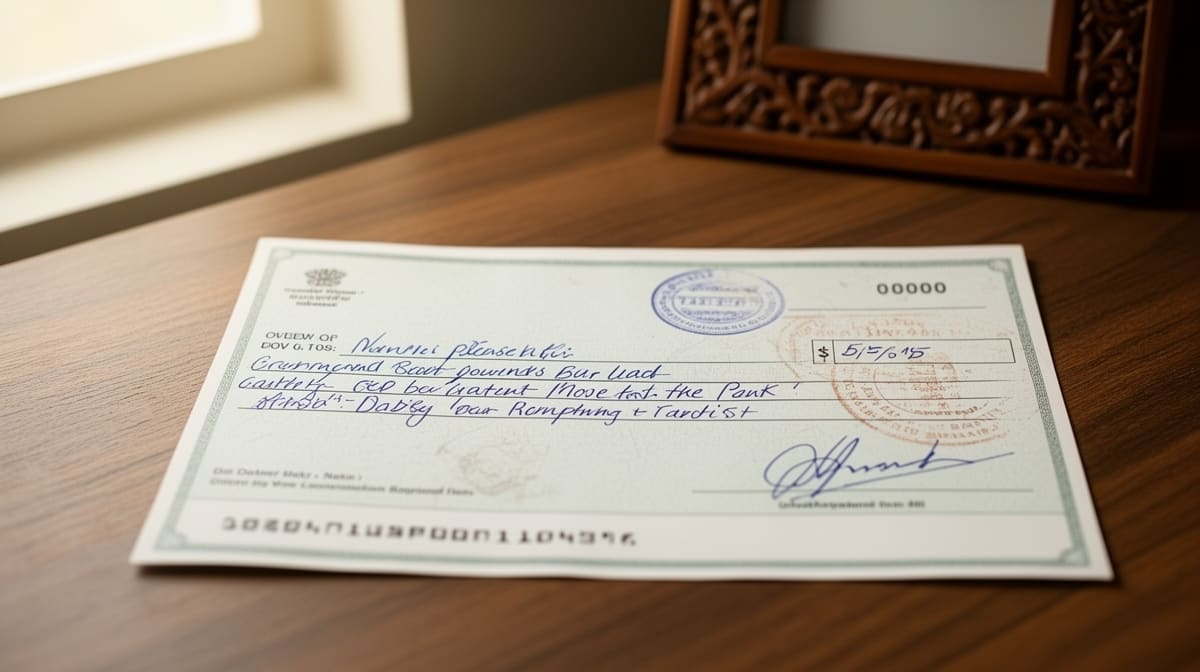
The Himachal Pradesh High Court has reaffirmed a foundational principle in cheque dishonour cases: once the accused admits to issuing a cheque and its signature, the law presumes it was issued for a legally enforceable debt or liability. The burden then shifts entirely to the accused to rebut this presumption with credible evidence, not mere denial.
Background & Facts
The Dispute
The complainant alleged that the accused borrowed ₹9,00,000 in July 2011 and issued a cheque for the same amount in October 2012 as repayment. The cheque, drawn on Union Bank of India, Bhuntar, was presented for payment but dishonoured due to "funds insufficient". The complainant issued a statutory notice, which the accused refused to accept. A complaint was filed under Section 138 of the Negotiable Instruments Act.
Procedural History
- December 2022: Learned Chief Judicial Magistrate convicted the accused under Section 138 NI Act, sentencing him to six months’ simple imprisonment and ₹1,50,000 compensation.
- October 2023: Sessions Judge upheld the conviction, finding no error in the trial court’s appreciation of evidence.
- March 2026: Revision petition filed before the Himachal Pradesh High Court challenging the concurrent findings.
Relief Sought
The accused sought quashing of the conviction, arguing that the cheque was not signed by him, the debt was unproven, and the complaint was premature. He contended that the presumption under Section 139 NI Act could not be invoked.
The Legal Issue
The central question was whether Section 139 of the Negotiable Instruments Act creates a rebuttable presumption of debt when the accused admits to issuing the cheque and its signature, and whether the complainant must independently prove the existence of the underlying debt or financial capacity.
Arguments Presented
For the Petitioner
The accused’s counsel argued that the presumption under Section 139 NI Act could not arise because the accused denied signing the cheque. He relied on Dyal Negi v. Anil Kumar and Indian Bank Association v. Union of India to contend that the complaint was premature and that the complainant failed to prove the loan’s existence through documents like Income Tax Returns or receipts. He asserted that the burden remained on the complainant to establish the debt.
For the Respondent
The complainant’s counsel argued that the accused had not disputed the issuance of the cheque during cross-examination, where the suggestion that the cheque was handed over by the bank manager was not denied. He cited Balu Sudam Khalde v. State of Maharashtra to show that such suggestions bind the accused. He further argued that the complainant’s bank statement corroborated the withdrawal of ₹9,00,000, and that failure to file Income Tax Returns or obtain a receipt does not invalidate the claim under Section 138 NI Act.
The Court's Analysis
The Court began by emphasizing the narrow scope of revisional jurisdiction under Section 397 CrPC, citing Malkeet Singh Gill v. State of Chhattisgarh and Kishan Rao v. Shankargouda. It held that revisional courts cannot reappreciate evidence or substitute their view for concurrent findings unless there is perversity, jurisdictional error, or gross illegality.
The Court then turned to the core legal issue. It held that the accused’s admission in his Section 313 CrPC statement - that the cheque book belonged to him - coupled with the suggestion in cross-examination that the cheque was handed over by the bank manager, constituted an admission of issuance. As per Balu Sudam Khalde v. State of Maharashtra, such suggestions, if incriminating, bind the accused. The Court further relied on APS Forex Services v. Shakti International Fashion Linkers and Sanjabij Tari v. Kishore S. Borcar, which establish that once issuance and signature are admitted, presumptions under Sections 118(a) and 139 NI Act arise automatically.
"Once the execution of a cheque is admitted, the presumption under Section 118 of the NI Act that the cheque was drawn for consideration and the presumption under Section 139 that the holder received it in discharge of a legally enforceable debt or liability arises against the accused."
The Court rejected the argument that the complainant must prove the source of funds or produce an Income Tax Return, citing Uttam Ram v. Devinder Singh Hudan and Ashok Singh v. State of U.P.: "The onus is not on the complainant at the threshold to prove his financial wherewithal. Only if the accused raises a probable defence regarding lack of capacity does the burden shift back to the complainant."
The Court also held that the accused’s mere denial in his Section 313 statement, without leading any defence evidence, was insufficient to rebut the presumption, as per Sumeti Vij v. Paramount Tech Fab Industries. The defence witness’s testimony actually corroborated the complainant’s bank statement, further weakening the accused’s case.
Regarding service of notice, the Court held that the endorsement "refused" on the registered letter constituted deemed service under C.C. Allavi Haji v. Pala Pelly Mohd. and Section 27 of the General Clauses Act, making the complaint timely. The complaint was filed 19 days after deemed service - well beyond the 15-day window.
Finally, the Court upheld the compensation of ₹1,50,000 (₹6 lakh over the cheque amount), noting that Kalamani Tex v. P. Balasubramanian permits compensation up to twice the cheque amount, and the 10-year delay justified additional relief.
The Verdict
The revision was dismissed. The Court held that the presumption under Section 139 NI Act arises upon admission of cheque issuance and signature, and the accused’s failure to rebut it with evidence rendered the conviction valid. The sentence and compensation were upheld as lawful and proportionate.
What This Means For Similar Cases
Admission of Cheque Issuance Triggers Presumption
- Practitioners must treat any admission - even indirect - of cheque issuance or signature as triggering Section 139 NI Act presumption.
- Defence counsel should avoid allowing suggestions in cross-examination that imply issuance without contemporaneous objection.
- Mere denial in Section 313 CrPC statement is legally insufficient; defence evidence is mandatory.
Financial Proof Not Required at Threshold
- Complainants need not produce Income Tax Returns, loan agreements, or bank statements to prove source of funds at the outset.
- Only if the accused raises a credible defence about the complainant’s lack of financial capacity does the burden shift.
- Courts must not treat Section 138 proceedings as civil recovery suits.
Deemed Service Is Absolute on "Refused" Endorsement
- A notice returned with "refused" is deemed served on the date of refusal, not the date of last attempted delivery.
- Postman’s notes of "door locked" after refusal are legally irrelevant.
- Complaints filed after 15 days from refusal date are valid, regardless of affidavit swearing date.