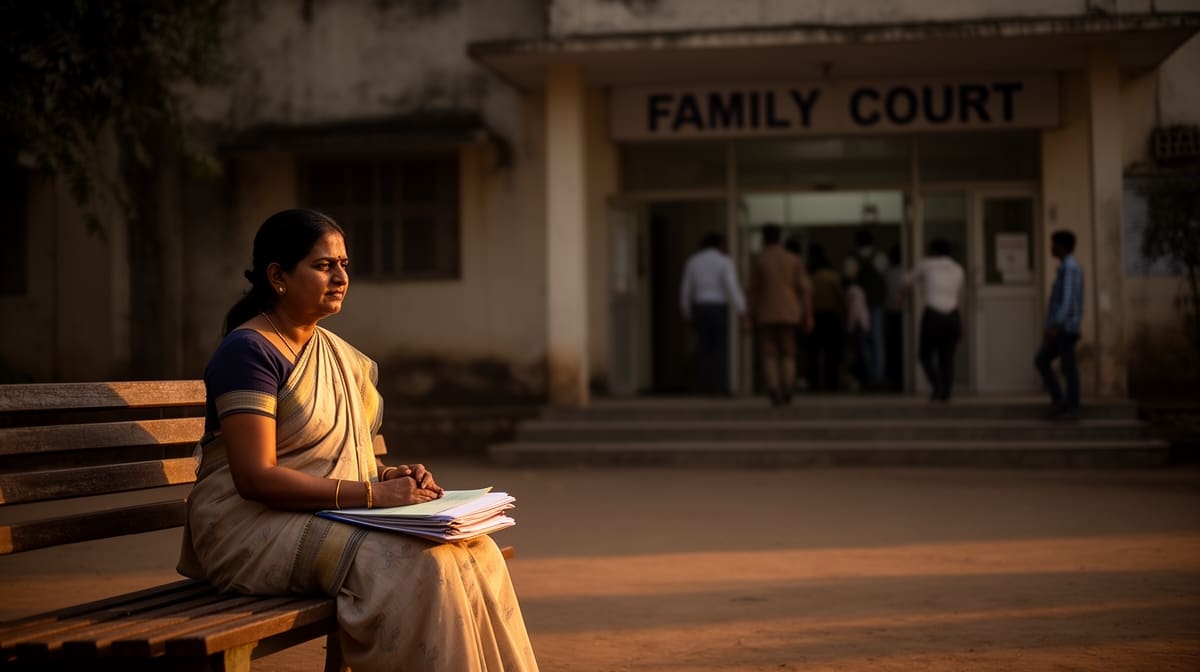
The Jharkhand High Court has recognized that a marriage enduring two decades of separation, devoid of emotional or practical continuity, constitutes an irretrievable breakdown warranting dissolution. In a significant ruling, the Court granted divorce not on traditional grounds of cruelty or desertion alone, but on the principle that forcing spouses to remain bound in a lifeless union serves no legal or human purpose.
Background & Facts
The Dispute
The appellant, Gopal Maity, filed a petition under Section 13(1)(i-a) and (i-b) of the Hindu Marriage Act, 1955 seeking divorce on grounds of cruelty and desertion against his wife, Pratima Maity. The marriage, solemnized on 28.04.1998 in accordance with Hindu rites at Chalunia, East Singhbhum, produced one daughter, Purnima Maity, born on 22.12.1999. The marital relationship deteriorated rapidly after the child’s birth, leading to prolonged separation.
Key Facts
- The respondent-wife left the matrimonial home in December 1999 with the minor daughter and has resided at her parental residence since.
- In 2006, she returned to the appellant’s home for four months but resumed hostile conduct, including verbal abuse and physical assault.
- The respondent filed criminal proceedings under Sections 498A, 406, 313 IPC and Section 3/4 of the Dowry Prohibition Act, which resulted in the acquittal of the appellant and his family on 24.06.2019.
- The respondent also initiated a maintenance proceeding, resulting in a court order for the appellant to pay Rs. 8,000 per month, which he continues to pay.
- Both parties have lived separately for over 20 years, with no reconciliation attempted or possible.
- The appellant voluntarily retired from Tata Steel Limited in 2022, receiving a lump-sum retiral benefit of Rs. 74,01,469.
- The appellant owns an ancestral property in Adityapur (co-owned with his brother) and a movable property in Chakulia purchased for Rs. 6,50,000 during service.
- The daughter, now a major, expressed her desire to pursue M.Tech and requires financial support for education and marriage.
Procedural History
- 28.04.1998: Marriage solemnized at respondent’s parental home.
- 22.12.1999: Birth of daughter; respondent leaves matrimonial home.
- 2006: Respondent returns for four months, resumes hostility.
- 2004: Criminal case filed under IPC and Dowry Prohibition Act.
- 24.06.2019: Acquittal of appellant and family in criminal case.
- 2022: Appellant files divorce petition (Original Suit No. 615 of 2022).
- 09.06.2023: Notice issued; respondent fails to appear; suit proceeded ex-parte.
- 29.05.2024: Family Court dismisses divorce petition, holding cruelty and desertion unproven.
- 03.06.2024: Decree signed by Family Court.
- 12.02.2026: Hearing concluded in First Appeal No. 125 of 2025.
- 12.03.2026: Judgment pronounced by Jharkhand High Court.
Relief Sought
The appellant sought dissolution of marriage on grounds of cruelty and desertion. In alternative, he offered Rs. 10 lakhs for daughter’s education and marriage. The respondent opposed divorce but acknowledged 20-year separation and sought adequate permanent alimony for herself and daughter.
The Legal Issue
The central question was whether a marriage that has endured over two decades of separation, with no possibility of reconciliation and no emotional or practical continuity, constitutes an irretrievable breakdown sufficient to grant divorce under the Hindu Marriage Act, 1955, even in the absence of conclusive proof of cruelty or desertion.
Arguments Presented
For the Appellant
The appellant’s counsel argued that the Family Court erred in dismissing the petition by narrowly focusing on technical proof of desertion and cruelty, while ignoring the overwhelming reality of 20-year separation. He relied on Durga Prasanna Tripathy v. Arundhati Tripathy and Sujata Uday Patil v. Uday Madhukar Patil to assert that courts must adopt a pragmatic approach when marriages become dead wood. He emphasized that the appellant had made repeated efforts to reconcile, but the respondent’s conduct rendered cohabitation impossible. He offered Rs. 10 lakhs for the daughter’s future, but acknowledged this was insufficient given his financial capacity.
For the Respondent
The respondent’s counsel conceded that the marriage had broken down irretrievably and that reconciliation was impossible. However, he contended that the appellant’s retiral benefit of over Rs. 74 lakhs, coupled with immovable property, warranted a substantial permanent alimony award. He argued that the respondent, with no independent income and a daughter requiring higher education and marriage expenses, could not survive on Rs. 8,000 monthly maintenance. He rejected the Rs. 10 lakh offer as inadequate and urged the Court to fix a fair lump-sum alimony.
The Court's Analysis
The Court undertook a comprehensive review of the evidence and jurisprudence on irretrievable breakdown. It noted that while the Family Court correctly observed that desertion requires proof of factum and animus, the 20-year separation, coupled with the respondent’s refusal to return and the appellant’s acquittal in criminal proceedings, rendered the marriage a legal fiction.
"It is evident that the marital relation between the parties has become 'dead wood marriage' and marital relation has become lifeless and without emotional or practical value."
The Court emphasized that forcing parties to remain married under such circumstances only prolongs suffering. It relied on Durga Prasanna Tripathy and Rajnesh v. Neha to affirm that courts must prioritize human dignity over procedural technicalities.
The Court then turned to the quantum of permanent alimony under Section 25 of the Hindu Marriage Act. It rejected the notion of fixed formulas, citing Vinny Parmvir Parmar, U. Sree v. U. Srinivas, and Rakhi Sadhukhan v. Raja Sadhukhan. It considered:
- The appellant’s gross monthly salary of Rs. 1,13,000 until retirement
- His retiral benefit of Rs. 74,01,469
- His ownership of immovable and movable assets
- The respondent’s age (44), lack of income, and 28-year life expectancy
- The daughter’s need for higher education and marriage expenses
The Court held that Rs. 8,000 monthly maintenance was inadequate for long-term sustenance, especially given inflation and the appellant’s financial capacity. It concluded that a one-time payment would provide certainty and prevent future litigation.
"A sum of Rs. 50,00,000/- in total as one-time permanent alimony would be just, fair and reasonable, for sustenance of the respondent-wife who has no other source of income than the alimony so received by the appellant-husband and the daughter born out of their wedlock for her study and future prospects."
The Court directed that Rs. 10 lakhs of the total amount be fixed in a bank account in the daughter’s name for her education, while the remainder be paid in four installments over 12 months.
The Verdict
The appellant succeeded. The Jharkhand High Court set aside the Family Court’s order dated 29.05.2024 and granted a decree of divorce on the ground of irretrievable breakdown. The appellant is directed to pay Rs. 50,00,000 as one-time permanent alimony in four equal installments within 12 months, with the first installment due within one month. Of this, Rs. 10,00,000 must be deposited in a fixed deposit in the daughter’s name for her education and marriage. The daughter’s inheritance rights remain unaffected. The Court granted liberty to the respondent to approach the court for enforcement if payments are defaulted.
What This Means For Similar Cases
Irretrievable Breakdown Is a Standalone Ground
- Practitioners may now argue irretrievable breakdown as an independent ground for divorce, even where cruelty or desertion is technically unproven.
- 20 years of continuous separation, coupled with no reconciliation attempts, creates a strong presumption of breakdown.
- Courts are increasingly willing to grant divorce based on lived reality rather than rigid statutory proof.
One-Time Alimony Is Viable for Long-Term Separation
- Lump-sum alimony is now a recognized remedy in cases of prolonged separation, especially where the paying spouse has substantial assets.
- Courts will consider life expectancy, inflation, and future needs of the dependent spouse and children when fixing lump-sum amounts.
- Fixed deposits for children’s education are now a standard component of alimony orders in such cases.
Financial Disclosure Is Non-Negotiable
- Courts will compel disclosure of income, assets, and retiral benefits even in contested divorce cases.
- Voluntary retirement and receipt of large lump-sum payments cannot be used to evade maintenance obligations.
- The standard of living during marriage remains the benchmark, not current income alone.