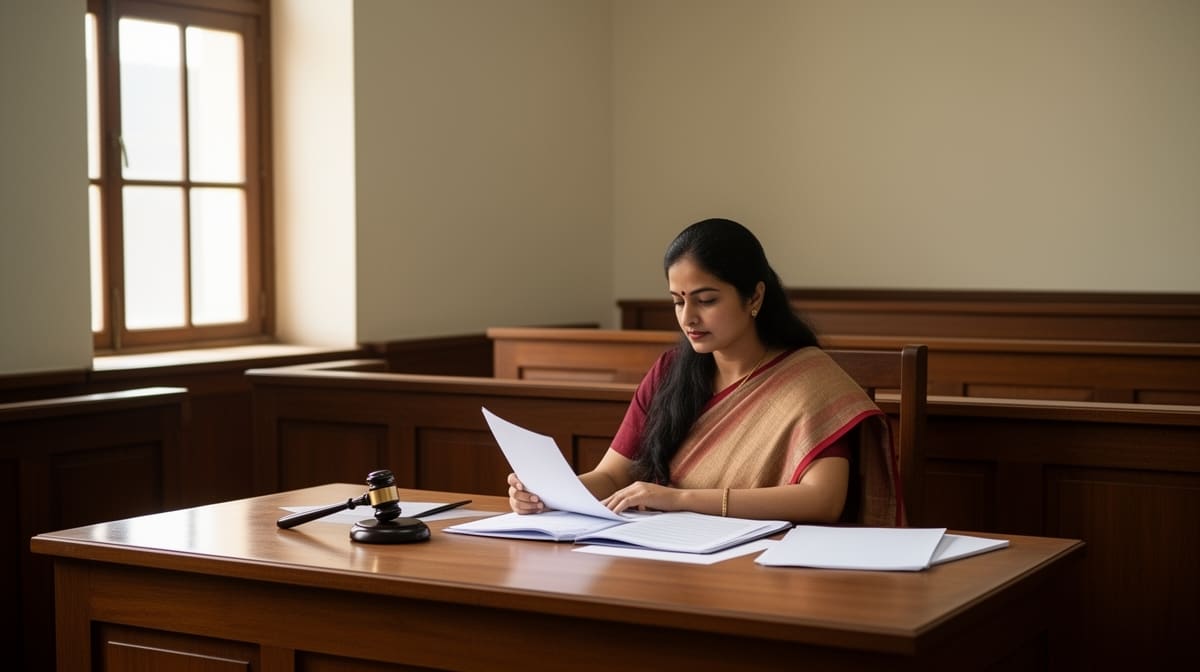
A woman cannot claim maintenance under Section 125 of the Criminal Procedure Code if her prior marriage remains legally subsisting, even if she entered a subsequent ceremonial union. The Bombay High Court’s recent ruling in Rekha W/o. Janardhan Harne v. Janardhan s/o Bhimrao Harne reaffirms that legal validity of marriage, not social or ritualistic recognition, is the threshold for maintenance entitlement.
Background & Facts
The Dispute
The applicants, Rekha (wife) and her minor son Ganesh, sought maintenance under Section 125 CrPC from Janardhan Harne, alleging a temple marriage in 2007 and subsequent domestic cruelty. Rekha claimed she was forced to leave the matrimonial home due to physical and mental abuse, and that Janardhan, a salaried police officer with rental and agricultural income, was capable of providing maintenance but refused to do so.
Procedural History
- 2017: Petition filed under Section 125 CrPC before the Family Court, Aurangabad
- 2019: Family Court dismissed the petition, holding no legally valid marriage could be established
- 2019: Criminal Revision Application filed before the Bombay High Court, Aurangabad Bench
Relief Sought
The applicants sought monthly maintenance of ₹15,000 each for Rekha and her minor son, based on the alleged marital relationship and Janardhan’s financial capacity.
The Legal Issue
The central question was whether a woman who entered a second marriage while her first marriage remained legally undissolved is entitled to maintenance under Section 125 of the CrPC, despite performing a ceremonial Hindu wedding.
Arguments Presented
For the Petitioner
Counsel for the applicants argued that the temple marriage was solemnized with Vedic rituals and was accompanied by long-term cohabitation, raising a presumption of marriage. They cited the filing of FIRs under Sections 498A and complaints to the Women Grievance Cell as evidence of marital relationship and cruelty. They contended that the Family Court erred in ignoring the totality of circumstantial evidence and the principle of equitable relief under Section 125.
For the Respondent
The respondent’s counsel countered that no documentary proof - such as marriage registration, witness affidavits, or divorce decree - was produced to establish the validity of the second marriage. They emphasized that Rekha admitted to a prior marriage with Jaywant Sonawane and failed to prove its legal dissolution, rendering the second union void under the Hindu Marriage Act.
The Court's Analysis
The Court examined the legal status of the marriage under the Hindu Marriage Act, 1955, particularly Section 5(1)(i), which prohibits bigamy, and Section 11, which declares such marriages void. The Court held that Section 125 CrPC does not extend protection to women in void marriages, regardless of social recognition or cohabitation.
"Hindu woman marrying a Hindu male, who has wife already living, is not entitled to receive maintenance under Section 125 of the Cr.P.C., her marriage being null and void under Section 11 read with Section 5(1)(i) of the Hindu Marriage Act, 1955."
The Court relied on Yamunabai Anantrao Adhav v. Anantrao Shivram Adhav and Bakulabai v. Gangaram, both decided by the Supreme Court in 1988, to affirm that the statutory bar against bigamy overrides any claim to maintenance. The Court rejected the argument that the Family Court failed to appreciate evidence, noting that the absence of proof of divorce from the first marriage was fatal to the claim. The revisional jurisdiction under Section 397 CrPC was narrowly construed, and the Court found no patent illegality or perversity in the Family Court’s findings.
The Verdict
The revision was dismissed. The Court held that Section 125 CrPC does not confer maintenance rights on a woman whose prior marriage remains legally subsisting, even if she entered a subsequent ceremonial union. The burden to prove dissolution of the first marriage lies squarely on the claimant.
What This Means For Similar Cases
Valid Marriage Is a Prerequisite for Maintenance
- Practitioners must establish legal validity of marriage before invoking Section 125 CrPC
- Ceremonial rituals alone, without proof of compliance with statutory requirements, are insufficient
- Failure to produce divorce decree or annulment order from a prior marriage is a fatal defect
Burden of Proof Is On the Claimant
- The petitioner bears the burden to prove both the existence of the second marriage and the dissolution of the first
- Oral testimony without corroboration, even if consistent, cannot substitute documentary proof of divorce
- Courts will not presume dissolution of marriage; it must be affirmatively established
Bigamy Nullifies Maintenance Claims Even in Cases of Abuse
- Domestic cruelty or financial dependency cannot override the statutory invalidity of a bigamous union
- Section 125 is not a remedy for social injustice but a statutory mechanism tied to legal marital status
- Petitioners in similar circumstances must first seek annulment or divorce before claiming maintenance