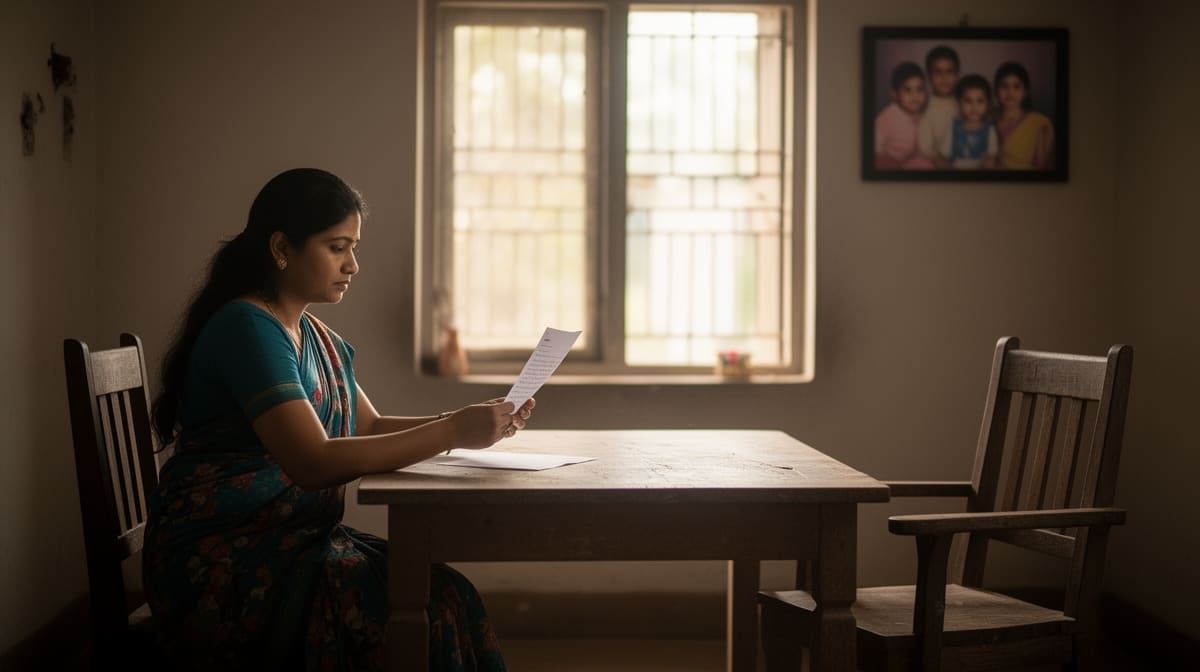
The Madhya Pradesh High Court has clarified that a husband’s net income, after accounting for legitimate personal and familial expenses, forms the foundational basis for determining fair maintenance to a wife living separately due to marital breakdown. The judgment rejects the notion that a wife’s educational qualifications automatically obligate her to seek employment, reinforcing the husband’s duty to provide support.
Background & Facts
The Dispute
Rishabh Agrawal and Smt. Payal Agrawal are married but have been living separately due to irreconcilable differences. The wife has filed multiple criminal complaints against the husband under the Dowry Prohibition Act and the Protection of Women from Domestic Violence Act, 2005. While these allegations remain pending adjudication before the trial court, the wife has sought maintenance under Section 125 CrPC. The husband has filed a criminal revision challenging the maintenance order of Rs. 15,000 per month passed by the Family Court on 10.12.2025 in MJC No. 238/2024. Simultaneously, the wife has filed a separate criminal revision seeking enhancement of the maintenance amount.
Key Facts
- The husband is employed as a Technical Engineer in Hyderabad with a gross monthly salary of Rs. 1,90,000
- After statutory and other deductions, his net take-home salary is Rs. 1,55,000 per month
- The husband claims he does not own a house and resides with his parents
- The wife holds a B.Sc. and D.Ed. degree and is qualified for employment
- The wife alleges mental cruelty leading to the death of her father, which she attributes to marital discord
- The husband denies any direct responsibility for the death and asserts his willingness to reconcile
- Both parties have refused to pursue divorce by mutual consent; the wife demands Rs. 40 lakhs, the husband offers Rs. 15 lakhs
Procedural History
- 10.12.2025: Family Court ordered maintenance of Rs. 15,000 per month in MJC No. 238/2024
- 2025: Smt. Payal Agrawal filed Criminal Revision No. 6113 of 2025 seeking enhancement
- 2026: Rishabh Agrawal filed Criminal Revision No. 987 of 2026 seeking setting aside of the maintenance order
- 16.03.2026: Both revisions heard together before the High Court at Jabalpur
The Parties' Positions
For the Husband
- Argues that his net income after deductions is Rs. 1,55,000
- Claims financial burden due to supporting his parents
- Contends that the wife, being educated, can earn and should not be entitled to high maintenance
- Asserts that pending criminal cases should not influence maintenance determination
For the Wife
- States she is entitled to maintenance commensurate with the husband’s standard of living
- Argues that education does not negate her right to support during marital breakdown
- Highlights mental cruelty and its impact on her health and family
- Seeks enhancement to Rs. 40,000 per month or at least Rs. 30,000
Relief Sought
- Husband seeks quashing of the maintenance order dated 10.12.2025
- Wife seeks enhancement of maintenance from Rs. 15,000 to at least Rs. 30,000 - 40,000 per month
- Both parties seek finality on maintenance pending resolution of criminal proceedings
The Legal Issue
The central question was whether a wife’s educational qualifications can be used to reduce or deny maintenance, and how a husband’s net income should be apportioned to determine a fair monthly maintenance amount when the couple is living separately.
Arguments Presented
For the Appellant/Petitioner
The husband’s counsel argued that the Family Court erred in fixing maintenance without considering the wife’s employability. He cited Smt. Sunita Devi v. Smt. Kamla Devi to assert that a wife with professional qualifications should be expected to contribute to her own upkeep. He further submitted that the husband’s financial obligations to his elderly parents must be factored in, and that the maintenance order of Rs. 15,000 was already generous given the husband’s liabilities.
For the Respondent/State
The wife’s counsel contended that education does not equate to employment, and that the husband’s duty to maintain his wife is statutory and non-negotiable under Section 125 CrPC. He relied on Rajnesh v. Neha to argue that maintenance must reflect the husband’s standard of living and ability to pay, not the wife’s potential earning capacity. He emphasized that the wife’s mental distress, stemming from marital discord and pending criminal proceedings, justifies higher support.
The Court's Analysis
The Court examined the principles laid down in Rajnesh v. Neha and Smt. Sunita Devi v. Smt. Kamla Devi, distinguishing between the obligation to maintain and the expectation to earn. The Court held that while a wife’s education may be a factor, it cannot be used to impose an obligation to work, especially when the marriage has broken down due to the husband’s conduct.
"After marriage it is the duty of the husband to support his wife when she is living separately from him due to some disputes which are pending in the Court."
The Court accepted the husband’s net salary of Rs. 1,55,000 as the starting point. It allowed a deduction of Rs. 50,000 for personal and familial expenses, including support to his parents, arriving at a disposable income of Rs. 1,05,000. The Court then divided this amount equitably among four family members - the husband, his wife, and his two parents - concluding that Rs. 25,000 per month is a fair and reasonable share for the wife.
The Court explicitly rejected the Family Court’s reliance on presumption, noting that maintenance must be grounded in actual income and reasonable expenditure, not speculative assumptions about the wife’s earning capacity.
The Verdict
The wife’s revision petition was partly allowed. The maintenance amount was enhanced from Rs. 15,000 to Rs. 25,000 per month, payable from the date of her application. The husband’s revision petition was dismissed. The Court directed that the enhanced maintenance shall be paid monthly without delay, and any arrears shall be settled within 60 days of the judgment date.
What This Means For Similar Cases
Education Does Not Obligate a Wife to Work
- Practitioners must argue that a wife’s educational qualifications cannot be used to reduce maintenance unless she is actively employed or has a proven, stable income
- Courts must distinguish between potential and actual earning capacity
- The burden remains on the husband to prove that the wife is deliberately avoiding employment
Maintenance Must Reflect Net Income, Not Gross
- Courts must deduct legitimate personal and familial expenses before apportioning maintenance
- Reasonable deductions for supporting dependent parents are permissible
- The apportionment must be equitable, not arbitrary, and should consider all dependents
Pending Criminal Cases Do Not Bar Maintenance
- Maintenance under Section 125 CrPC is independent of criminal proceedings under DV Act or Dowry Prohibition Act
- Allegations of cruelty or dowry demand must be adjudicated separately
- Maintenance cannot be withheld pending outcome of criminal trials