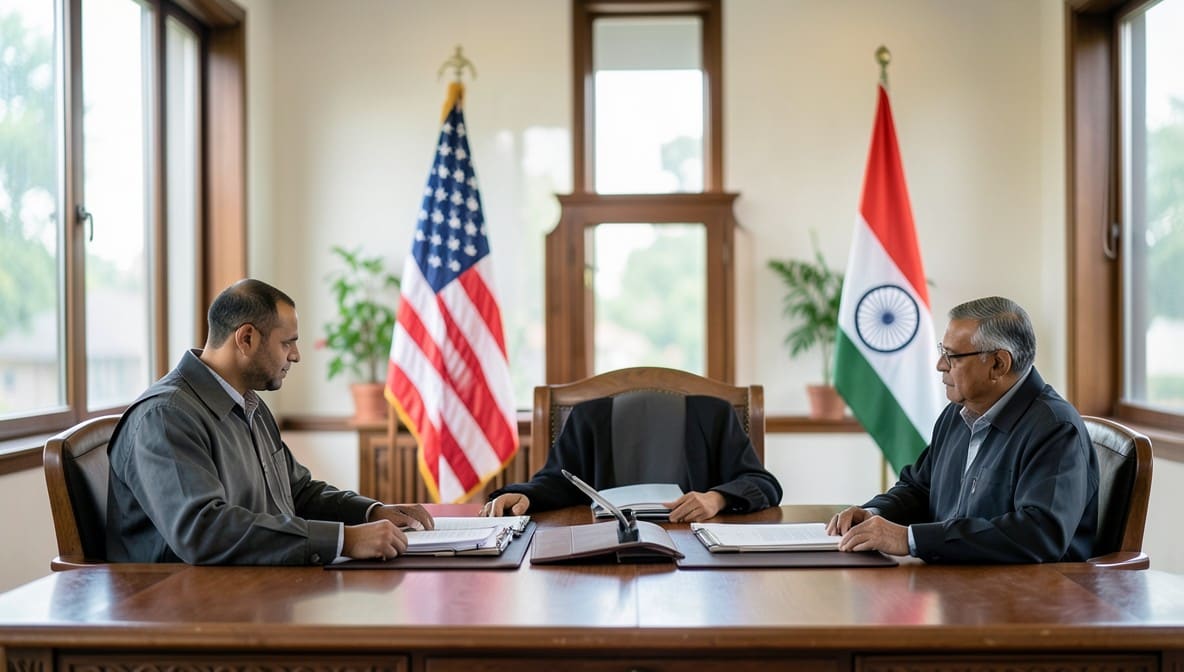
The Bombay High Court has clarified that the mandatory pre-institution mediation requirement under Section 12-A of the Commercial Courts Act, 2015, does not bar a plaintiff from filing a suit when urgent interim relief is genuinely contemplated, even if a non-starter report has not yet been issued. This ruling reinforces the statutory balance between dispute resolution efficiency and the protection of substantial civil rights.
Background & Facts
The Dispute
The plaintiff, Phoenix ARC Private Limited, is a registered Asset Reconstruction Company under the Reserve Bank of India. It is the assignee of loan facilities extended by L & T Finance Limited to defendant no. 2, Future Entertainment Private Limited. The loan was secured by a charge over royalty receivables arising from trademark license agreements between defendant no. 2 and defendant no. 1, Future Brands Limited, which owns the brands 'Spunk', 'Buffalo', 'RIG', and 'AFL'.
Key Facts
- The original loan facility was restructured under the One Time Restructuring Framework dated 6th August 2020.
- As a condition of restructuring, defendant no. 1 agreed to extend the trademark license agreements until 1st July 2025 to ensure continued royalty inflows.
- Defendant no. 1 executed a Guarantee Letter dated 4th June 2021, committing to infuse Rs. 250,00,00,000 as equity into defendant no. 2 upon request.
- The Master Restructuring Agreement dated 14th June 2021 prohibited defendant no. 2 from allowing the trademark agreements to lapse without the Security Trustee’s consent.
- As of the date of filing the suit, Rs. 514,91,42,038.08 was due and payable by defendant no. 2 to the plaintiff.
- Defendant no. 1 failed to make the equity infusion despite notices dated 19th August 2023, 29th December 2023, and 5th January 2024.
- The trademark license agreements were set to expire on 1st July 2025, threatening the plaintiff’s primary security interest.
Procedural History
- 21st March 2025: Plaintiff filed application for pre-institution mediation under Section 12-A of the Commercial Courts Act.
- 24th April 2025: First notice issued to defendants by the mediation centre.
- 8th May 2025: Second notice issued after non-appearance.
- 11th June 2025: Defendants appeared and consented to mediation.
- 20th June 2025: Mediation centre issued notice to plaintiff to pay mediation fees - the last day of the initial three-month period under Rule 3(8) of the Mediation Rules.
- 8th July 2025: Defendants paid their share of mediation fees.
- 2nd July 2025: Plaintiff filed Commercial Suit No. 124 of 2025 and Interim Application (L) No. 20363 of 2025 seeking mandatory injunction and interim relief.
- 5th August 2025: Plaintiff requested closure of the mediation process.
- 20th August 2025: Non-Starter Report issued by the Maharashtra State Legal Services Authority.
Relief Sought
The plaintiff sought:
- A mandatory injunction directing defendant no. 1 to infuse Rs. 250,00,00,000 into defendant no. 2.
- A temporary injunction restraining defendants from transferring, licensing, or encumbering the brands.
- An interim mandatory injunction directing defendant no. 1 to deposit Rs. 50,00,00,000 (20% of the equity infusion) as security.
- Damages exceeding Rs. 500 crores.
The Parties' Positions
Plaintiff: Argued that the expiry of the trademark agreements on 1st July 2025 created an imminent threat to its security interest of over Rs. 500 crores, justifying immediate court intervention. The mediation process was initiated in good faith, but the three-month statutory period expired on 20th June 2025, and no extension was granted. The suit was filed immediately thereafter.
Defendants: Contended that the plaintiff abandoned mediation by failing to pay its share of fees, suppressed material facts by not disclosing the non-starter report at the time of filing, and used the urgency claim as a pretext to bypass mandatory mediation.
The Legal Issue
Does the filing of a commercial suit before the issuance of a non-starter report, but after the expiry of the mandatory three-month mediation period under Rule 3(8) of the Commercial Courts (Pre-Institution Mediation and Settlement) Rules, 2018, constitute non-compliance with Section 12-A of the Commercial Courts Act, 2015, when the plaintiff alleges urgent interim relief is required to prevent irreparable loss of a security interest?
Arguments Presented
For the Appellant/Petitioner
The plaintiff relied on Dhanbad Fuels Pvt. Ltd. v. Union of India, Novenco Building and Industry A/S v. Xero Energy Engineering Solutions Pvt. Ltd., and Yamini Manohar v. T.K.D. Keerthi to argue that Section 12-A does not bar suits where urgent interim relief is genuinely contemplated. The plaintiff filed the mediation application on 21st March 2025, and the three-month period under Rule 3(8) expired on 20th June 2025. The suit was filed on 2nd July 2025, after this period, and before the non-starter report was issued. The plaintiff had no obligation to wait for the report, as the statutory period had lapsed. The threat to the security interest - the imminent lapse of trademark agreements - constituted a real and immediate peril, satisfying the exception under Section 12-A. The non-payment of fees by the plaintiff after the expiry of the mediation period did not amount to abandonment, as the process had already concluded by operation of law.
For the Respondent/State
The defendants relied on Nagina Choube v. Ajay Mohan, IIFL Finances Ltd. v. Gundecha Estates Pvt. Ltd., and ITC Ltd. v. DRAT to argue that the plaintiff’s failure to pay mediation fees and its unilateral request to close the process amounted to abandonment. The non-starter report, issued on 20th August 2025, confirmed that the mediation was not completed. The plaintiff’s suppression of this fact in the plaint rendered the suit vitiated by unclean hands. The defendants contended that the urgency claim was artificial, as the cause of action arose in 2023, and the suit was filed only when the trademark agreements were about to expire - a foreseeable event. The plaintiff’s conduct, they argued, was a deliberate attempt to circumvent the mandatory mediation requirement.
The Court's Analysis
The Court undertook a detailed statutory interpretation of Section 12-A of the Commercial Courts Act and Rule 3 of the Mediation Rules. It emphasized that the purpose of Section 12-A is to encourage settlement, not to deprive parties of their right to urgent judicial intervention. The Court noted that the word "shall" in Section 12-A imposes a mandatory obligation only when no urgent interim relief is contemplated. Where urgency exists, the bar does not apply.
"The insistence of pre-institution mediation in a situation of impending loss of a security interest, in effect, would render the plaintiff remediless, allowing the defaulting party to profit under the protection of procedural formality. Section 12-A was not intended to achieve such an anomalous result."
The Court held that the three-month period under Rule 3(8) is a statutory deadline for the mediation authority to complete its process. Once this period expires without extension by consent, the plaintiff is entitled to file a suit, regardless of whether a non-starter report has been issued. The issuance of the report is merely a procedural formality, not a jurisdictional precondition.
The Court rejected the defendants’ argument that non-payment of fees by the plaintiff amounted to abandonment. It observed that the defendants themselves paid their fees only after the three-month period had expired and after the suit was filed - indicating their own lack of urgency to resolve the matter through mediation. The plaintiff’s request to close the mediation on 5th August 2025 was a consequence of the suit having already been filed, not a cause of its failure.
The Court further distinguished Nagina Choube, where suppression of facts was deliberate and material to jurisdiction. Here, the plaintiff disclosed the filing of the mediation application and the expiry of the statutory period. The non-starter report was not available at the time of filing and could not have been annexed.
The Court concluded that the plaintiff’s pleadings, viewed holistically, demonstrated a genuine and immediate threat to a security interest worth over Rs. 500 crores. The urgency was not manufactured but flowed from the contractual expiry date, which was known to both parties.
The Verdict
The plaintiff succeeded. The Court rejected the defendants’ preliminary objections under Order VII Rule 11 of the CPC and held that the suit is maintainable. The bar under Section 12-A of the Commercial Courts Act, 2015, does not apply because the plaintiff filed the suit after the expiry of the mandatory three-month mediation period and demonstrated a genuine need for urgent interim relief to prevent irreparable loss of a security interest worth Rs. 514,91,42,038.08. The interim application for mandatory injunction and deposit of Rs. 50,00,00,000 is to be heard on merits.
What This Means For Similar Cases
Urgency Must Be Substantive, Not Strategic
- Practitioners must clearly articulate the nature of the imminent peril - such as expiry of a security agreement, loss of market access, or collapse of a revenue stream - and link it directly to the timing of the suit.
- Vague claims of "urgency" without quantified financial exposure or time-bound contractual deadlines will not suffice.
- The Court will examine whether the urgency was foreseeable and whether the plaintiff acted promptly upon its emergence.
Non-Starter Reports Are Not Jurisdictional Prerequisites
- A suit filed after the statutory mediation period (three months, extendable to five) is not defective merely because a non-starter report has not yet been issued.
- The obligation to exhaust mediation ends when the statutory period lapses, not when the report is generated.
- Parties should not delay filing suits awaiting administrative reports; the law permits immediate recourse once the mediation window closes.
Disclosure Is Key - Suppression Requires Intent
-
Failure to annex a non-starter report at the time of filing is not suppression if the report was not available.
-
Suppression requires deliberate concealment of facts material to jurisdiction or maintainability.
-
Plaintiffs must disclose the filing of the mediation application and the expiry of the statutory period - which the plaintiff did here.
-
Practitioners should include in pleadings: (a) date of mediation application, (b) statutory period expiry date, (c) nature of urgency, and (d) reason for non-availability of non-starter report.
-
This judgment empowers creditors and secured parties to act swiftly when contractual security interests are at risk, without being held hostage to administrative delays in mediation processes.