The Allahabad High Court has affirmed that the testimony of a child witness, if found credible, reliable, and untutored, can form the sole basis for conviction under Sections 302/34 IPC, even in the absence of corroboration. This judgment reinforces the legal principle that the competency and truthfulness of a child witness must be assessed on a case-by-case basis, rejecting rigid doctrinal requirements that demand independent evidence to sustain a conviction.
Background & Facts
The Dispute
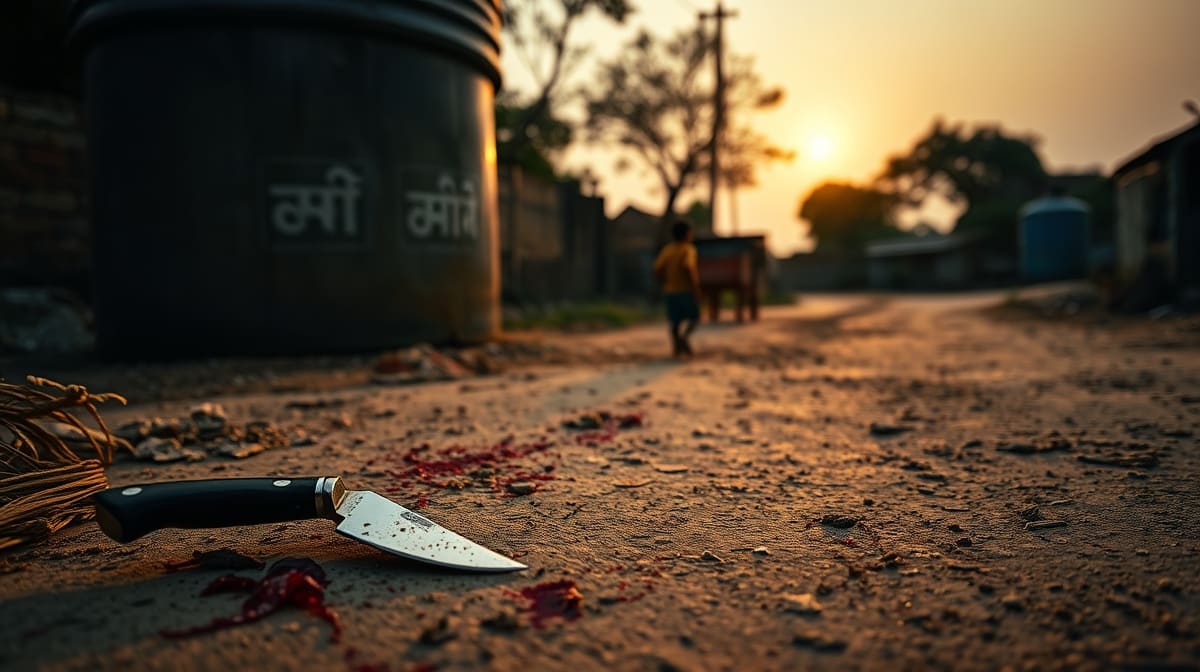
The case arose from the brutal murder of Chameli Devi, wife of Devi Singh, on 30.12.2011 at approximately 03:15 PM near the Jamun tree in front of Komal’s house in Danapur, police station Dibai, district Bulandshahr. The deceased was beheaded, her stomach cut open, and her head hung from the tree. Her six-year-old grandson, Krishna Kumar, was injured by a firearm shot to his right thigh. The accused - Lakhmi, Languri, and Yogesh - were alleged to have committed the crime with common intention using a Daav (axe), knife, and gun.
Key Facts
- The deceased’s husband, Devi Singh, filed the first information report (FIR) at 04:30 PM on 30.12.2011 (Ext. Ka-1).
- The incident occurred in broad daylight, witnessed by the injured child, Krishna Kumar (aged 7 years 6 months at the time).
- The accused were armed: Lakhmi with a Daav, Languri with a knife, and Yogesh with a gun.
- The head of the deceased was recovered from the Jamun tree; a 14-foot bloodstained rope used to hang it was seized (Ext. Ka-2).
- Bloodstained clothing of the deceased (Kameez, Dhoti, Petticoat), a trident (Trishul), Daav, knife, and gun were recovered.
- The trident and Daav were recovered from Lakhmi at the scene; knife and gun were recovered on the pointing out of Languri and Yogesh on 20.01.2012.
- Two separate cases were registered under the Arms Act against Languri and Yogesh (Case Crime No. 57/2012 and 58/2012).
- The post-mortem conducted on 31.12.2011 revealed two ante-mortem injuries: (1) a clean incised wound at C-5 vertebrae causing decapitation, and (2) a 20 cm incised wound below the navel penetrating the abdomen, causing massive internal bleeding.
- The medical opinion confirmed death due to shock and haemorrhage from these injuries.
- The injured child, Krishna Kumar, sustained a lacerated firearm wound on his right thigh, with blackening and fresh bleeding, consistent with close-range firing.
- The Forensic Science Laboratory confirmed human blood on the trident, Daav, knife, and clothing (Ext. Ka-21).
- The prosecution examined 11 witnesses; the defence called five, including DW-5 Raj Kumar, who claimed to have seen the body at 4:00 PM with no one present.
Procedural History
- 30.12.2011: FIR registered at PS Dibai under Section 302/34 IPC (Case Crime No. 400/2011).
- 31.12.2011: Post-mortem conducted at District Hospital, Bulandshahr.
- 10.01.2012: Accused Yogesh and Languri surrendered before court.
- 19.01.2012: Court granted remand for Languri and Yogesh.
- 20.01.2012: Recovery of knife and gun on pointing out of accused.
- 25.03.2012: Forensic materials sent to FSL Agra.
- 20.04.2012: Charges framed by Sessions Court under Sections 302/34, 307/34, 509/34, and 506 IPC (ST No. 310/2012).
- 04.06.2016: Cross-examination of PW-8, Krishna Kumar, completed.
- 06.07.2017: Additional District and Sessions Judge, Anoopshahr, convicted all three appellants and sentenced them to life imprisonment under Section 302/34 IPC, 12 years under Section 307/34 IPC, 2 years under Section 509/34 IPC, and 2 years under Section 506 IPC (Languri and Yogesh only). All sentences directed to run concurrently.
- 18.02.2026: Judgment reserved.
- 18.03.2026: Judgment delivered by the Allahabad High Court.
The Parties' Positions
For the Appellants
The appellants contended that:
- The testimony of the child witness, PW-8 Krishna Kumar, contained material contradictions, rendering it unreliable.
- The doctrine of falsus in uno, falsus in omnibus should apply to discard his entire testimony.
- The trial court ignored the testimony of DW-5 Raj Kumar, a chance witness who claimed to have seen the body at 4:00 PM with no one present.
- The prosecution failed to examine Komal, the owner of the house where the incident occurred.
- The non-recovery of empty cartridges from the scene cast doubt on the use of a firearm.
- The child witness’s evidence required corroboration, which was absent.
For the Respondent/State
The State defended the trial court’s findings, asserting that:
- The prosecution evidence was consistent and credible.
- Minor discrepancies in the child witness’s testimony were natural due to trauma and age.
- The forensic and medical evidence corroborated the prosecution narrative.
- The timeline established by the FIR, inquest, and witness statements confirmed the occurrence at 03:15 PM, contradicting DW-5’s claim of 4:00 PM.
- The child witness was properly examined under Section 118 of the Evidence Act and was found competent.
Relief Sought
The appellants sought acquittal or, in the alternative, reduction of sentence, arguing that the conviction was based on unreliable evidence and procedural lapses.
The Legal Issue
The central question was whether the testimony of a child witness, who has been found competent under Section 118 of the Evidence Act and whose evidence inspires confidence without signs of tutoring, can form the sole basis for conviction under Sections 302/34 IPC, even in the absence of corroboration.
Arguments Presented
For the Appellant
The appellants’ counsel argued that the testimony of PW-8, Krishna Kumar, contained irreconcilable contradictions - specifically, whether he fled immediately after being shot or remained to witness the beheading. They contended that these contradictions triggered the doctrine of falsus in uno, falsus in omnibus, rendering his entire testimony unreliable. They further argued that the prosecution’s failure to examine Komal and recover empty cartridges undermined the credibility of the firearm allegation. The defence relied on DW-5 Raj Kumar’s testimony to challenge the prosecution’s timeline, asserting that the absence of witnesses at the scene at 4:00 PM cast doubt on the prosecution’s version. They emphasized that the child’s testimony, being inherently vulnerable to tutoring, required corroboration under settled principles.
For the Respondent
The State countered that the contradictions cited were trivial and arose from the child’s shock and limited comprehension, not fabrication. The prosecution highlighted that the child’s testimony was consistent with the medical evidence, recovery of weapons, and forensic reports. The State argued that the trial court had correctly assessed the child’s competence through preliminary examination and that his demeanour during cross-examination showed no signs of tutoring. The non-examination of Komal was explained as irrelevant, given the enmity between the complainant and Komal, making him a potential defence witness. The absence of empty cartridges was deemed immaterial since the firearm injury was medically confirmed and the weapon recovered on pointing out.
The Court's Analysis
The Court undertook a meticulous review of the evidence, beginning with the credibility of the child witness, PW-8 Krishna Kumar. It emphasized that the Supreme Court has consistently held that a child witness is a competent witness under Section 118 of the Evidence Act, provided the trial judge is satisfied that the child understands the duty to speak the truth and can give rational answers. The Court noted that the trial judge had conducted a preliminary examination, recorded his satisfaction, and found the child competent - a finding that the High Court declined to disturb.
"The evidence of a child witness who exhibits the demeanour of any other competent witness and whose evidence inspires confidence can be relied upon without any need for corroboration and can form the sole basis for conviction."
The Court rejected the appellants’ reliance on the doctrine of falsus in uno, falsus in omnibus, citing Hangovan v. State of Tamil Nadu and Ram Vijay Singh v. State of U.P., and held that Indian jurisprudence does not recognize this maxim as a mandatory rule of evidence. Minor inconsistencies in the child’s account - such as whether he told his family immediately or fled silently - were deemed natural under the circumstances of trauma and shock, and did not go to the root of the prosecution case.
The Court also dismissed the defence’s reliance on DW-5 Raj Kumar, noting that his testimony was vague - he did not know the year or month - and contradicted the FIR, inquest report, and testimony of PW-7 (SI Atar Singh), who arrived at the scene at 03:45 PM and arrested Lakhmi with the Daav. The timeline of the incident at 03:15 PM was corroborated by multiple independent sources.
Regarding the non-recovery of empty cartridges, the Court held that the presence of a firearm injury, confirmed by PW-5 (Dr. Surendra Goyal), and the recovery of the gun from Yogesh on pointing out, rendered the absence of cartridges immaterial. The forensic report confirmed human blood on the recovered weapons and clothing, further strengthening the prosecution’s case.
The Court also noted that the trial court had correctly assessed the evidence as a whole, and the High Court found no reason to interfere with its findings. The gruesome nature of the crime, the presence of multiple eyewitnesses, and the forensic corroboration collectively established guilt beyond reasonable doubt.
The Verdict
The appeal was dismissed. The convictions and sentences imposed by the trial court were upheld: life imprisonment with a fine of Rs. 50,000 under Section 302/34 IPC; twelve years rigorous imprisonment with a fine of Rs. 25,000 under Section 307/34 IPC; two years simple imprisonment with a fine of Rs. 1,000 under Section 509/34 IPC; and two years simple imprisonment under Section 506 IPC for appellants Languri and Yogesh. All sentences were directed to run concurrently. The appellants shall remain in custody to serve out their sentences. The court directed the trial court to submit a compliance report within two months.
What This Means For Similar Cases
Child Witness Testimony Can Sustain Conviction Without Corroboration
- Practitioners must now argue that the absence of corroboration is not fatal if the child’s testimony is consistent, detailed, and withstands cross-examination.
- The burden shifts to the defence to prove tutoring or fabrication - not merely to raise suspicion.
- Courts must record the preliminary examination under Section 118 of the Evidence Act, including the child’s demeanour and understanding of truth.
Minor Contradictions Do Not Invalidate Testimony
- Minor inconsistencies in timing, sequence, or detail, especially in traumatic events, are not material if they do not affect the core of the incident.
- Courts must distinguish between natural lapses of memory and deliberate fabrication.
- The doctrine of falsus in uno, falsus in omnibus has no legal standing in Indian criminal law and cannot be invoked to discard entire testimony.
Forensic and Medical Evidence Trumps Procedural Gaps
- Non-recovery of specific items (e.g., cartridges, witness) does not automatically create reasonable doubt if other evidence (medical, forensic, recovery on pointing out) is conclusive.
- Recovery of weapons on pointing out, coupled with forensic confirmation of blood, is sufficient to establish weapon use.
- Defence must produce affirmative evidence to challenge prosecution’s timeline, not merely rely on speculative alternative narratives.