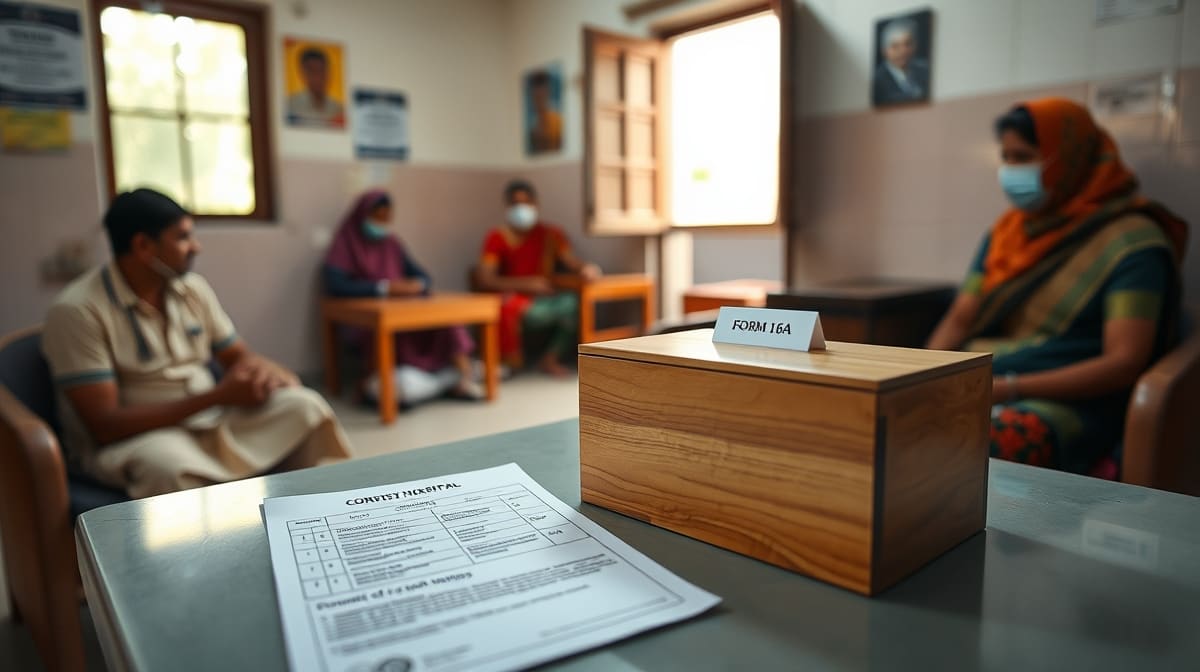
The Income Tax Appellate Tribunal, Mumbai, has clarified a critical principle in charitable trust taxation: the mere denial of exemption under Sections 11 and 12 does not convert gross receipts into taxable income. The Tribunal emphasized that allowable expenditures must be examined under the normal provisions of the Income-tax Act, ensuring only net surplus is taxed.
Background & Facts
The Dispute
The assessee, Dream Foundation, is a registered public charitable trust. For the assessment year 2024-25, it filed its return of income in Form ITR-7 on 15.11.2024, claiming exemption under Sections 11 and 12 of the Income-tax Act, 1961. The trust disclosed voluntary donations of Rs.9,92,500 and claimed an aggregate exemption of Rs.9,55,523, comprising Rs.8,06,648 as application of income towards charitable objects and Rs.1,48,875 as accumulation not exceeding 15% of income from property. After these claims, it reported a net income of Rs.54,160.
Key Facts
- The trust was registered under Section 12AB, but its registration status for A.Y. 2024-25 was not reflected in the Department’s database.
- The audit report in Form 10BB was not electronically filed within the due date.
- No application for condonation of delay under Section 119(2)(b) was submitted.
- The trust’s managing trustee, Mr. Khwaja Mohammed Arif, suffered from Parkinson’s disease and advanced diabetes, affecting timely compliance.
- The return was processed under Section 143(1) by the Centralised Processing Centre (CPC).
- The CPC denied the entire exemption of Rs.9,55,523 on grounds of non-filing of Form 10BB and lack of valid registration.
- The CPC recomputed the income at Rs.10,09,680, resulting in a tax demand of Rs.1,38,080 including interest under Sections 234B and 234C.
- The assessee filed a rectification application under Section 154 on 13.03.2025, which was rejected on 16.04.2025.
- An appeal was filed before the CIT(A) on 12.05.2025, with delay condoned on account of the trustee’s illness.
Procedural History
- 15.11.2024: Return filed in Form ITR-7 for A.Y. 2024-25
- 27.11.2024: CPC issued proposal for adjustment under Section 143(1)(a)
- 28.01.2025: CPC intimation issued, denying exemption and raising demand of Rs.1,38,080
- 13.03.2025: Rectification application filed under Section 154
- 16.04.2025: Rectification application rejected by CPC
- 12.05.2025: Appeal filed before CIT(A)-1, Ahmedabad
- 19.02.2026: CIT(A) order passed, dismissing appeal but directing Assessing Officer to recompute income under normal provisions
- 23.06.2026: Hearing held before ITAT Mumbai
- 30.06.2026: ITAT judgment pronounced
Relief Sought
The assessee sought:
- Setting aside of the CIT(A) order dated 19.02.2026
- Allowance of the claimed expenditure of Rs.9,55,523 as deductible
- Recomputation of taxable income after allowing admissible expenses
- Relief from the tax demand of Rs.1,38,080
The Legal Issue
The central question was whether, upon denial of exemption under Sections 11 and 12 due to non-compliance with registration or audit report requirements, the entire gross receipts of a charitable trust can be taxed as income without allowing any expenditure incurred in furtherance of its objects under the normal provisions of the Act.
Arguments Presented
For the Appellant
The assessee contended that:
- Denial of exemption under Sections 11 and 12 does not equate to automatic taxation of gross receipts.
- The principle established in SCMS Maritime Training Institute v. ITO (ITA No. 6474/Mum/2024) mandates that only net surplus, after allowing admissible expenses, can be taxed.
- The expenditure of Rs.8,06,648 towards charitable activities and Rs.1,48,875 as accumulation were legitimate and should be considered under the normal provisions of the Act.
- The delay in filing Form 10BB was due to the managing trustee’s severe illness, which was already condoned by the CIT(A).
- The CIT(A) had allowed similar relief for A.Y. 2023-24 on identical facts, making the current denial inconsistent.
For the Respondent
The Department argued that:
- The assessee failed to obtain valid registration under Section 12AB for A.Y. 2024-25.
- Form 10BB was not filed within the statutory time limit, and no condonation order under Section 119(2)(b) was produced.
- The adjustment under Section 143(1) was valid and within jurisdiction.
- Once exemption is denied, the entire receipts become taxable unless specifically allowed under other provisions.
- The CIT(A) had already provided relief by directing the Assessing Officer to examine expenditure under normal provisions.
The Court's Analysis
The Tribunal examined the statutory framework under Sections 11, 12, and 12AB, and the nature of income computation under the Act. It held that exemption under Sections 11 and 12 is a concessional benefit, not a mandatory entitlement. Its denial does not alter the fundamental principle that only income, not receipts, is taxable.
"Denial of exemption under sections 11 and 12 does not, by itself, result in the entire gross receipts becoming the taxable income of the assessee. Once the assessee is required to be assessed under the normal provisions of the Act, its taxable income has to be computed in accordance with those provisions. The expenditure actually incurred and otherwise admissible under the Act cannot be ignored merely because the exemption under section 11 is unavailable."
The Tribunal noted that the CIT(A) had correctly recognized this principle by directing the Assessing Officer to treat the trust as an Association of Persons and allow expenditure admissible under the Act. However, the formal dismissal of the appeal created ambiguity. To ensure clarity and effective implementation, the Tribunal restored the matter to the Assessing Officer with explicit directions.
The Tribunal distinguished between "accumulation" and "expenditure". It clarified that Rs.1,48,875, shown as accumulation, cannot be treated as expenditure merely because it was part of the claimed exemption. Its treatment must be determined independently under Sections 11, 12, or other relevant provisions after verification.
The Tribunal declined to rely solely on the rule of consistency, holding that its decision was independently grounded in statutory interpretation and the precedent in SCMS Maritime Training Institute v. ITO. The illness of the trustee, while relevant to delay condonation, was rendered academic after the CIT(A) had already accepted the explanation.
The Verdict
The appeal was partly allowed. The denial of exemption under Sections 11 and 12 was upheld. However, the issue of computation of taxable income was restored to the file of the Assessing Officer. The Assessing Officer is directed to:
- Treat the assessee as an Association of Persons
- Recompute taxable income under the normal provisions of the Act
- Examine books of account, audited financial statements, vouchers, and bank statements
- Allow expenditure actually incurred to the extent admissible under the Act
- Not mechanically treat gross receipts as income
- Exclude Rs.1,48,875 from expenditure unless independently substantiated
- Provide the assessee a reasonable opportunity to produce evidence
- Complete the recomputation within 8 weeks from the date of the order
What This Means For Similar Cases
Gross Receipts Are Not Synonymous with Taxable Income
- Practitioners must argue that even if a trust loses exemption under Section 11, the entire corpus of donations cannot be taxed without deducting allowable expenses.
- The burden shifts to the Department to prove that specific expenditures are not admissible under Sections 30 to 37, not to assume all receipts are taxable.
- This principle applies equally to NGOs, religious institutions, and educational trusts.
Procedural Non-Compliance Does Not Erase Substantive Rights
- Failure to file Form 10BB or maintain registration does not extinguish the right to claim deductions under normal provisions.
- The CIT(A)’s direction to recompute under normal provisions is not a mere formality - it is a substantive legal obligation.
- Tax officers must conduct a separate, independent assessment of expenditure, not rely on the automatic disallowance triggered by procedural defaults.
Precedent from Coordinate Benches Must Be Respected
- The ITAT reaffirmed that coordinate benches must follow consistent interpretations unless overruled by a larger bench.
- SCMS Maritime Training Institute v. ITO now stands as binding authority for trusts facing similar issues.
- Practitioners should cite this judgment when opposing blanket disallowance of expenses in charitable trust assessments.