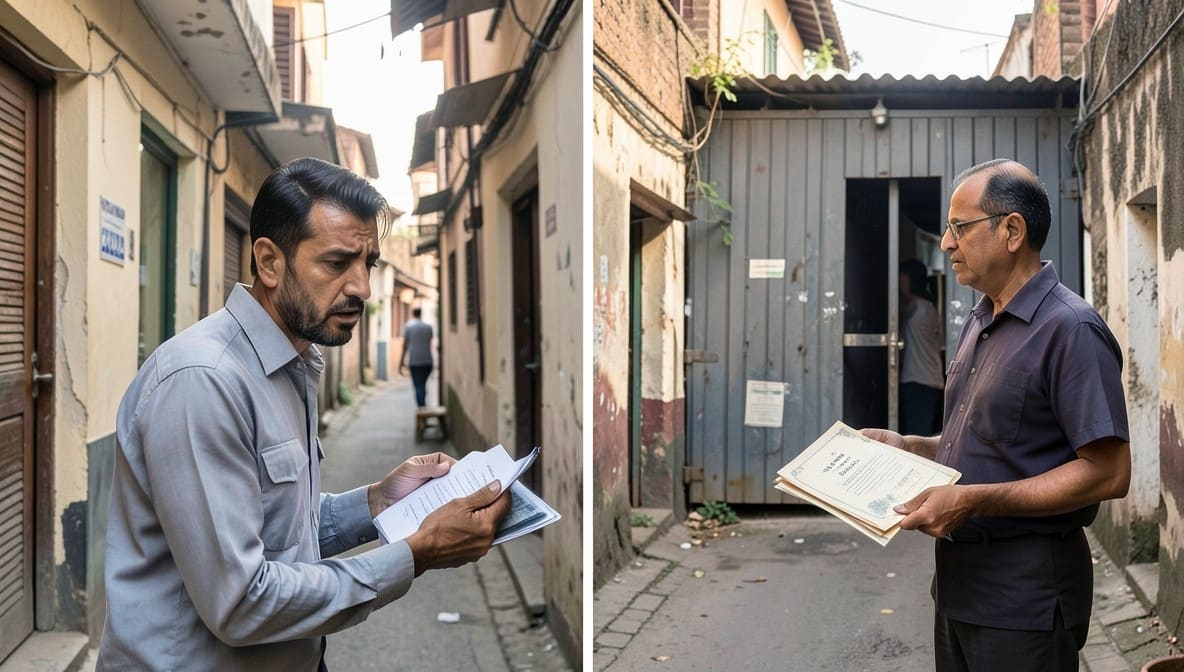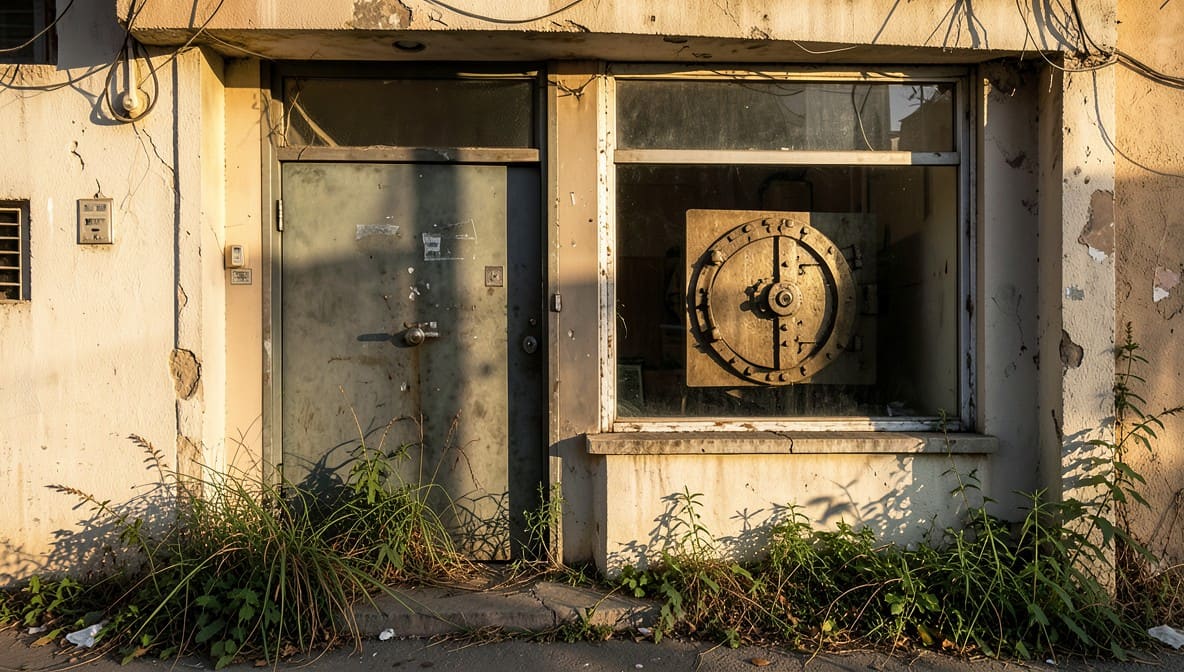
The Punjab and Haryana High Court has clarified that mere issuance of a notice to terminate a lease does not extinguish tenancy if the tenant continues to hold possession and fails to deliver vacant possession. The judgment reinforces that silence, inaction, and retention of property elements like fixtures constitute ongoing tenancy under the Transfer of Property Act.
Background & Facts
The Dispute
The dispute arose from a lease agreement dated 24.02.1995 between the plaintiff, Ram Lubhaya (deceased), and the defendant, Oriental Bank of Commerce, for commercial premises in Jalandhar. The lease was for an initial term of five years commencing 01.08.1993, with an option to renew for three successive terms of five years each, subject to a 15% rent increase upon renewal. The monthly rent was fixed at Rs.5,000, payable by the 7th of each month.
Key Facts
- The lease deed (Ex.P2) contained Clause 11, granting the bank the right to remove the strong room door and other fixtures installed by it upon vacating.
- Clause 16 permitted either party to terminate the lease by serving three months’ notice.
- The initial five-year term expired on 31.07.1998.
- On 01.12.1998, the bank served a registered notice (Ex.D1) terminating the lease, requesting the plaintiff to accept three months’ rent in lieu of notice and permitting removal of the strong room door and fixtures.
- The plaintiff replied on 08.12.1998 (Ex.D2), refusing to allow removal of the strong room door and fixtures, effectively rejecting the bank’s termination offer.
- The bank continued to pay rent at Rs.5,000 per month until November 1998.
- The bank claimed it shifted operations to a new branch at Lambra Main Road on 20.01.1998, but no evidence of physical vacating was produced.
- The strong room door and other fixtures remained in the premises.
- The plaintiff served a notice under Section 106 of the Transfer of Property Act on 14.05.2001 (Ex.P3), demanding possession and arrears.
- The bank did not respond to the 14.05.2001 notice.
- The plaintiff filed the suit for possession and arrears of Rs.2,01,250 on 01.07.2001.
Procedural History
- 01.07.2001: Suit filed by plaintiff before the Trial Court (CS No. 123/2001)
- 15.03.2005: Trial Court decreed suit for possession and recovery of Rs.1,55,000 as arrears
- 20.04.2007: First Appellate Court affirmed the decree
- 22.07.2007: Regular Second Appeal (RSA-4722-2009) filed before the High Court
- 12.10.2012: High Court passed an interim order in CM-6759-C-2011 allowing access to premises for removal of strong room door
- 07.04.2026: Judgment delivered by Division Bench
The Parties' Positions
Plaintiff (Appellee): Contended that despite the bank’s 01.12.1998 notice, possession was never delivered. Rent continued to be paid until November 1998, and the bank retained control over the premises. The 14.05.2001 notice under Section 106 was valid and unchallenged.
Defendant (Appellant): Claimed tenancy terminated on 01.12.1998 by its notice. Asserted it vacated the premises on 20.01.1998 and shifted operations. Argued that the plaintiff’s refusal to allow removal of fixtures prevented delivery of possession, and therefore, no rent was due after December 1998.
Relief Sought
The appellant sought to set aside the decrees of the Trial Court and First Appellate Court, and to dismiss the suit for possession and arrears. The respondent sought confirmation of the decrees and recovery of Rs.1,55,000 as arrears from 01.08.1998 to June 2001, along with possession.
The Legal Issue
The central question was whether the termination of a lease under Clause 16 of a deed, by serving notice, automatically extinguishes tenancy and terminates liability for rent, or whether continued possession and failure to deliver vacant possession - even after notice - sustain the tenancy and obligation to pay rent.
Arguments Presented
For the Appellant
The bank argued that Clause 16 granted it an absolute right to terminate the lease by serving three months’ notice, which it did on 01.12.1998. It contended that the plaintiff’s refusal to allow removal of fixtures did not negate the termination, as the notice itself operated as a unilateral termination under the deed. It relied on the principle that a contractual right to terminate, once exercised, ends the relationship irrespective of subsequent conduct. It further argued that the plaintiff’s failure to accept rent or allow removal of property amounted to a refusal to cooperate, thereby preventing delivery of possession.
For the Respondent
The plaintiff contended that termination under Clause 16 required not just notice but also actual delivery of vacant possession. He argued that the bank’s continued payment of rent until November 1998, its retention of fixtures, and its silence after the 01.12.1998 notice demonstrated ongoing possession. He relied on Section 106 of the Transfer of Property Act, which requires notice and actual surrender of possession to terminate a lease. He emphasized that the bank never produced evidence of physical vacating or handover.
The Court's Analysis
The Court emphasized that the High Court, in a second appeal, cannot reappreciate evidence unless findings are perverse, contrary to law, or based on no evidence. The trial and appellate courts had meticulously examined the testimonies of the bank’s three witnesses - DW-1, DW-2, and DW-3 - and found their accounts inconsistent and self-contradictory.
DW-1, the Branch Manager, admitted he had no knowledge of the bank’s possession status after 1997. DW-2 confirmed rent was paid until November 1998 and that the bank retained possession until his transfer on 22.05.1999. DW-3’s claim that the bank vacated on 20.01.1998 was directly contradicted by the other witnesses and the bank’s own admission of rent payments until November 1998.
The Court noted that the bank’s notice dated 01.12.1998 was not a surrender of possession but a proposal to terminate, contingent on the plaintiff’s acceptance. The plaintiff’s reply rejecting removal of fixtures constituted a rejection of the bank’s offer to terminate. The Court held that under the Transfer of Property Act, a lease is terminated only when possession is surrendered, not merely when notice is served.
"It is settled that the right to terminate a lease by notice does not operate automatically; possession must be delivered. The bank’s continued retention of the strong room door and fixtures, along with its silence and non-delivery of possession, negated any claim of termination."
The Court also relied on its own interim order dated 12.10.2012, which explicitly acknowledged that the bank’s strong room door remained in the premises and that access was required to remove it. This order, unchallenged by the bank, was treated as an admission of continued possession.
The Court further observed that the bank’s failure to produce any evidence of rent payment after November 1998, or of physical vacating, rendered its claim of termination legally unsustainable. The absence of any specific date of handover in the written statement was fatal to the bank’s case.
The Verdict
The appeal was dismissed. The High Court upheld the decrees of the Trial Court and First Appellate Court. The appellant, Oriental Bank of Commerce, is liable to deliver vacant possession of the premises and pay arrears of rent amounting to Rs.1,55,000. The Court directed compliance within four weeks from the date of judgment. No costs were awarded.
What This Means For Similar Cases
Possession Is the Key to Termination
- A contractual notice to terminate a lease is ineffective unless accompanied by actual surrender of possession.
- Merely serving notice under a lease clause does not extinguish tenancy; the tenant remains liable for rent until possession is delivered.
- Retention of fixtures, locks, or keys by the tenant is prima facie evidence of continued possession.
Silence and Inaction Are Adverse to the Tenant
- A tenant’s failure to respond to a notice under Section 106 of the Transfer of Property Act, or to deliver possession after a termination notice, constitutes acquiescence in the continuation of tenancy.
- Courts will infer continued possession from conduct: payment of rent, non-removal of fixtures, and lack of formal handover.
- Practitioners must ensure that termination notices are followed by documented handover, with receipts and witness statements.
Documentary Evidence Trumps Oral Testimony
- Where oral testimony is inconsistent or contradicted by documentary evidence (e.g., rent receipts, court orders), courts will prioritize the latter.
- The bank’s claim of vacating on 20.01.1998 was rejected because it conflicted with its own rent payment records and the court’s prior order.
- Always preserve records of rent payments, handover receipts, and correspondence to substantiate claims of possession or vacating.