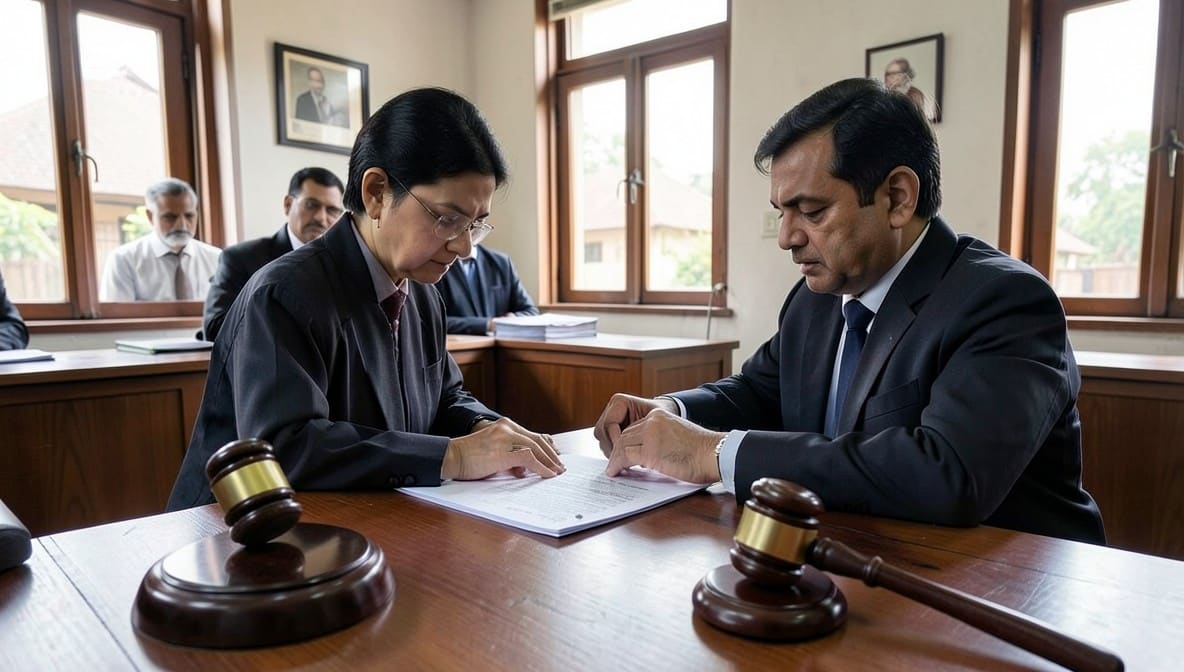
In a significant ruling on bail jurisprudence, the Allahabad High Court granted bail to an applicant accused under Section 105 of the Bharatiya Nyaya Sanhita (B.N.S.), holding that the medical evidence did not support the prosecution's case. The judgment underscores the importance of corroborative evidence in criminal trials and sets a precedent for bail considerations where medical reports contradict allegations of physical assault.
Background & Facts
The Dispute
The applicant, Brijesh Kumar Yadav, was accused in Case Crime No. 80 of 2026 under Section 105 B.N.S. at Police Station Meerganj, District Jaunpur. The informant alleged that the applicant, along with other accused persons, assaulted the informant's brother, who later succumbed to injuries while being taken to the hospital.
Key Facts
- The First Information Report (FIR) and the statement of the informant recorded under Section 180 of the Bharatiya Nagarik Suraksha Sanhita (B.N.S.S.) alleged assault by the applicant and others.
- The deceased was taken to the hospital, where he succumbed to injuries.
- The post mortem report revealed no external injuries on the body of the deceased.
- The cause of death, as per the doctor's opinion, was haemorrhagic stroke leading to cardiopulmonary arrest.
- The applicant has been in jail since 22.05.2026 and has no criminal history.
- The charge sheet has been submitted, but there is no indication of an early trial conclusion.
Procedural History
- Case Crime No. 80 of 2026 registered under Section 105 B.N.S. at Police Station Meerganj, District Jaunpur.
- The applicant was arrested and has been in custody since 22.05.2026.
- Bail Application No. 20867 of 2026 filed before the Allahabad High Court seeking release on bail during the pendency of the trial.
- 03.07.2026: The High Court heard arguments from both sides and perused the material on record, including the post mortem report.
The Parties' Positions
For the Applicant
- The applicant was falsely implicated in the case.
- The medical evidence, particularly the post mortem report, did not support the prosecution's allegations of assault.
- There was no corroborative evidence linking the applicant to the offence.
- The applicant had been in jail for over a month with no hope of an early trial conclusion.
- The applicant had no criminal history and would not misuse liberty if granted bail.
For the Opposite Party
- The State and the informant's counsel opposed the bail application but failed to satisfactorily dispute the applicant's submissions.
Relief Sought
The applicant sought release on bail during the pendency of the trial, subject to conditions ensuring his appearance and non-interference with the prosecution evidence.
The Legal Issue
The central question before the Court was whether bail could be granted under Section 105 B.N.S. where the medical evidence did not support the prosecution's allegations of physical assault, and there was no reasonable apprehension of the applicant tampering with evidence or intimidating witnesses.
Arguments Presented
For the Applicant
- The post mortem report showed no external injuries on the deceased, contradicting the prosecution's case of assault.
- The cause of death was haemorrhagic stroke, which could not be attributed to the alleged incident.
- There was no corroborative evidence linking the applicant to the offence.
- The applicant had been in custody for over a month with no prospect of an early trial.
- The applicant had no criminal history and would not misuse bail if granted.
For the Opposite Party
- The State and the informant's counsel opposed the bail application but did not dispute the medical evidence or the lack of corroborative evidence on record.
The Court's Analysis
The Court conducted a prima facie assessment of the evidence on record, particularly focusing on the post mortem report and the medical opinion regarding the cause of death. The Court observed:
"As per the post mortem report, no external injury was seen over the body of the deceased. Medical evidence does not support the prosecution case. Moreover, the applicant has remained confined for more than a month and after submission of the charge sheet there is no hope of early conclusion of trial, more so when no reasonable apprehension has been brought to the fore by the State that the applicant, if enlarged on bail, would either tamper with the evidence or delay the trial or intimidate the witness."
The Court emphasized that bail should not be denied merely on the gravity of the offence but must be considered based on evidence, the likelihood of trial delay, and the conduct of the accused. Since the medical evidence did not support the prosecution's allegations and there was no reasonable apprehension of the applicant misusing bail, the Court held that the applicant was entitled to bail.
The Verdict
The Allahabad High Court allowed the bail application and directed the release of the applicant, Brijesh Kumar Yadav, on furnishing:
- A personal bond and
- Two sureties each in the like amount,
subject to the following conditions:
- The applicant shall appear on the date fixed by the trial court.
- The applicant shall not tamper with the prosecution evidence.
- The applicant shall not pressurize the prosecution witnesses.
The Court further clarified that in case of breach of any of the above conditions, the prosecution would be at liberty to move a bail cancellation application before the Court.
What This Means For Similar Cases
Medical Evidence Is Crucial in Bail Considerations
- Courts are increasingly relying on medical and forensic evidence to assess the merits of prosecution allegations, particularly in cases involving physical assault or homicide.
- Where medical reports contradict the prosecution's case, bail may be granted even in serious offences, provided there is no reasonable apprehension of the accused tampering with evidence or intimidating witnesses.
Bail Should Not Be Denied Solely on Gravity of Offence
- The judgment reinforces that bail cannot be denied automatically based on the gravity of the offence alone.
- Courts must consider evidence, trial delays, and the accused's conduct before denying bail. If the prosecution fails to establish a prima facie case or apprehension of misuse of liberty, bail should be granted.
Procedural Safeguards Must Be Followed
- The Court imposed strict conditions on the applicant, including non-interference with evidence and witnesses, ensuring that bail is not misused.
- Practitioners should argue for tailored bail conditions that address the specific concerns of the prosecution while safeguarding the accused's liberty.