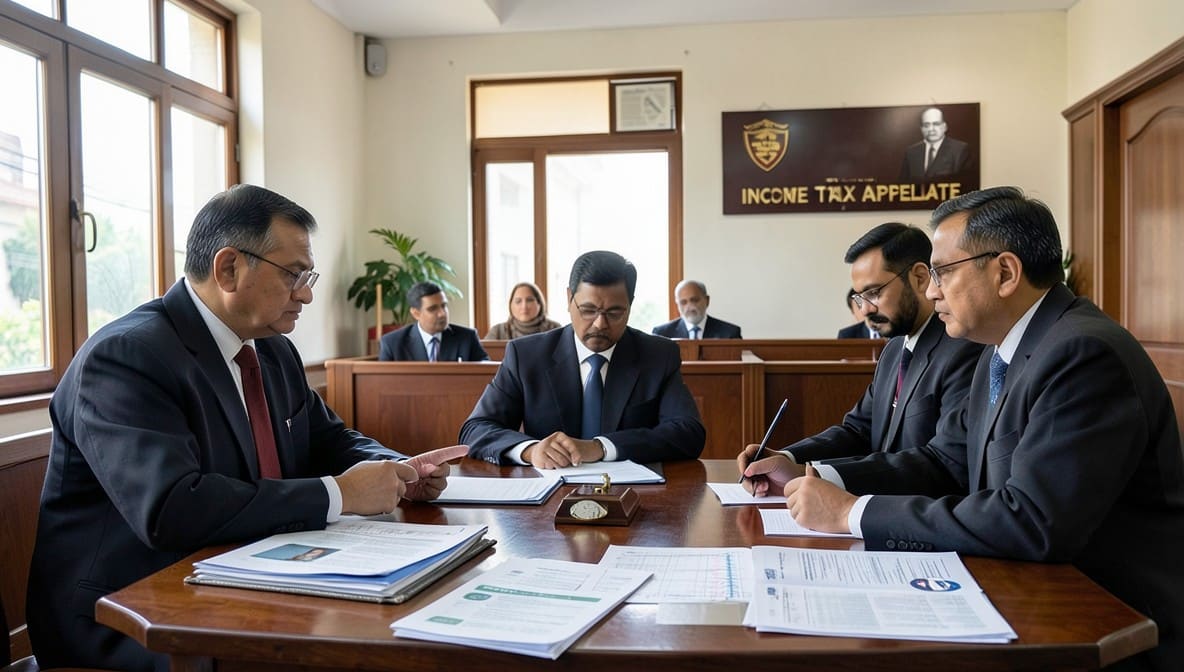
The Income Tax Appellate Tribunal, Delhi, has reaffirmed that the exemption under Section 10(38) of the Income Tax Act for long term capital gains from listed shares cannot be denied merely on the basis of generalized investigation reports or speculative assumptions about penny stock trading. The Tribunal emphasized that tax authorities must establish a direct, evidentiary link between the assessee and fraudulent activity before disallowing such exemptions.
Background & Facts
The Dispute
The appellant, Late Gyan Prakash Gupta, claimed a long term capital gain (LTCG) of Rs. 1,49,14,984/- from the sale of 36,100 equity shares of HPC Biosciences Limited during the financial year 2014-15, relevant to assessment year 2015-16. He filed his return on 30.09.2015 declaring total income of Rs. 41,630/- and claimed the entire LTCG as exempt under Section 10(38). The Income Tax Department, however, treated the transaction as a bogus arrangement to convert unaccounted money into exempt income and made an addition of Rs. 1,49,62,513/- under Section 68 as unexplained income.
Key Facts
- The appellant acquired 1,00,000 pre-IPO equity shares of HPC Biosciences Limited @ Rs. 10/- per share on 04.02.2013 via account payee cheque from AMS Powertronics Private Limited.
- The shares were dematerialized with NSDL on 16.03.2014.
- HPC Biosciences Limited was listed on the BSE SME segment on 19.03.2013 at an issue price of Rs. 35/-.
- The appellant sold the shares between 27.03.2014 and 11.07.2014 through online trading on the Bombay Stock Exchange at prices ranging from Rs. 540 to Rs. 735.90 per share.
- All transactions were routed through M/s. Divya Portfolio Pvt. Ltd., a registered stock broker.
- Security Transaction Tax (STT) was paid on all sales.
- Payments for purchase and receipt of sale proceeds were made through banking channels.
- The appellant submitted bank statements, demat account statements, broker statements, and STT payment receipts to the Assessing Officer.
- The Department relied on investigation reports from the Directorate of Investigation, Kolkata, and SEBI orders against HPC Biosciences Limited and other entities, none of which named the appellant or his broker.
Procedural History
- 30.09.2015: Assessee filed return for AY 2015-16 claiming LTCG exemption under Section 10(38).
- 08.08.2016: Notices under Sections 143(2) and 142(1) issued by Ld. AO.
- 15.05.2017 & 19.06.2017: Assessee submitted bank and broker documents (Paper Book Pages 8A-8K).
- 08.12.2017: Ld. AO passed assessment order making addition of Rs. 1,49,62,513/- under Section 68.
- 31.05.2019: Ld. CIT(A)-2, Guwahati dismissed the appeal, upholding the addition.
- 22.07.2021: Appeal filed before ITAT Delhi (ITA No. 6271/Del/2019).
- 09.04.2026: Judgment pronounced by ITAT Delhi.
The Parties' Positions
Appellant: Contended that the transaction was genuine, fully documented, and compliant with all statutory requirements. He argued that the Department relied on generalized reports, failed to confront him with adverse material, and did not conduct any independent verification of his broker or banking trail. He cited multiple precedents where courts had held that suspicion cannot replace evidence.
Respondent (Revenue): Argued that HPC Biosciences Limited was a penny stock with weak financials, and the sharp price appreciation was indicative of manipulation. Relied on SEBI orders and investigation reports against other entities in the same sector to infer that the appellant’s transaction was part of a broader pattern of bogus LTCG.
Relief Sought
The appellant sought deletion of the addition of Rs. 1,49,62,513/- under Section 68, restoration of the claimed LTCG exemption under Section 10(38), and setting aside of the orders of the Ld. AO and Ld. CIT(A).
The Legal Issue
Can the exemption under Section 10(38) of the Income Tax Act for long term capital gains from shares traded on a recognized stock exchange be denied under Section 68 solely on the basis of generalized investigation reports, suspicious price movements, and failure of third parties to respond to notices, without any direct evidence linking the assessee to fraudulent activity?
Arguments Presented
For the Appellant
The appellant relied on multiple judgments including Principal Commissioner of Income Tax v. Renu Aggarwal (2023), Principal Commissioner of Income-tax v. Genuine Finance (P.) Ltd. (2024), and Pr. CIT v. Ziauddin A Siddique (Bombay HC, 2022). He argued that:
- The transaction was conducted through registered brokers via banking channels.
- STT was paid, and shares were dematerialized and traded on BSE.
- SEBI’s final order dated 06.09.2017 specifically revoked the earlier directions against him after investigation, granting him a clean chit.
- The Department failed to prove any connection between the appellant and any entry operator, exit provider, or price manipulator.
- The lower authorities violated principles of natural justice by not providing access to or opportunity to cross-examine witnesses whose statements were relied upon.
- Mere association with a company later found to be involved in irregularities does not taint the transaction of an innocent investor.
For the Respondent
The Revenue contended that:
- The share price of HPC Biosciences Limited rose from Rs. 35/- to over Rs. 700/- in under a year, with no commensurate improvement in financials.
- The company was under investigation by SEBI and the Income Tax Department for IPO manipulation and accommodation entries.
- The appellant’s transaction fit the modus operandi of bogus LTCG schemes identified in the Kolkata investigation report.
- The burden shifted to the assessee to prove the genuineness of the transaction, which he failed to do conclusively.
- Precedents like Suman Poddar v. ITO supported the view that high returns on penny stocks with weak fundamentals are inherently suspect.
The Court's Analysis
The Tribunal conducted a meticulous review of the evidence and the judicial precedents cited by both parties. It emphasized that Section 10(38) provides a clear statutory exemption for LTCG arising from the sale of shares listed on a recognized stock exchange, provided STT is paid. The burden on the Revenue to disprove this exemption is high and must be met with concrete, case-specific evidence.
"The Assessing Officer has drawn a negative inference from the fact that the M/s. Sunstar Realty Development Limited, HPC Biosciences Limited and AMS Powertronics Limited have not complied with the notices issued under section 133(6) of the Act. Non-compliance by any third party over which the Assessee is not having any control, cannot be used against the Assessee."
The Tribunal noted that SEBI’s final order dated 06.09.2017 explicitly revoked the earlier interim orders against the appellant after a detailed investigation, stating that no violation of SEBI Act or PFUTP Regulations was found in respect of the appellant. This was a decisive factor.
The Tribunal further relied on Pr. CIT v. Ziauddin A Siddique (Bombay HC), where the court held that even if a scrip exhibits characteristics of a penny stock, the Revenue must establish a direct link between the assessee and price rigging or accommodation entries. Mere suspicion, human probability, or association with a company under investigation is insufficient.
"The conclusion drawn by the AO, that there was an agreement to convert unaccounted money by taking fictitious LTCG in a pre-planned manner, is therefore entirely unsupported by any material on record. This finding is thus purely an assumption based on conjecture made by the AO."
The Tribunal also found that the lower authorities failed to comply with principles of natural justice by not providing the appellant access to the investigation reports and statements relied upon, nor giving him an opportunity to cross-examine the persons whose statements were used against him.
The Tribunal concluded that the appellant had discharged his initial burden under Section 68 by producing documentary evidence of purchase, dematerialization, sale, and receipt of funds through banking channels. The Revenue failed to rebut this with any specific, admissible evidence linking the appellant to fraud.
The Verdict
The appeal is allowed. The orders of the Ld. AO dated 08.12.2017 and Ld. CIT(A) dated 31.05.2019 are set aside. The addition of Rs. 1,49,62,513/- under Section 68 is deleted. The long term capital gain of Rs. 1,49,14,984/- claimed under Section 10(38) is allowed as exempt income. The appellant’s return for AY 2015-16 stands revised accordingly.
What This Means For Similar Cases
Suspicion Alone Cannot Override Documentary Evidence
- Practitioners must insist that Revenue authorities produce direct, case-specific evidence linking the assessee to fraudulent activity before invoking Section 68 against LTCG claims.
- Generalized investigation reports, SEBI orders against unrelated entities, or financial weakness of the company are insufficient grounds for disallowance.
Natural Justice Is Non-Negotiable in Tax Proceedings
- Tax authorities must provide the assessee with copies of all adverse material and afford an opportunity to cross-examine witnesses whose statements are relied upon.
- Failure to do so renders the order voidable, regardless of the merits of the case.
SEBI’s Final Orders Carry Weight
- If SEBI, after a full investigation, revokes earlier interim orders and grants a clean chit to the assessee, such findings are binding on tax authorities.
- Tax officers cannot override SEBI’s final conclusions without independent, contradictory evidence.
Penny Stock Characteristics Are Not Fatal
-
High volatility, low market capitalization, or sharp price appreciation alone do not render a transaction bogus.
-
The key test is whether the transaction was conducted through recognized channels (stock exchange, registered broker, banking route, STT paid) and whether the assessee was directly implicated in manipulation.
-
Always demand production of the specific documents relied upon by the Revenue.
-
File applications under Section 131 and 133(6) to obtain broker and bank records independently.
-
Cite Ziauddin Siddique and Krishna Devi as binding precedents in all penny stock LTCG cases.
-
Argue that Section 68 cannot be used to negate a statutory exemption under Section 10(38) without direct proof of fraud.