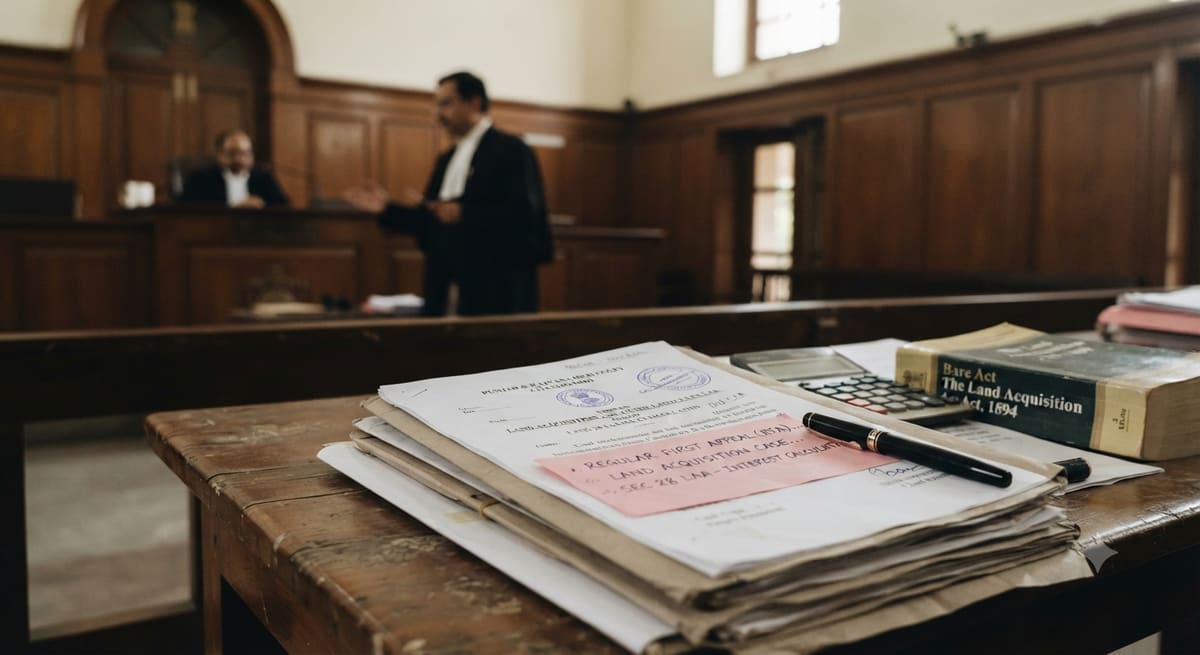
The Punjab & Haryana High Court has settled a long-running dispute over compensation for land acquired under the 1894 Act, holding that interest cannot accrue on previously awarded interest and that the executing court cannot entertain a second objection after five years.
Background & Facts
The Dispute
Petitioners: Land Acquisition Collector-cum-Sub-Divisional Magistrate, Moonak and the State of Punjab.
Respondents: A large group of landowners (e.g., Amanpreet Singh, Mahinder Singh, Rangi Ram, etc.) whose lands in Sangrur and Patiala districts were acquired.
The State issued a notification under Section 4 of the Land Acquisition Act, 1894 on 20-11-2006 expressing intent to acquire land, followed by a second notification on 29-04-2007 under Section 6.
The Land Acquisition Collector passed the award on 12-04-2008 fixing compensation.
Landowners challenged the award; the Additional District Judge, Sangrur, dismissed their reference petition under Section 18 of the Act.
The matter reached this Court via multiple appeals, notably the judgment dated 27-01-2016 in Sadhu Ram v. State of Punjab (RFA No.3367 of 2011) which enhanced market value from ₹5,95,000 to ₹15,95,600 per acre and fixed solatium and additional compensation.
Key Facts
Compensation components as per the 2016 order:
Market value: ₹15,95,600 per acre.
Additional amount under Section 23(1A) at 12% per annum: ₹1,87,120.
Solatium under Section 23(2) at 30%: ₹3,40,218.
Total enhanced compensation: ₹16,61,400 per acre.
Interest calculations by the Executing Court (order dated 21-12-2017):
9% p.a. from 12-04-2008 to 11-04-2009: ₹1,49,526.
15% p.a. from 12-04-2009 to 21-12-2017: ₹21,39,156 (later found erroneous).
Correct interest for the period up to 21-12-2017 should have been ₹19,68,146.
Payments made by the State:
Partial payment of ₹11,34,000 on 21-12-2017 (adjusted against interest).
Further partial payments on 03-10-2018 and 31-05-2019.
The State filed an objection on 24-01-2023 contesting the interest calculation; the Executing Court rejected it on 08-11-2023.
Procedural History
20-11-2006: Notification under Section 4 of the Act.
29-04-2007: Notification under Section 6.
12-04-2008: Award passed by the Collector.
27-01-2016: High Court judgment in Sadhu Ram v. State of Punjab enhancing compensation.
21-12-2017: Executing Court order calculating compensation and interest.
03-10-2018: First partial payment by the State.
31-05-2019: Second partial payment by the State.
24-01-2023: State’s objection application.
08-11-2023: Executing Court dismisses the objection.
29-07-2026: Present judgment delivered.
Relief Sought
The State, invoking Article 227 of the Constitution, sought setting aside of the Executing Court’s orders dated 21-12-2017 and 08-11-2023, contending that interest on interest was incorrectly awarded and that the second objection application was ultra vires.
The Legal Issue
The central questions were: (i) Does the Land Acquisition Act, 1894 permit interest to accrue on previously awarded interest? (ii) Is interest part of the principal compensation after the Executing Court’s 21-12-2017 order? (iii) Can the Executing Court entertain a second objection application filed after five years? (iv) Is an application under Section 152 of the CPC permissible to correct alleged clerical mistakes?
Arguments Presented
For the State (Petitioner)
Asserted that Section 34 mandates a statutory 9% interest on compensation not paid at the time of possession and a 15% interest thereafter; it does not allow compounding of interest.
Cited Maj. Gen. Kapil Mehra v. Union of India (2015) to emphasize that interest under Section 28 is discretionary but, when awarded, must be simple interest, not compounded.
Relied on Dipali Biswas v. Nirmalendu Mukherjee (2021) and Subhash Chander v. M/s Rare Tyres Traders (2009) to argue that a second objection after five years is not maintainable.
Contended that the Executing Court’s inclusion of interest in the principal for subsequent interest calculation amounted to a legal error, correctable only under Section 152 CPC, not by a fresh objection.
For the Landowners (Respondents)
Maintained that the Executing Court correctly adjusted the ₹11,34,000 payment against interest and that the remaining amount of ₹26,75,336 constituted principal attracting future interest.
Argued that the interest calculated up to 21-12-2017 formed part of the compensation, thereby justifying interest on interest thereafter.
Opposed the State’s reliance on Dipali Biswas and Subhash Chander, claiming the circumstances differed because the Executing Court had already corrected an arithmetic mistake.
Sought confirmation that the Executing Court could entertain a second objection to rectify the alleged mis-calculation.
The Court's Analysis
The Court began by delineating the statutory scheme of the Land Acquisition Act, 1894. Section 34 imposes a mandatory 9% simple interest on compensation unpaid at the time of possession, escalating to 15% after one year. By contrast, Section 28 authorises the Court to award interest on any excess compensation it enhances, but this power is discretionary and limited to simple interest.
"The award of interest under Section 34 is mandatory in as much the word used in the Section is ‘shall’. The scheme of the Act and the express provisions thereof establish that the interest payable under Section 34 is statutory. The claim for interest under Section 28 proceeds on the basis that due compensation not having been paid, the claimant should be allowed interest on the enhanced compensation amount. The award of interest under Section 28 is discretionary power vested in the Court and it must be exercised in a judicious manner and not arbitrarily."
The Court noted that the 2016 judgment had enhanced market value and prescribed solatium and additional compensation, but it did not expressly direct interest under Section 28. Consequently, the only statutory interest applicable was that under Section 34, which is simple and non-compounding. The Court rejected the notion that interest accrued up to 21-12-2017 became part of the principal; such a conversion would contravene the clear language of the Act, which distinguishes between principal compensation and interest.
Addressing the second objection, the Court relied on Dipali Biswas and Subhash Chander to hold that a second objection filed after the statutory limitation of five years is not maintainable. The proper remedy for the State was to challenge the Executing Court’s order under Section 152 CPC, which is limited to correcting clerical or arithmetical errors, not to revisit substantive calculations.
The Court examined the arithmetic in the Executing Court’s order and identified that the interest figure of ₹21,39,156 was inflated; the correct amount as of 21-12-2017 was ₹19,68,146. However, this was a clerical mistake amenable to correction under Section 152 CPC, not a ground for a fresh objection. Accordingly, the Court directed the Executing Court to amend its order to reflect the correct interest figure and to continue applying simple interest at 15% on the outstanding principal thereafter.
In sum, the Court affirmed that:
Interest under Section 34 is simple and cannot be compounded.
Interest does not become part of the principal compensation.
The Executing Court lacks jurisdiction to entertain a second objection after five years.
A correction under Section 152 CPC is permissible for the identified arithmetic error.
The Verdict
The State’s petition succeeded. The Court set aside the Executing Court’s orders dated 21-12-2017 and 08-11-2023 to the extent they awarded interest on interest. It directed the Executing Court to recalculate interest as ₹19,68,146 (simple interest at 15% from 12-04-2009 to 21-12-2017) and to continue charging simple interest at 15% on the remaining principal until full payment. The Court also held that the Executing Court could not entertain a second objection application but could correct the clerical mistake under Section 152 CPC.
What This Means For Similar Cases
No Compounding of Statutory Interest
Practitioners must advise clients that interest under Section 34 and discretionary interest under Section 28 are simple; any calculation that adds interest on previously awarded interest will be rejected.
Drafting of compensation schedules should clearly separate principal compensation from interest components.
Limits on Second Objection Applications
A second objection to an executing court’s order becomes barred after five years; parties should file any challenge within the statutory period or resort to Section 152 CPC for clerical errors.
Courts will not entertain substantive revisions of interest calculations beyond the scope of a correction under Section 152 CPC.
Use of Section 152 CPC for Arithmetical Errors
When a mistake is purely arithmetic, an application under Section 152 CPC is appropriate and will be entertained even years later.
Lawyers should prepare a concise statement of the error, attach the original order, and specifically request correction rather than a fresh objection.