The Income Tax Appellate Tribunal, Delhi, has reaffirmed that payments made by Indian entities for satellite bandwidth services to foreign providers do not constitute royalty under Section 9(1)(vi) of the Income Tax Act, 1961, and are not subject to TDS under Section 195 when protected by a Double Taxation Avoidance Agreement. This decision reinforces the primacy of treaty obligations over domestic legislative amendments, offering critical clarity to cross-border telecom and satellite service providers.
Background & Facts
The Dispute
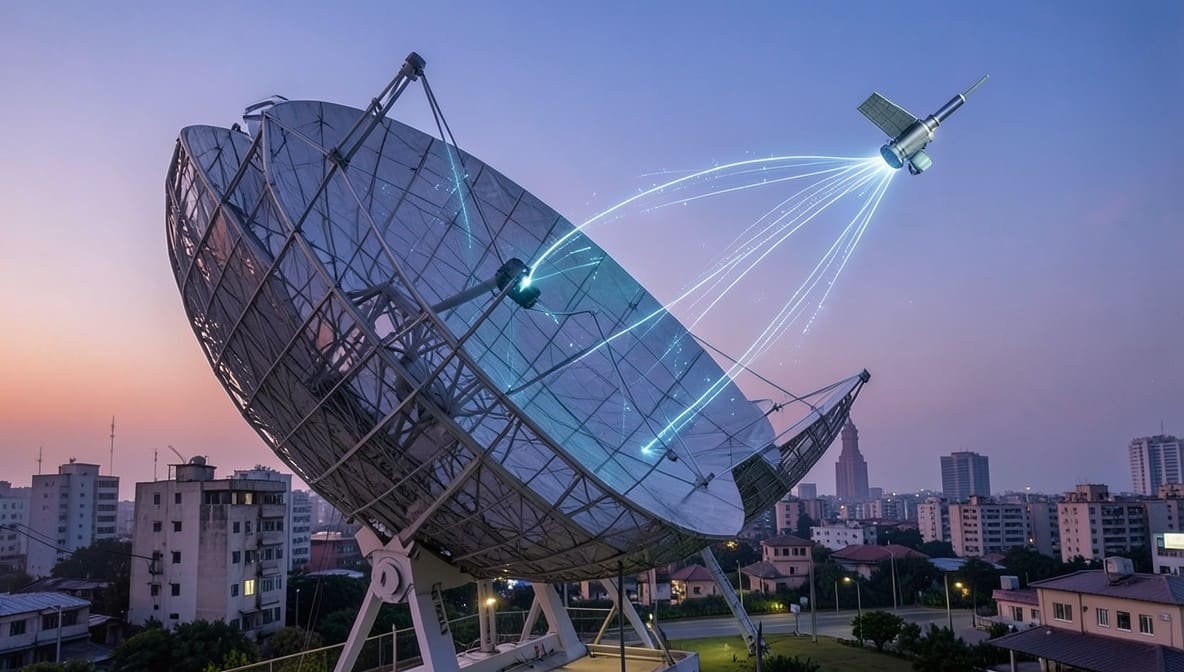
The dispute arose from payments made by Bharti Teleports Ltd. (now Indo Teleports Ltd.), an Indian company operating a teleport hub for up-linking TV channels to satellites, to Intelsat Global Sales and Marketing Limited (IGSML), a UK-based satellite services provider. Between April 2013 and March 2014, the assessee paid Rs. 15,49,45,416 to IGSML for transponder services - enabling the up-linking of television content to satellites for global distribution. No Tax Deducted at Source (TDS) was withheld on these payments.
Key Facts
- The assessee does not own or operate satellites; it leases transponder capacity on satellites owned and operated by IGSML.
- The contract with IGSML provides access to a shared transponder bandwidth; no exclusive equipment, process, or software is transferred to the assessee.
- All satellite operations - including signal amplification, relaying, tracking, telemetering, and control - are performed entirely outside Indian territory.
- The payment is for the use of satellite capacity, not for the transfer of any right in property, process, or equipment.
- The assessee does not receive or control any hardware, software, or technical infrastructure from IGSML.
Procedural History
- 30.03.2021: The Assessing Officer (AO) issued an order under Section 201(1)/(1A) and Section 195, treating the payments as royalty under Explanation 5 and 6 to Section 9(1)(vi) of the Income Tax Act, as amended by the Finance Act, 2012. A demand of Rs. 6,07,28,711 was raised, applying a 20% tax rate under Section 206AA.
- 05.08.2025: The Commissioner of Income Tax (Appeals) [Ld. CIT(A)] allowed the assessee’s appeal, holding that the payments were not royalty and that the DTAA between India and the UK prevailed over domestic amendments.
- 13.05.2026: The Revenue filed this appeal before the ITAT Delhi.
- 03.06.2026: The ITAT delivered its order dismissing the Revenue’s appeal.
The Parties' Positions
For the Revenue
The Revenue contended that:
- The payments constituted royalty under Explanation 5 and 6 to Section 9(1)(vi), introduced by the Finance Act, 2012, which retrospectively expanded the definition of royalty to include payments for use of or right to use any process or equipment.
- The amendments were clarificatory and therefore applicable to prior years, including A.Y. 2014-15.
- The judgment in Verizon Communications Singapore Pte Ltd. v. ITO (Madras HC) supported taxing such payments as royalty.
- The payments should be treated as Fee for Technical Services (FTS) under Section 9(1)(vii), making TDS mandatory.
For the Assessee
The assessee argued that:
- The transaction involved mere access to shared satellite bandwidth, not transfer of any right in property, process, or equipment.
- The Finance Act, 2012 amendments could not override the India-UK DTAA, which defines royalty more narrowly under Article 13.
- Binding precedents from the Delhi High Court in Asia Satellite Telecommunications Co. Ltd., New Skies Satellite BV, Intelsat Corporation, and Telstra Singapore Pte Ltd. consistently held such payments non-royalty.
- The Supreme Court in Engineering Analysis Centre of Excellence Pvt. Ltd. held that domestic amendments cannot be read into DTAA provisions without treaty amendment.
- The CBDT had accepted that telecom interconnect charges are not FTS, and the same logic applied to satellite bandwidth.
Relief Sought
The Revenue sought to set aside the order of the Ld. CIT(A) and uphold the demand of Rs. 6,07,28,711 for non-deduction of TDS on the satellite bandwidth payments.
The Legal Issue
The central question was whether payments made by an Indian entity for satellite bandwidth services to a foreign provider constitute royalty under Section 9(1)(vi) of the Income Tax Act, 1961, and whether the retrospective amendments introduced by the Finance Act, 2012, can override the definition of royalty under the India-UK Double Taxation Avoidance Agreement (DTAA).
Arguments Presented
For the Appellant (Revenue)
The Revenue relied on the expanded definition of royalty under Explanation 5 and 6 to Section 9(1)(vi), introduced by the Finance Act, 2012, which included payments for use of or right to use any process or equipment. It argued that satellite bandwidth transmission involved the use of a technical process (signal amplification and relaying) and therefore fell within the amended definition. It further contended that the amendments were clarificatory and thus applicable to prior years. The Revenue also cited the Madras High Court’s decision in Verizon Communications Singapore Pte Ltd. and the Karnataka High Court’s decision in Synopsys International Ltd. to support its position.
For the Respondent (Assessee)
The assessee relied on multiple binding precedents from the Delhi High Court, which had consistently held that satellite bandwidth payments are not royalty because no transfer of rights in property or process occurs. It emphasized that the Supreme Court in Engineering Analysis Centre of Excellence Pvt. Ltd. had ruled that domestic amendments cannot be read into DTAA provisions unless the treaty itself is amended. It further argued that the CBDT had accepted that interconnect charges are not FTS, and the same principle applied to satellite services. The assessee distinguished Verizon on factual grounds, noting that it involved dedicated point-to-point circuits, unlike the shared transponder access in the present case.
The Court's Analysis
The ITAT undertook a detailed review of judicial precedents and statutory interpretation principles. It noted that the Delhi High Court had repeatedly held that payments for satellite transponder services do not constitute royalty under Section 9(1)(vi), even after the 2012 amendments. The Tribunal emphasized that the Supreme Court in Engineering Analysis Centre of Excellence Pvt. Ltd. had unequivocally held that "any amendment to domestic law, whether retrospective or prospective, cannot be read into treaty provisions without amending the treaty itself."
"The crucial difference between the judgments however lies in the application of the amendments to the DTAA. While TV Today Network Ltd.'s case (supra) recognizes that the question will have to be decided and the submission argued, Verizon Communications Singapore Pte. Ltd.'s case (supra) cites no reason for the extension of the amendments to the DTAA."
The Tribunal further held that the Verizon judgment was distinguishable on facts: Verizon provided dedicated point-to-point leased circuits with equipment delivery, whereas IGSML merely provided shared transponder capacity without transferring any equipment or process. The ITAT also rejected the Revenue’s attempt to classify the payment as FTS, noting that the CBDT had ceased contesting the Karnataka High Court’s view in CIT v. Vodafone South Ltd., thereby accepting that standard services without human intervention do not qualify as FTS.
The Tribunal also relied on the Supreme Court’s recent decision in Vodafone Idea Ltd., which held that bandwidth charges paid to foreign telecom operators are not royalty, and affirmed the Delhi High Court’s view in Telstra Singapore that the same principle applies to satellite services. The ITAT concluded that the jurisprudence on this issue was settled and binding on the Tribunal.
The Verdict
The appeal of the Revenue was dismissed. The ITAT upheld the order of the Ld. CIT(A) and deleted the demand of Rs. 6,07,28,711 raised by the Assessing Officer for non-deduction of TDS on payments of Rs. 15,49,45,416 made to IGSML. The Tribunal held that the payments did not constitute royalty under Section 9(1)(vi) and were not taxable in India under the India-UK DTAA, and that the Finance Act, 2012 amendments could not override treaty obligations.
What This Means For Similar Cases
Treaty Provisions Prevail Over Domestic Amendments
- Practitioners must now argue that any domestic amendment to the definition of royalty under Section 9(1)(vi) cannot be applied to transactions covered by a DTAA unless the treaty itself is amended.
- This principle applies to all DTAA-covered payments, including software licensing, cloud services, and data transmission.
Bandwidth Payments Are Not Royalty
- Payments for shared satellite or telecom bandwidth, where no equipment or process is transferred, are not royalty under Section 9(1)(vi), even post-2012 amendments.
- This applies to both satellite and terrestrial telecom operators receiving payments from Indian clients.
FTS Classification Is No Longer Viable
-
The CBDT’s acceptance of the Karnataka High Court’s view in Vodafone South Ltd. has rendered the FTS classification for standard bandwidth services untenable.
-
Tax authorities can no longer treat payments for automated, non-human-intervention services as FTS.
-
Practitioners should cite Engineering Analysis Centre of Excellence Pvt. Ltd., Vodafone Idea Ltd., and Telstra Singapore Pte Ltd. as binding authority.
-
TDS compliance strategies for foreign satellite and telecom service providers must now be aligned with DTAA definitions, not domestic statutory amendments.