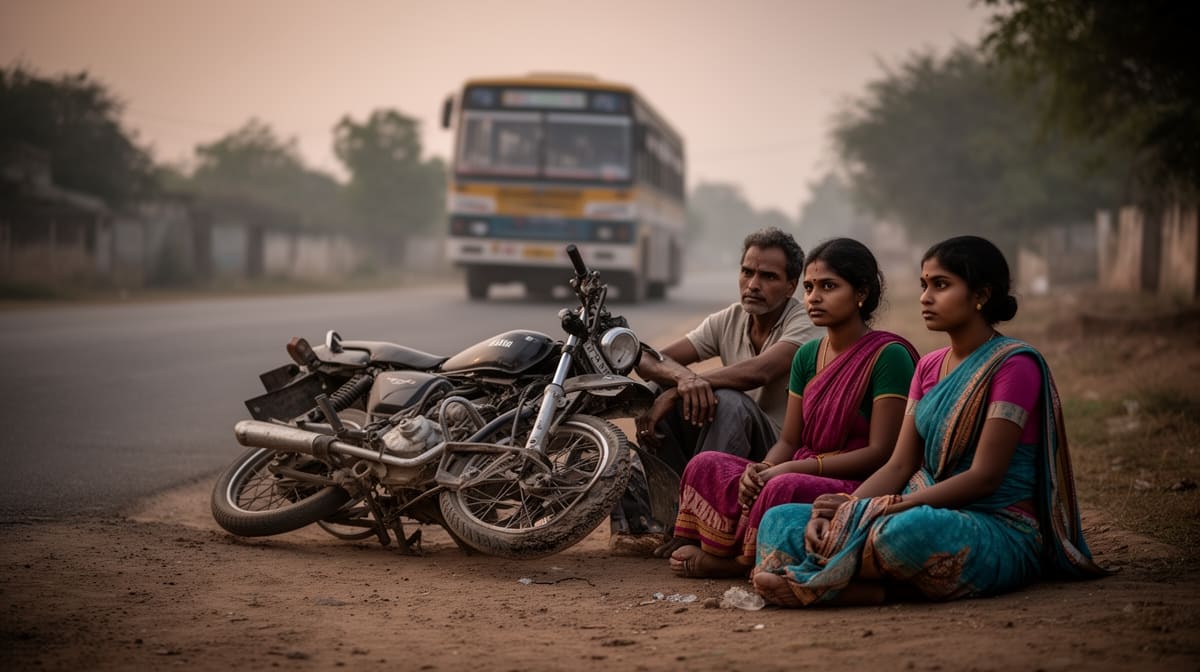
The Madhya Pradesh High Court has clarified a critical principle in motor accident compensation cases: when the deceased is a bachelor, the deduction for personal and living expenses must be 50%, not less. This ruling resolves a recurring dispute in Claims Tribunals and ensures uniform application of the Sarla Verma precedent. The judgment reduces an awarded compensation of Rs.16.4 lakh to Rs.12.73 lakh, emphasizing doctrinal precision over discretionary leniency.
Background & Facts
The Dispute
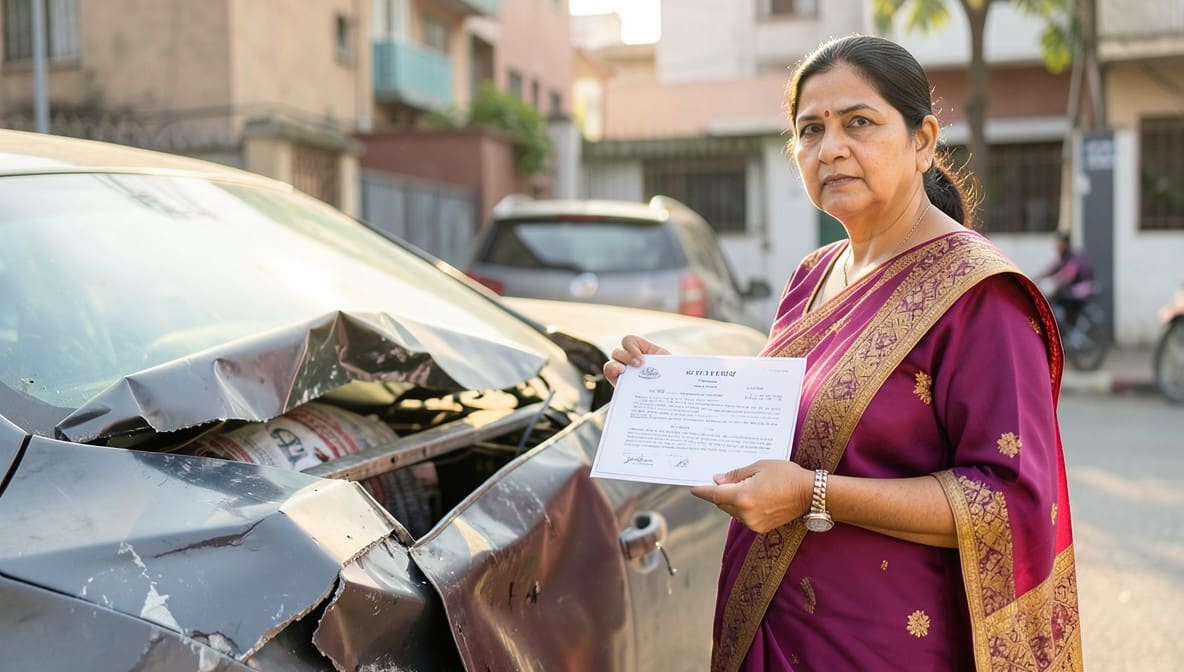
On 03.07.2019, Abhishek, a 28-year-old unmarried man, was riding his motorcycle from village Bhowai to Seondha on the Datia-Seondha Road. Near Atra Bus Stand, he was involved in a head-on collision with another motorcycle allegedly driven rashly and negligently by the driver of vehicle bearing registration number MP32-MG-3965. Abhishek sustained severe head injuries and died at Civil Hospital, Seondha, on the same day.
An FIR was registered on 03.07.2019. Initially, the vehicle number was recorded as MP32-MG-0936, but during investigation, the police corrected the record and identified the actual offending vehicle as MP32-MG-3965. A charge-sheet was filed against the driver of the latter vehicle.
The claimants - parents and siblings of Abhishek - filed Claim Case No. 47/2019 before the Second Motor Accident Claims Tribunal, Seondha, seeking compensation for wrongful death. The appellant, National Insurance Company Ltd., the insurer of the offending vehicle, contested the claim. Respondents No.4 and 5, alleged owners or other parties, did not appear before the Tribunal and were treated as ex parte.
Key Facts
- Date of accident: 03.07.2019
- Date of FIR: 03.07.2019
- Initial vehicle number in FIR: MP32-MG-0936
- Corrected vehicle number in charge-sheet: MP32-MG-3965
- Date of charge-sheet filing: Not specified, but prior to Tribunal proceedings
- Date of Tribunal award: 13.12.2024
- Amount awarded by Tribunal: Rs.16,40,510/-
- Deceased’s age at death: 28 years
- Deceased’s marital status: Bachelor
- Deceased’s occupation: Not explicitly stated, but income assessed at Rs.7,696 per month
- Respondents No.4 and 5: Not served, not present before Tribunal
Procedural History
- 03.07.2019: Accident occurs
- 03.07.2019: FIR lodged
- 13.12.2024: Second Motor Accident Claims Tribunal, Seondha, awards compensation of Rs.16,40,510/-
- 2025: Appeal filed before High Court of Madhya Pradesh, Gwalior (Misc. Appeal No. 2616 of 2025)
- 04.05.2026: High Court delivers judgment
Relief Sought
The appellant-Insurance Company sought:
- Setting aside of the Tribunal’s award of Rs.16,40,510/-
- Reduction in compensation on grounds of:
- Discrepancy in vehicle registration number
- Absence of independent witnesses
- Contributory negligence by deceased (no valid license, riding in middle of road)
- Incorrect dependency ratio (2/3rd instead of 50% for bachelor)
- Overestimated income and excessive multiplier
The Parties' Positions / Positions Before This Court
For the Appellant (Insurance Company)
- Argued that the initial FIR recorded MP32-MG-0936, creating doubt about the identity of the offending vehicle
- Contended that no independent witness examined, making the Tribunal’s finding on negligence unreliable
- Asserted that the deceased was riding without a valid license and in the middle of the road, indicating contributory negligence
- Claimed that for a bachelor, dependency deduction should be 50%, not 33.33% (2/3rd)
- Argued that income assessment of Rs.7,696/month was excessive for the locality
- Sought reduction in future prospects (40%) and multiplier (18)
For the Respondents (Claimants)
- Supported the Tribunal’s findings
- Argued that the corrected vehicle number in the charge-sheet was sufficient to establish liability
- Maintained that the Tribunal correctly appreciated evidence and applied settled legal principles
- Opposed any reduction in compensation
The Legal Issue
The central question was whether, in a claim for compensation arising from the death of a bachelor, the deduction for personal and living expenses must be fixed at 50% as mandated by Sarla Verma v. Delhi Transport Corporation, or whether Tribunals retain discretion to apply a lower percentage.
Arguments Presented
For the Appellant
The appellant relied on Sarla Verma v. Delhi Transport Corporation (2009) 6 SCC 121 to argue that the deduction for personal and living expenses in the case of a deceased bachelor must be 50%. It contended that the Tribunal erred in applying only 33.33% (1/3rd), leading to an inflated compensation. It further argued that the discrepancy in the vehicle number in the FIR and charge-sheet cast doubt on the identity of the offending vehicle, and that the absence of independent witnesses undermined the Tribunal’s finding of negligence. The appellant also challenged the income assessment and the application of 40% future prospects, asserting that the locality and economic conditions warranted a lower figure.
For the Respondent
The respondents defended the Tribunal’s award, asserting that the charge-sheet, which correctly identified MP32-MG-3965 as the offending vehicle, superseded the initial error in the FIR. They argued that the Tribunal had properly evaluated the oral evidence and that the absence of independent witnesses did not invalidate the claim, especially where the police report and medical evidence corroborated the incident. They maintained that the income, multiplier, and future prospects were correctly assessed under National Insurance Co. Ltd. v. Pranay Sethi (2017 ACJ 2700) and Sarla Verma.
The Court's Analysis
The Court undertook a meticulous review of the Tribunal’s reasoning and the evidence on record. It noted that while the initial FIR recorded MP32-MG-0936, the police investigation corrected the error and the charge-sheet clearly identified MP32-MG-3965 as the offending vehicle. The Court held that such a correction, supported by investigation records, does not invalidate the claim. The absence of independent witnesses was deemed insufficient to overturn the Tribunal’s finding, particularly where the FIR, medical reports, and police investigation collectively established the occurrence of the accident and the negligence of the driver.
The Court then turned to the critical issue of dependency deduction. It observed that the Tribunal had deducted only one-third (33.33%) of the deceased’s income for personal and living expenses, relying on an erroneous interpretation of Sarla Verma. The Court emphasized that Sarla Verma lays down a clear, non-discretionary rule: for a deceased bachelor, the deduction must be 50%. The Court stated:
"The deduction towards personal and living expenses in the case of a bachelor must be 50% as per the settled law laid down in Sarla Verma v. Delhi Transport Corporation. The Claims Tribunal erred in applying only 1/3rd, which is contrary to the ratio decidendi of the Supreme Court."
The Court further upheld the Tribunal’s application of 40% future prospects under Pranay Sethi and the multiplier of 18 based on the deceased’s age of 28, as both were in strict conformity with Supreme Court precedents. The income of Rs.7,696 per month was accepted as reasonable given the context.
The Court recalculated the compensation as follows:
- Annual income: Rs.92,352
- Future prospects (40%): Rs.36,941 → Total: Rs.1,29,293
- Deduction for personal expenses (50%): Rs.64,647
- Multiplied by 18: Rs.11,63,646
- Loss of consortium: Rs.80,000 (Rs.40,000 x 2 claimants)
- Loss of estate and funeral expenses: Rs.30,000
- Total: Rs.12,73,646
The Verdict
The appellant’s appeal was partly allowed. The High Court set aside the Tribunal’s award of Rs.16,40,510/- and reduced the compensation to Rs.12,73,646/-. The Court directed that this amount shall carry interest at the rate awarded by the Tribunal from the date of filing of the claim petition until realization. The Insurance Company is entitled to recover any excess amount already deposited with the Tribunal. The judgment is final and binding.
What This Means For Similar Cases
Dependency Ratio for Bachelors Is Fixed at 50%
- Practitioners must now uniformly apply 50% deduction for personal expenses in all claims involving deceased bachelors, regardless of occupation, income level, or family structure
- Any Tribunal award applying less than 50% is legally unsustainable and subject to immediate correction on appeal
- This rule applies irrespective of whether the deceased was employed, self-employed, or unemployed at the time of death
Vehicle Registration Discrepancies Do Not Invalidate Claims
- Minor errors in FIRs, if corrected in the charge-sheet and supported by investigation records, do not create reasonable doubt about liability
- The burden shifts to the insurer to prove that the corrected vehicle was not involved, not to the claimant to prove the initial error was a clerical mistake
- Tribunals must rely on the final investigative record, not preliminary reports
Future Prospects and Multipliers Remain Prescribed by Precedent
- 40% future prospects for deceased under 40 years remains the standard unless exceptional circumstances are shown
- Multiplier of 18 for age 28 is correct under Sarla Verma and cannot be reduced without compelling reasons
- Income assessment must be based on locality and occupation, but must not be arbitrarily lowered without evidence