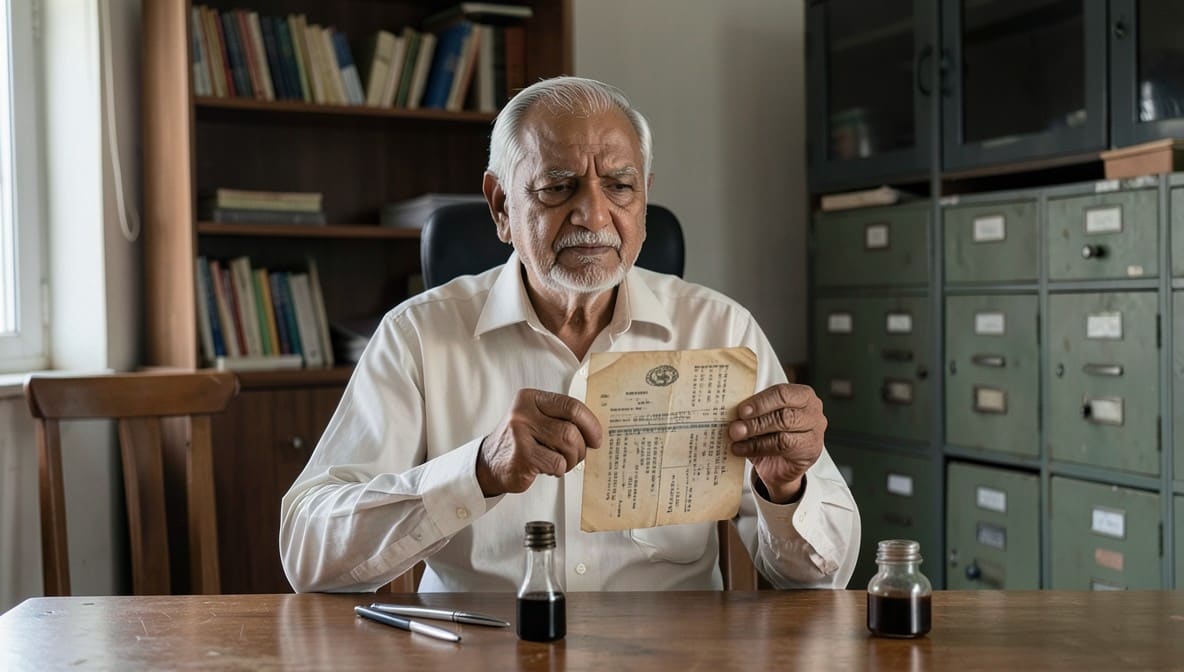
The Kerala High Court has clarified that dismissal from government service on disciplinary grounds does not automatically disqualify an employee from claiming compassionate allowance under Rule 41 of the CCS (Pension) Rules, 1972, if the conduct does not involve moral turpitude, dishonesty, or personal gain. This ruling reinforces the discretionary nature of the proviso to Rule 41 and mandates a case-specific evaluation grounded in established legal parameters.
Background & Facts
The Dispute
The petitioner, V.K. Prabhakara Panicker, a retired Store Keeper Grade II of the Border Roads Organisation (BRO), was removed from service on 25.02.1982 after being accused of wearing a black badge during duty in Bhutan. He was never formally charged with any act of corruption, fraud, or misconduct involving dishonesty or moral turpitude. The removal was based on a presumption that he had participated in a protest by wearing the badge, despite his denial and lack of corroborating evidence. He was denied pension on the ground that he had not completed 20 years of qualifying service and that his removal disqualified him from any pensionary benefits.
Key Facts
- The petitioner was initially appointed on 26.09.1961 and reappointed on a regular basis on 30.04.1968
- He served continuously until his removal on 25.02.1982, totaling over 20 years of service
- His service records (Exhibit P4 and P5) confirm continuous employment from 1961 to 1982
- He was not found guilty of any act involving moral turpitude, dishonesty, or personal gain
- The removal order did not specify any violation of service rules beyond the alleged wearing of a black badge
- The petitioner was informed that his pension was denied because he lacked 20 years of qualifying service
Procedural History
- 25.02.1982: Petitioner removed from service on disciplinary grounds
- 05.11.2009: First formal rejection of pension claim via Ext.P6, citing disciplinary discharge
- 22.10.2024: Kerala High Court, in WP(C) No.14845/2019 (Ext.P1), directed the petitioner to file a representation for compassionate allowance under Rule 41
- 10.11.2024: Petitioner submitted Ext.P2 representation seeking compassionate allowance
- 17.02.2025: Ext.P3 order issued by the 7th Respondent rejecting the claim on two grounds: (i) dismissal forfeits pension, and (ii) petitioner lacked 20 years of qualifying service
- 15.06.2026: Present writ petition (WP(C) No.16072/2025) heard and decided by the Kerala High Court
The Parties' Positions
For the Petitioner
- Argued that his removal was based on a mere presumption without any inquiry or evidence of misconduct
- Contended that wearing a black badge in protest, without any act of insubordination, corruption, or harm to public interest, does not constitute moral turpitude or dishonesty
- Relied on Mahinder Dutt Sharma v. Union of India to assert that compassionate allowance must be evaluated on the nature of the offence, not merely the fact of dismissal
- Highlighted that Rule 49 of the CCS (Pension) Rules, 1972, requires only 10 years of service for pension eligibility, not 20
For the Respondents
- Contended that Rule 41 mandates forfeiture of pension upon dismissal or removal
- Relied on Government of India decision below Rule 41, which bars compassionate allowance if the employee was dishonest
- Argued that the petitioner’s removal on disciplinary grounds automatically disqualified him
- Maintained that the petitioner had not completed 20 years of qualifying service
Relief Sought
The petitioner sought:
- Quashing of Ext.P3 order dated 17.02.2025
- Direction to the 3rd Respondent (Director General, Border Roads) to reconsider his claim for compassionate allowance under Rule 41
- Grant of compassionate allowance not exceeding two-thirds of the pension he would have received had he retired on medical or compensation pension
- Payment of all consequential arrears from the date of retirement
The Legal Issue
Can a government servant dismissed or removed from service without any finding of moral turpitude, dishonesty, or personal gain still be denied compassionate allowance under Rule 41 of the CCS (Pension) Rules, 1972, solely on the ground of dismissal and alleged lack of 20 years of service?
Arguments Presented
For the Petitioner
The petitioner relied on Mahinder Dutt Sharma v. Union of India to argue that Rule 41’s proviso requires a nuanced assessment of the nature of the misconduct. He submitted that the act of wearing a black badge in protest, without any evidence of insubordination, corruption, or harm to public interest, does not fall within any of the five illustrative categories of disqualifying conduct outlined by the Supreme Court. He further contended that the 20-year service requirement was legally incorrect, as Rule 49 of the 1972 Rules mandates only 10 years for pension eligibility, a point already affirmed by this Court in Ext.P1.
For the Respondent
The respondents argued that Rule 41(1) unequivocally mandates forfeiture of pension upon dismissal, and that the proviso is an exception to be granted sparingly. They cited a Government of India decision below Rule 41, which states that dishonesty bars compassionate allowance, and contended that dismissal itself implies serious misconduct. They maintained that the petitioner’s service record did not meet the 20-year threshold, despite the petitioner’s claim of over 20 years of continuous service.
The Court's Analysis
The Court undertook a detailed examination of Rule 41 and the Supreme Court’s judgment in Mahinder Dutt Sharma v. Union of India. It observed that Rule 41(1) provides for forfeiture of pension upon dismissal, but the proviso explicitly empowers the competent authority to grant compassionate allowance if the case is deserving of special consideration. The Court emphasized that the proviso is not a mere formality but a substantive safeguard against arbitrary denial of benefits.
"The determination of a claim based under R.41 of the Pension Rules, 1972, will necessarily have to be sieved through an evaluation based on a series of distinct considerations..."
The Court held that the respondents’ reliance on the Government of India decision regarding dishonesty was misplaced, as no finding of dishonesty, fraud, or moral turpitude had been made against the petitioner. The act of wearing a black badge, even if construed as protest, was not shown to be an act of baseness, depravity, or deceit toward the employer or the public. The Court noted that the removal order contained no details of the alleged misconduct, no inquiry report, and no opportunity of hearing.
Regarding the 20-year service requirement, the Court reiterated its earlier finding in Ext.P1 that Rule 49 of the 1972 Rules requires only 10 years of qualifying service for pension eligibility. The respondents’ reliance on a 20-year threshold was legally unsustainable.
The Court further held that Ext.P3 order was mechanically worded, failed to apply the Mahinder Dutt Sharma parameters, and did not exercise the discretionary power under the proviso. The order was therefore vitiated by non-application of mind and legal error.
The Verdict
The writ petition was allowed. The Court set aside Ext.P3 order dated 17.02.2025. The 3rd Respondent, Director General, Border Roads, was directed to reconsider the petitioner’s claim for compassionate allowance under Rule 41 of the CCS (Pension) Rules, 1972, applying the five parameters laid down in Mahinder Dutt Sharma v. Union of India. A decision must be taken within three months from the date of receipt of this judgment. The petitioner’s service of over 20 years from 26.09.1961 to 25.02.1982 qualifies him for pension eligibility under Rule 49. Compassionate allowance, if granted, shall not exceed two-thirds of the pension admissible on compensation pension, and shall be calculated from the date of retirement.
What This Means For Similar Cases
Compassionate Allowance Is Not Automatic, But Also Not Automatic
- Practitioners must now argue that dismissal alone is insufficient to deny compassionate allowance - the nature of the misconduct must be evaluated under the Mahinder Dutt Sharma criteria
- Cases involving protest, minor insubordination, or administrative errors without dishonesty or moral turpitude are now clearly eligible for reconsideration
- Authorities must record reasons applying each of the five illustrative parameters before rejecting a Rule 41 claim
Service Duration Must Be Calculated Under Correct Rule
- For employees governed by the 1972 Rules, Rule 49 mandates only 10 years of service for pension eligibility - not 20
- Any denial based on a 20-year threshold is legally invalid unless the employee is governed by amended rules
- Service records must be meticulously verified, including pre-regularization and contractual periods, if continuous
Procedural Fairness in Disciplinary Proceedings Is Critical
- Removal orders lacking inquiry reports, chargesheets, or opportunity of hearing cannot be used to bar compassionate allowance
- Courts will scrutinize whether the dismissal was procedurally fair and substantively justified
- Petitioners may now invoke Mahinder Dutt Sharma to challenge blanket denials based on disciplinary status alone