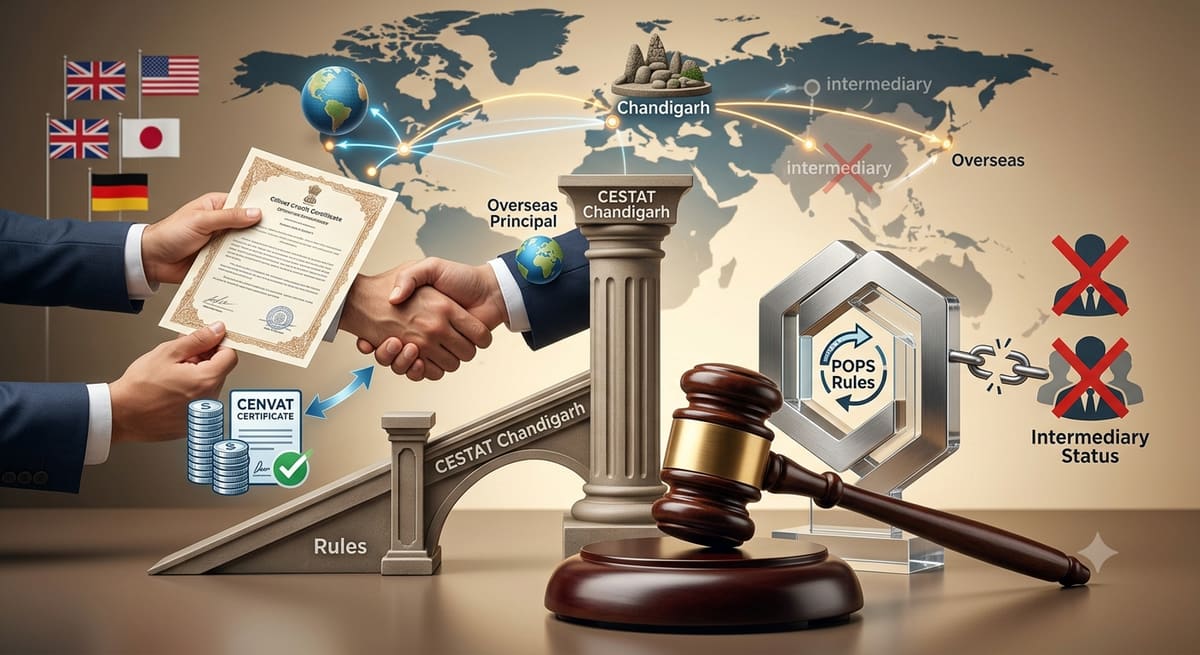
The CESTAT Chandigarh has definitively clarified that the phrase 'used outside India' under the Export of Service Rules, 2005 does not require physical performance of services abroad, but rather the effective enjoyment of services by an overseas recipient. This ruling resolves long-standing ambiguity in service tax rebate claims for Indian-based call centers serving foreign clients.
Background & Facts
The Dispute
The respondent, M/s BA Call Centre India Pvt. Ltd., provided call center support services to British Airways UK (BA UK) under a Masters Services Agreement dated 20.11.2007. The services were rendered from Gurgaon, India, to BA UK’s customers across Asia Pacific, including India, Dubai, Sydney, and Singapore. The consideration was paid by BA UK in convertible foreign exchange. The Revenue denied rebate claims under Rule 5 of the Export of Service Rules, 2005, arguing that the services were 'used' in India because end-customers were located there.
Procedural History
- 2008 - 2009: Respondent discharged service tax and filed rebate claims for services rendered.
- 2010: Deputy Commissioner rejected rebate, relying on All India Federation of Practitioners (2007) and asserting that 'use' occurred in India.
- 2012: Commissioner (Appeals) remanded the matter, directing reconsideration per CBEC Circular No. 111/05/2009.
- 2016: Assistant Commissioner again rejected claim, insisting 'use' must be outside India.
- 2016: Commissioner (Appeals) allowed the appeal, holding services qualified as exports.
- 2026: Revenue appealed to CESTAT Chandigarh.
Relief Sought
The respondent sought confirmation that its call center services met the criteria for export under Rule 3(2) of the Export of Service Rules, 2005, entitling it to rebate of service tax paid.
The Legal Issue
The central question was whether Rule 3(2) of the Export of Service Rules, 2005 requires the service to be physically performed outside India, or whether 'used outside India' refers to the place of effective use and enjoyment by the overseas recipient.
Arguments Presented
For the Appellant
The Revenue contended that the term 'used outside India' under Rule 3(2) must be interpreted literally, meaning the service must be consumed or performed beyond Indian borders. It relied on the All India Federation of Practitioners case to argue that where end-customers are in India, the service is deemed used in India. It further argued that Circulars No. 111/2009 and No. 141/2011 were merely interpretative and could not override statutory language. The Revenue also distinguished prior Tribunal decisions as factually inapposite.
For the Respondent
The respondent argued that 'used outside India' must be understood in context of the recipient’s location and the nature of the service. It cited Circulars No. 111/2009 and No. 141/2011, which explicitly state that 'use' means 'effective use and enjoyment'. It relied on multiple Tribunal precedents - Paul Merchants Ltd., Vodafone Essar, Microsoft India - and the Supreme Court’s affirmation in Commissioner of Service Tax-III v. Vodafone India Ltd. (2025). It emphasized that BA UK, the contractual recipient and payer, was located abroad, making it the sole beneficiary of the service.
The Court's Analysis
The Tribunal conducted a purposive interpretation of Rule 3(2), rejecting a narrow, territorial reading of 'used outside India'. It held that the phrase must be read in conjunction with the Department’s own clarificatory Circulars, which explicitly define 'use' as the 'effective use and enjoyment' of the service. The Court noted that Circulars issued under Section 119 of the Income Tax Act, 1961, carry binding weight unless ultra vires, and neither Circular was challenged in law.
"The recipient of service is the person at whose instance and expense the service is provided, whether or not he is the beneficiary of the service."
The Court relied on the Larger Bench decision in Arcelor Mittal Stainless (I) Pvt. Ltd., which established that the recipient is the party contracting for and paying for the service. In this case, BA UK was the sole contracting party, paid in foreign exchange, and directed the nature and scope of services. The fact that end-customers were in India was irrelevant, as the respondent had no direct contractual or financial relationship with them.
The Tribunal further held that the issue was no longer res integra, as it had previously decided in favor of the respondent for overlapping periods, and the Revenue had not appealed or sought a stay. The Supreme Court’s affirmation in Vodafone India Ltd. reinforced that service tax jurisprudence must align with the economic reality of cross-border transactions.
The Verdict
The respondent won. The Court held that call center services provided from India to an overseas recipient, where payment is received in convertible foreign exchange and the effective use and enjoyment accrue abroad, qualify as export of services under Rule 3(2). The Revenue’s appeal was dismissed, upholding the rebate claim.
What This Means For Similar Cases
Effective Use Trumps Physical Location
- Practitioners must now focus on the contractual recipient and the point of economic benefit, not the end-user’s location.
- Service providers to foreign MNCs (e.g., BPOs, ITES, tech support) can claim export status even if services impact Indian customers, provided the payer and controller are overseas.
Circulars Are Binding Interpretative Tools
- Departmental Circulars clarifying ambiguous statutory terms (e.g., 'used outside India') are binding unless declared invalid.
- Tax authorities cannot ignore such circulars to deny benefits without judicial override.
Precedent Binding Unless Stayed
- Where a Tribunal has previously ruled in favor of a taxpayer on identical facts, and the Revenue has not appealed or obtained a stay, subsequent claims on the same issue are protected by the doctrine of consistency.
- Practitioners should cite prior favorable orders as res judicata in similar cases.