The Gauhati High Court has clarified that the post of Secretary in the Nagaland Legislative Assembly Secretariat is a selection post, not subject to mandatory promotion through a Departmental Promotion Committee. This ruling resolves a long-standing dispute over procedural fairness in senior bureaucratic appointments and affirms the primacy of statutory appointment mechanisms over automatic seniority-based promotion.
Background & Facts
The Dispute
The petitioner, Smti. Jenny Ndang, was appointed as Assistant Research Officer (Class-II Gazetted) on 02.09.1996 under the general cadre of the Nagaland Legislative Assembly Secretariat. The respondent no.4, Smti. Khruohituonuo Rio, was appointed as Assistant Transport Officer (Class-II Gazetted) on 03.09.1996 under a separate transport cadre. Both appointments were made pursuant to the same advertisement dated 22.12.1995. Initially, the service rules did not distinguish between cadres for these posts. However, the Nagaland Legislative Assembly Secretariat (Recruitment and Conditions of Service) Rules, 1999 (1999 Rules), introduced a cadre distinction under the Second Schedule, placing the petitioner in the general cadre and the respondent in the transport cadre.
Key Facts
- The petitioner was promoted five times in the general cadre, reaching the substantive rank of Additional Secretary by notification dated 30.11.2019.
- The respondent’s post was upgraded five times in the transport cadre, culminating in her holding the rank of Additional Secretary (Transport) by notification dated 30.11.2019.
- On 01.11.2021, the respondent was irregularly encadred into the general cadre and regularized as Additional Secretary, which was quashed by this Court in WP(C) No. 323/2021 on 12.05.2022.
- Within six days of that judgment, the 1999 Rules were amended by the Nagaland Legislative Assembly Secretariat (Recruitment and Conditions of Service) 3rd Amendment Rules, 2022, effective 18.05.2022, removing cadre distinctions above the rank of Joint Secretary.
- The 3rd Amendment Rules revised the Third Schedule to allow appointment to Secretary from "Additional Secretary or equivalent in the Assembly Secretariat" with minimum two years’ service, subject to the appointing authority’s discretion.
- On 05.07.2022, the respondent was granted temporary officiating charge of Secretary, which was challenged by the petitioner in WP(C) No. 144/2022. An interim stay was granted on 22.07.2022 but vacated on 12.08.2022. The writ appeal (WA No. 28/2022) was dismissed on 03.09.2024 with a direction to fill the post "in accordance with law."
- On 09.03.2026, the respondent was regularized as Secretary with retrospective effect from 05.07.2022, without a DPC. This was superseded by a new notification dated 25.03.2026, promoting her with retrospective effect from 05.03.2022, again without a DPC.
- The petitioner, who had been eligible for consideration since 2019, was never formally considered for promotion.
Procedural History
- 02.09.1996: Petitioner appointed as Assistant Research Officer (General Cadre)
- 03.09.1996: Respondent appointed as Assistant Transport Officer (Transport Cadre)
- 30.11.2019: Both promoted to Additional Secretary (petitioner substantively; respondent via post upgradation)
- 01.11.2021: Respondent irregularly encadred into general cadre
- 12.05.2022: WP(C) No. 323/2021 quashed encadrement
- 18.05.2022: 3rd Amendment Rules notified, removing cadre distinction
- 05.07.2022: Respondent granted officiating charge of Secretary
- 22.07.2022: Interim stay granted in WP(C) No. 144/2022
- 12.08.2022: Interim stay vacated
- 03.09.2024: WA No. 28/2022 dismissed with direction to fill post "in accordance with law"
- 09.03.2026: Notification issued regularizing respondent as Secretary (retrospective from 05.07.2022)
- 25.03.2026: Superseding notification issued promoting respondent as Secretary (retrospective from 05.03.2022)
- 08.05.2026: Present writ petition dismissed
The Parties' Positions
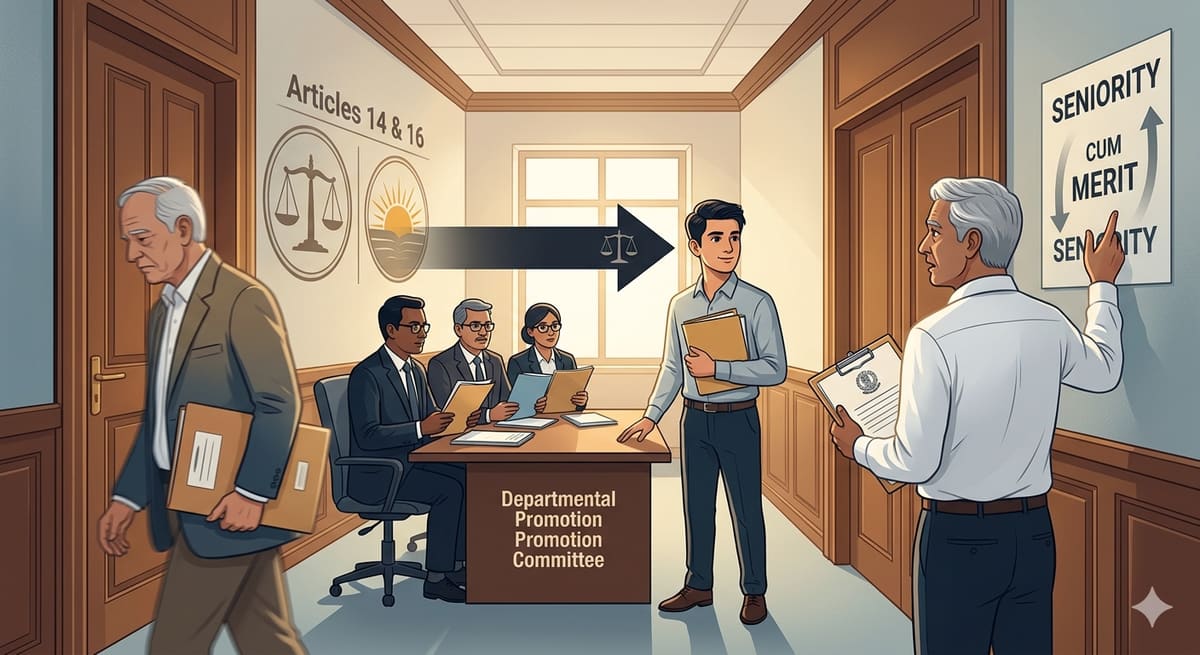
Petitioner: Argued that promotion to Secretary requires a DPC under Rule 15 of the 1999 Rules (as amended), that she was senior and eligible since 2019, and that the respondent’s promotion without DPC was arbitrary, violative of Articles 14 and 16, and contrary to the Court’s earlier direction in WA No. 28/2022.
Respondents 1-3: Contended that Rule 12(1) of the 1999 Rules (as amended) governs appointment to Secretary, making it a selection post by the Governor on recommendation of the Speaker and consultation with the Chief Minister, and that DPC provisions under Rule 15 are inapplicable to such posts.
Respondent no.4: Added that the writ petition is barred by res judicata, non-joinder of necessary parties (Governor and Chief Minister), and that the post is inherently a selection post requiring discretion, not seniority.
Relief Sought
The petitioner sought quashing of the notification dated 25.03.2026, a direction to constitute a DPC for promotion to Secretary, and inclusion of her name in the zone of consideration with seniority over the respondent.
The Legal Issue
The central question was whether appointment to the post of Secretary, Nagaland Legislative Assembly Secretariat, requires a Departmental Promotion Committee under Rule 15 of the 1999 Rules (as amended), or whether it is governed exclusively by Rule 12(1) as a selection post determined by the Governor on recommendation of the Speaker and consultation with the Chief Minister.
Arguments Presented
For the Petitioner
The petitioner relied on Punjab State Power Corporation Ltd. v. Bal Krishan Sharma, Sanjay K. Sinha-II v. State of Bihar, and Ravindra Kumar Shrivastava v. State of Madhya Pradesh to argue that promotion to any Gazetted post above a certain level must follow DPC procedures to ensure fairness, transparency, and avoidance of arbitrariness. She contended that Rule 15, which applies to "all cases of recruitment by promotion and selection," is unambiguous and includes the post of Secretary. She further argued that the retrospective promotion of the respondent without DPC violated the principles of natural justice and equal opportunity under Articles 14 and 16, especially since she had been eligible since 2019 and the respondent only became eligible after the 2022 amendment.
For the Respondent
The respondents relied on Hardeep Singh v. State of Punjab and Commissioner of Income Tax v. Hindustan Bulk Carriers to argue that Rule 12(1) is a specific, exhaustive provision governing appointment to Secretary, while Rule 15 governs promotions to lower posts. They contended that if Rule 15 were applied to Secretary, the DPC would be chaired by the Secretary himself - an impossibility - and would consist only of junior officers, rendering the process absurd. They emphasized that the phrase "if deemed fit by the appointing authority" in the Third Schedule confirms the discretionary, selection-based nature of the post. The respondents also argued that the 3rd Amendment Rules removed cadre distinctions, placing both parties on equal footing, and that seniority alone cannot override the Governor’s discretion under Rule 12(1).
The Court's Analysis
The Court undertook a detailed textual and structural analysis of the 1999 Rules, particularly Rules 12 and 15. It noted that Rule 12(1), as amended in 2022, explicitly vests the power to appoint the Secretary in the Governor, acting on the recommendation of the Speaker and in consultation with the Chief Minister. This is a direct, non-delegable constitutional function under Article 187(3). In contrast, Rule 15 governs promotions for posts below Secretary, including Joint Secretary and Deputy Secretary.
"It cannot be envisaged that persons in the rank of the Addl. Secretary or lower than Addl. Secretary would constitute a DPC for appointment of the Secretary."
The Court observed that the composition of the DPC under Rule 15 includes the Secretary as Chairman, making it logically impossible for the DPC to function if the Secretary’s own promotion is under consideration. This structural inconsistency, the Court held, demonstrates that Rule 15 was never intended to apply to the Secretary’s appointment.
The Court further applied the principle of harmonious construction from Hardeep Singh, holding that accepting the petitioner’s interpretation would render Rule 12(1) redundant and otiose - a result prohibited under statutory interpretation. The Court emphasized that the 3rd Amendment Rules were deliberately crafted to remove cadre barriers and to allow the Governor to select the most suitable candidate from among Additional Secretaries or equivalents, irrespective of cadre origin.
The Court also rejected the petitioner’s reliance on precedents, distinguishing them on facts: those cases involved promotions within a uniform cadre structure, whereas here, the respondent’s eligibility arose only after a statutory amendment that equalized the field. The Court found no arbitrariness in the promotion, noting that the respondent had served in equivalent grade since 2019 and met the minimum service requirement under the amended rules.
The Verdict
The writ petition was dismissed. The Court held that the appointment of Smti. Khruohituonuo Rio as Secretary, Nagaland Legislative Assembly Secretariat, by notification dated 25.03.2026, was valid, lawful, and in accordance with Rule 12(1) of the 1999 Rules (as amended). The promotion, with retrospective effect from 05.03.2022, was upheld. The petitioner’s claim for inclusion in a DPC process was rejected. The parties were directed to bear their own costs.
What This Means For Similar Cases
Selection Posts Override DPC Requirements
- Practitioners must now distinguish between posts governed by statutory selection mechanisms (e.g., Secretary, Chief Secretary, Commissioner) and those governed by promotion rules.
- Where the statute explicitly vests appointment power in a constitutional authority (Governor, President, Speaker) with discretionary language (e.g., "if deemed fit"), DPC procedures are inapplicable.
- Any challenge based on absence of DPC must be preceded by a careful reading of the specific appointment clause.
Cadre Amendments Can Reset Seniority Calculations
- When service rules are amended to remove cadre distinctions, eligibility for higher posts is recalibrated based on the new framework.
- Seniority claims based on pre-amendment cadre status will not prevail if the post is a selection one.
- Petitioners must demonstrate that the amendment was retrospective in effect and mala fide to challenge such promotions.
Judicial Deference to Constitutional Appointments
- Courts will not interfere with appointments made under Article 187(3) unless there is clear violation of procedure or mala fide intent.
- The phrase "in consultation with" in constitutional appointments does not imply mandatory consensus, but procedural compliance.
- The Court’s refusal to discuss cited precedents signals that factual context - especially statutory structure - trumps general principles of fairness in selection posts.