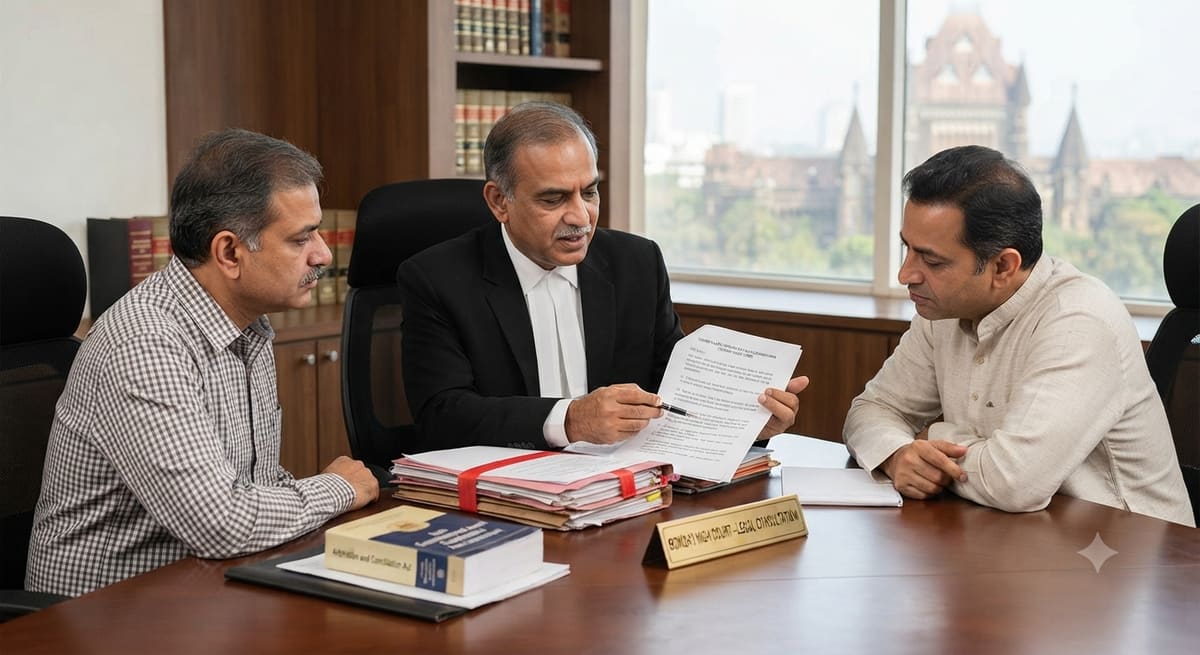
The Bombay High Court has clarified a critical limit on revisional powers under the Bombay Tenancy and Agricultural Lands Act, 1948: a Revenue Tribunal cannot bypass the appellate stage and directly adjudicate the merits of a tenancy dispute, even if it finds the remand order flawed. This ruling reinforces the structural integrity of statutory adjudication and protects litigants’ right to a full appellate hearing.
Background & Facts
The Dispute
The dispute arises under Section 32G of the Bombay Tenancy and Agricultural Lands Act, 1948, concerning the purchase rights of a tenant over agricultural land. The petitioners, Shabnoor Sulochana Marotrao Ganeshkar and another, are the landowners who sought to purchase the tenant’s share. The respondents, Ayub Pathan and others, are the tenants claiming protection under the Act.
Key Facts
- On 31 March 1962, the tenant’s name was deleted from revenue records for Survey Nos. 195, 198, 199, and 200, and mutation was made in favor of the landlady.
- Consolidation proceedings later merged these surveys into a new Gat No. 237, along with Gat No. 239.
- Proceedings under Section 32G were initiated for Gat Nos. 237 and 239.
- On 17 October 2005, the Tahsildar determined the purchase price for the tenant’s half-share and directed issuance of a certificate under Section 32M.
- The petitioners filed Tenancy Appeal No. 29 of 2005 before the Appellate Authority, challenging the Tahsildar’s order.
Procedural History
- 17 October 2005: Tahsildar passes order determining purchase price and directing certificate issuance under Section 32M.
- 26 December 2011: Appellate Authority sets aside the Tahsildar’s order and remands the matter for fresh consideration, without adjudicating the merits.
- 2012: Respondents file Tenancy Revision Application No. P/II/2 of 2012 before the Maharashtra Revenue Tribunal, challenging the remand order.
- 2017: Tribunal quashes the remand order and directly restores the Tahsildar’s order, deciding the dispute on merits.
- 2017: Petitioners file Writ Petition No. 10154 of 2017 under Article 227 of the Constitution before the Bombay High Court.
- 15 June 2026: High Court delivers judgment.
The Parties' Positions
Petitioners (Landowners): Argue that the Tribunal exceeded its revisional jurisdiction by deciding the merits of the case. They contend that since the Appellate Authority never heard the appeal on merits, the Tribunal had no basis to substitute its own decision. The statutory hierarchy requires the appellate forum to decide first.
Respondents (Tenants): Argue that the Tribunal acted efficiently to prevent prolonged litigation. They assert that the record was complete and the Tahsildar’s order was legally sound. They also contend that the petitioners have since transferred the land, thereby losing locus standi.
Relief Sought
The petitioners sought quashing of the Tribunal’s order dated 2017, restoration of the Appellate Authority’s remand order, and direction for the Appellate Authority to decide the appeal on merits. They also opposed the respondents’ claim of transfer of land, asserting that the entire property was not sold.
The Legal Issue
Can a Revenue Tribunal, while exercising revisional jurisdiction under the Bombay Tenancy and Agricultural Lands Act, 1948, directly decide the merits of a tenancy dispute after setting aside a remand order issued by the Appellate Authority, thereby bypassing the statutory appellate stage?
Arguments Presented
For the Petitioner
Learned counsel for the petitioners submitted that revisional jurisdiction under Section 227 of the Constitution and the statutory framework of the Tenancy Act is supervisory, not appellate. The Appellate Authority had not yet adjudicated the dispute on merits; it had merely remanded the matter. The Tribunal, by restoring the Tahsildar’s order, effectively became the first appellate forum, depriving the petitioners of their statutory right to challenge findings before a higher authority. Reliance was placed on the principle that statutory forums must be respected in sequence, and that bypassing an appellate stage violates natural justice and legislative intent.
For the Respondent
Learned counsel for the respondents argued that the Tribunal had access to the complete record and had thoroughly examined the revenue entries, Section 32G proceedings, and the Tahsildar’s order. They contended that remanding the matter again would cause undue delay in a dispute spanning over six decades. They further submitted that the Tribunal’s intervention was justified to achieve justice and prevent abuse of process. Additionally, they raised a preliminary objection regarding the petitioners’ locus standi, alleging transfer of the land to a third party.
The Court's Analysis
The Court emphasized that the statutory scheme under the Bombay Tenancy and Agricultural Lands Act, 1948, establishes a clear hierarchy: original authority → appellate authority → revisional authority. Each stage has a distinct function. The Appellate Authority’s role is to review findings of fact and law. The Revisional Authority’s role is to correct jurisdictional errors or patent illegality, not to substitute its own findings.
"A statutory appeal provides an opportunity to the parties to challenge findings, and obtain evaluation by the appellate forum. If that stage is bypassed, the parties lose safeguard created by the legislature."
The Court held that even if the remand order was erroneous, the Tribunal’s remedy was to restore the appeal to the Appellate Authority for fresh adjudication - not to decide the dispute itself. The Tribunal’s action effectively converted a revision into an appeal, which is impermissible. The Court noted that the Appellate Authority had not recorded any findings on the merits, leaving no appellate determination for the Tribunal to review.
The Court further rejected the respondents’ argument that efficiency justifies bypassing statutory procedure. "The ends of justice cannot be achieved by violating the means prescribed by law," the Court observed. The legislative design of layered adjudication exists precisely to ensure fairness, even at the cost of time.
Regarding the respondents’ claim of land transfer, the Court found no affidavit or documentary evidence on record. The petitioners contested the claim, stating only a portion of the land was involved. The Court held that such allegations must be raised before the Appellate Authority, which is the proper forum to examine evidence of transfer and its impact on tenancy rights.
The Verdict
The petition succeeded. The Bombay High Court quashed and set aside the Maharashtra Revenue Tribunal’s order dated 2017. Tenancy Appeal No. 29 of 2005 was restored to the file of the Appellate Authority for fresh adjudication on merits. The Sub Divisional Officer, Maval Division, Pune, was directed to decide the appeal independently, without being influenced by the Tribunal’s observations. The respondents were permitted to file documents regarding alleged land transfer before the Appellate Authority. The Appellate Authority was directed to dispose of the appeal within three months from the date of appearance of the parties. The parties were directed to appear on 29 June 2026 at 11:00 a.m. for early hearing. All contentions on the merits of the tenancy dispute were expressly kept open for determination by the Appellate Authority.
What This Means For Similar Cases
Revisional Powers Are Supervisory, Not Appellate
- Practitioners must argue that any revisional authority exceeding its supervisory role by deciding merits constitutes a jurisdictional error.
- A remand order cannot be treated as a final order ripe for appellate review by the revisional forum.
- The mere fact that the record is complete does not justify bypassing the appellate stage.
Statutory Hierarchy Cannot Be Circumvented for Efficiency
- Courts will not permit procedural shortcuts, even in long-pending disputes.
- Delay, however long, cannot override the statutory right to a full appellate hearing.
- The principle of audi alteram partem requires that each statutory forum be given its due role.
Transfer of Property Must Be Proved Before Competent Forum
- Allegations of transfer of property during pendency of litigation must be substantiated by affidavit or documentary evidence.
- Such issues are not for writ courts to decide on unverified claims.
- The appropriate forum for adjudicating transfer-related questions is the original or appellate authority under the statute.