The Customs, Excise and Service Tax Appellate Tribunal (CESTAT) Kolkata has delivered a significant ruling clarifying the application of the reverse charge mechanism under the Finance Act, 1994 for manpower supply services. The judgment decisively rejects revenue demands based solely on Form 26AS data and affirms that service tax liability cannot be imposed on individual service providers when the recipient is a body corporate. This decision reinforces statutory compliance and curbs arbitrary tax assessments.
Background & Facts
The Dispute
The appellant, M/s. Mofijul Ali, a proprietary firm engaged in manpower recruitment and supply services, was assessed for alleged short-payment of service tax amounting to Rs. 11,69,344 for the financial year 2016-17. The department alleged suppression of taxable turnover by comparing the appellant’s ST-3 returns with income tax data from Form 26AS and ITR filings. The Adjudicating Authority confirmed the demand, which was upheld by the Commissioner (Appeals). The appellant challenged this before CESTAT.
Key Facts
- The appellant was registered under Service Tax with Registration No. AZZPA9323JSD001.
- The appellant rendered services under three work orders during FY 2016-17:
- Work Order No. GIL/FY16-17/G-262/MANPOWER-OPGW dated 05.04.2016: Value Rs. 57,83,862
- Work Order No. GIL/G-289 & 290/OPGW/002 dated 01.05.2016: Value Rs. 3,79,033
- Work Order No. GIL/G-324/STR/001 dated 01.11.2016: Value Rs. 52,59,375
- Total turnover declared in ST-3: Rs. 36,26,640
- Total income as per Form 26AS: Rs. 99,23,245
- Total income as per ITR: Rs. 1,14,22,270
- Differential demand calculated: Rs. 11,69,344
- The appellant paid service tax of Rs. 7,88,907 (including SBC and KKC) through four challans dated 29.06.2017 and 18.07.2017.
- The appellant commenced operations in FY 2016-17.
Procedural History
- 04.04.2025: Order-in-Appeal No. 18/SLG-ST/2025-26 passed by Commissioner of CGST & C.Ex., Siliguri confirming demand of Rs. 11,69,344.
- 2025: Appeal filed before Commissioner (Appeals), dismissed.
- 12.06.2026: Hearing held before CESTAT, Eastern Zonal Bench, Kolkata.
- 15.06.2026: Final Order No. 75691/2026 passed by CESTAT.
The Parties' Positions
For the Appellant
- Argued that services under Work Order No. GIL/FY16-17/G-262/MANPOWER-OPGW were purely manpower supply services under direct supervision of Gammon India Limited, a body corporate.
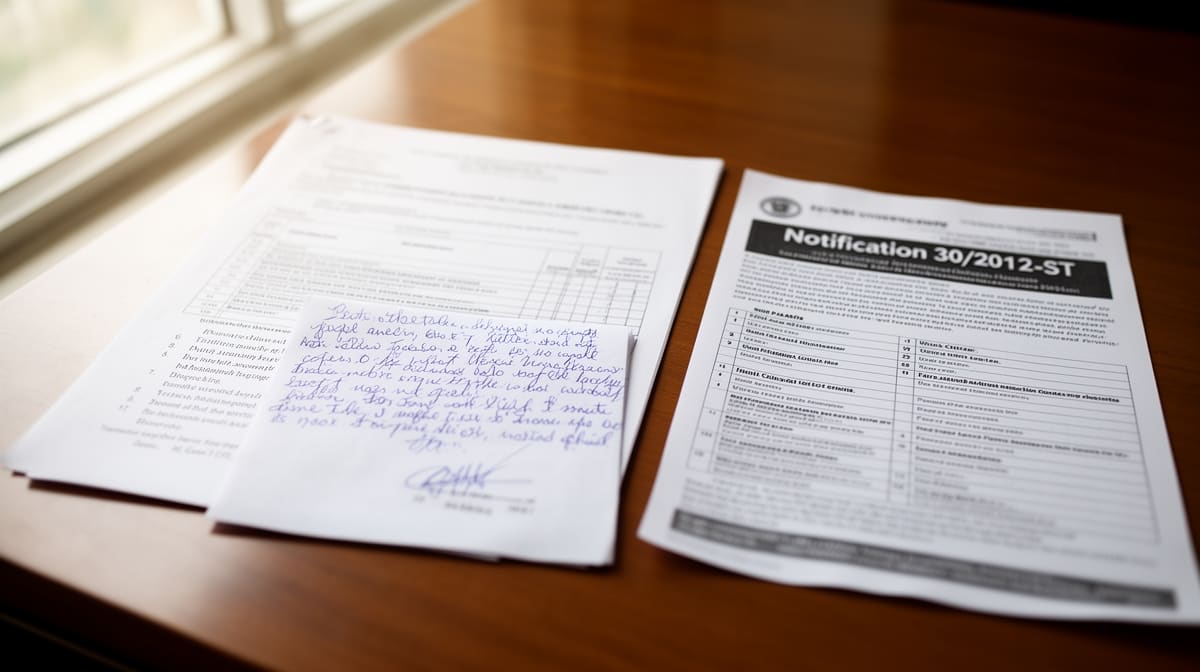
- Relied on Rule 2(g) of the Service Tax Rules, 1994 read with Notification No. 30/2012-ST dated 20.06.2012, which places service tax liability on the recipient under reverse charge when the provider is an individual and recipient is a body corporate.
- Contended that no service tax was charged or collected by the appellant, and therefore no liability arose on him.
- Asserted entitlement to small service provider exemption under Notification No. 33/2012-ST for the second work order (value Rs. 3,79,033), as threshold limit of Rs. 10,00,000 was not exceeded when reverse charge amounts are excluded.
- Demonstrated payment of Rs. 7,88,907 for the third work order through challans, rendering the demand of Rs. 2,44,910 as double taxation.
- Argued that the Show Cause Notice (SCN) issued on 16.10.2020 was barred by limitation as the department relied solely on Form 26AS and ITR data without independent verification or evidence of suppression.
- Cited precedents: M/s. Munna Construction, M/s. Arya Logistics, M/s. Balajee Machinery, and Tabassum Enterprises.
For the Respondent
- Contended that the appellant failed to disclose full receipts in ST-3 returns.
- Justified the demand as based on verification of Form 26AS and ITR data.
- Asserted that the appellant had not provided sufficient documentary evidence to rebut the differential.
- Maintained that the department had extended benefits where documents were furnished.
Relief Sought
The appellant sought:
- Setting aside of the entire demand of Rs. 11,69,344.
- Cancellation of interest and penalty under Sections 75 and 78 of the Finance Act, 1994.
- Declaration that the demand is time-barred.
- Consequential relief as per law.
The Legal Issue
The central question was whether service tax liability for manpower supply services rendered by an individual to a body corporate falls on the service provider or the recipient under the reverse charge mechanism, and whether a demand based solely on Form 26AS data, without independent corroboration of taxable service, can invoke the extended period of limitation under Section 73(1) of the Finance Act, 1994.
Arguments Presented
For the Appellant
The appellant relied on Rule 2(g) of the Service Tax Rules, 1994, as amended by Notification No. 30/2012-ST, which explicitly places the liability to pay service tax on the recipient of manpower supply services when the provider is an individual and the recipient is a body corporate. The appellant submitted copies of work orders and invoices showing no service tax charged, and established that Gammon India Limited exercised complete control over the deployed personnel. The appellant further demonstrated that the second work order fell within the Rs. 10,00,000 threshold exemption, and that the third work order’s tax liability had already been discharged via challans. The appellant argued that the SCN was issued beyond the normal limitation period and that the department’s reliance on Form 26AS data, without verifying the nature of receipts or service rendition, could not constitute suppression under Section 73(1). Precedents from CESTAT Kolkata, Ahmedabad, and Allahabad were cited to support the proposition that mechanical reliance on income tax data is legally unsustainable.
For the Respondent
The respondent contended that the appellant’s ST-3 returns understated turnover, necessitating verification through Form 26AS and ITR. The department argued that the appellant had not fully disclosed all receipts and that the differential was therefore valid. The respondent maintained that the appellant had access to the statutory framework but failed to comply, and that the department had acted reasonably in relying on available data. No specific statutory or judicial authority was cited to rebut the appellant’s reliance on the reverse charge mechanism or the limitation argument.
The Court's Analysis
The Tribunal undertook a meticulous review of the documentary evidence, including the work orders, invoices, and challans. It found that the nature of services under Work Order No. GIL/FY16-17/G-262/MANPOWER-OPGW was unequivocally that of manpower supply under the direct supervision of Gammon India Limited, with no responsibility for output or result. This squarely brought the transaction within the ambit of Rule 2(g) and Notification No. 30/2012-ST.
"The Service Tax liability is on the recipient of the service and not on the appellant. From the Invoice raised by the appellant, it is clear that he has neither charged nor received any Service Tax from the recipient."
The Tribunal held that the department’s failure to appreciate this statutory framework rendered the demand of Rs. 8,67,579 legally unsustainable.
Regarding the second work order, the Tribunal noted that the appellant’s aggregate turnover for FY 2016-17 was Rs. 1,14,22,270, but that only Rs. 76,32,895 (excluding reverse charge services) was subject to service tax. Since the threshold exemption of Rs. 10,00,000 applied to services on which the provider is liable, and reverse charge services are excluded from this computation, the demand of Rs. 56,855 was set aside.
For the third work order, the Tribunal examined the challans totaling Rs. 7,88,907, which included Rs. 2,44,910 corresponding to the disputed amount. The department had already appropriated Rs. 2,94,809, which exceeded the amount paid. The Tribunal concluded that the demand of Rs. 2,44,910 constituted double taxation and was legally untenable.
On the issue of limitation, the Tribunal emphasized that Section 73(1) permits invocation of the extended period only where there is suppression, wilful misstatement, or fraud. The department had not conducted any audit, scrutiny, or independent verification. The SCN was issued solely on the basis of Form 26AS data, which the Tribunal held is not a statutory document for determining service tax liability.
"Form No. 26AS is maintained on cash/receipt basis by the Income Tax Department for the purpose of tax deducted at source, etc. being the relevant data for Income Tax. Whereas under the Service Tax provisions, the service tax is chargeable on mercantile basis (accrual basis) on the service provided whether the value of such service is received or not."
The Tribunal relied on its own decision in Tabassum Enterprises and other precedents to hold that mechanical reliance on income tax data cannot establish suppression. The appellant had filed ST-3 returns regularly, and the department had all information within its knowledge. Therefore, the extended period was not invocable, and the demand was barred by limitation.
The Verdict
The appeal was allowed in full. The Tribunal set aside the entire demand of Rs. 11,69,344, along with interest and penalty, on merits and on grounds of limitation. The appellant is entitled to consequential relief as per law. The order dated 04.04.2025 was quashed, and the appellant’s tax compliance for FY 2016-17 was deemed complete.
What This Means For Similar Cases
Reverse Charge Liability Cannot Be Ignored
- Practitioners must verify the nature of service recipient before assessing liability under manpower supply.
- If the recipient is a body corporate, service tax liability lies with the recipient, not the individual provider.
- Invoices must clearly reflect that service tax is not charged by the provider to avoid misclassification.
Form 26AS Alone Cannot Sustain Tax Demands
- Revenue authorities cannot issue SCN or invoke extended limitation based solely on Form 26AS or ITR data.
- Independent corroboration of taxable service rendition is mandatory.
- Regular filing of ST-3 returns precludes allegations of suppression.
Threshold Exemption Applies Exclusively to Provider-Liable Services
- When computing eligibility for the Rs. 10,00,000 exemption under Notification No. 33/2012-ST, reverse charge services must be excluded.
- Failure to make this exclusion leads to erroneous assessment and is now legally unsustainable.
- Practitioners must segregate reverse charge and provider-liable turnover in returns and representations.