The Allahabad High Court has clarified that a lessee who lacks the legal right to sell units in a real estate project cannot be classified as a promoter under the Real Estate (Regulation and Development) Act, 2016. The judgment underscores that the statutory framework of RERA is triggered only when development is undertaken for the purpose of sale, not merely for leasing or sub-leasing. This decision resolves a critical ambiguity affecting developers operating on leased land and redefines the boundaries of regulatory jurisdiction.
Background & Facts
The Dispute
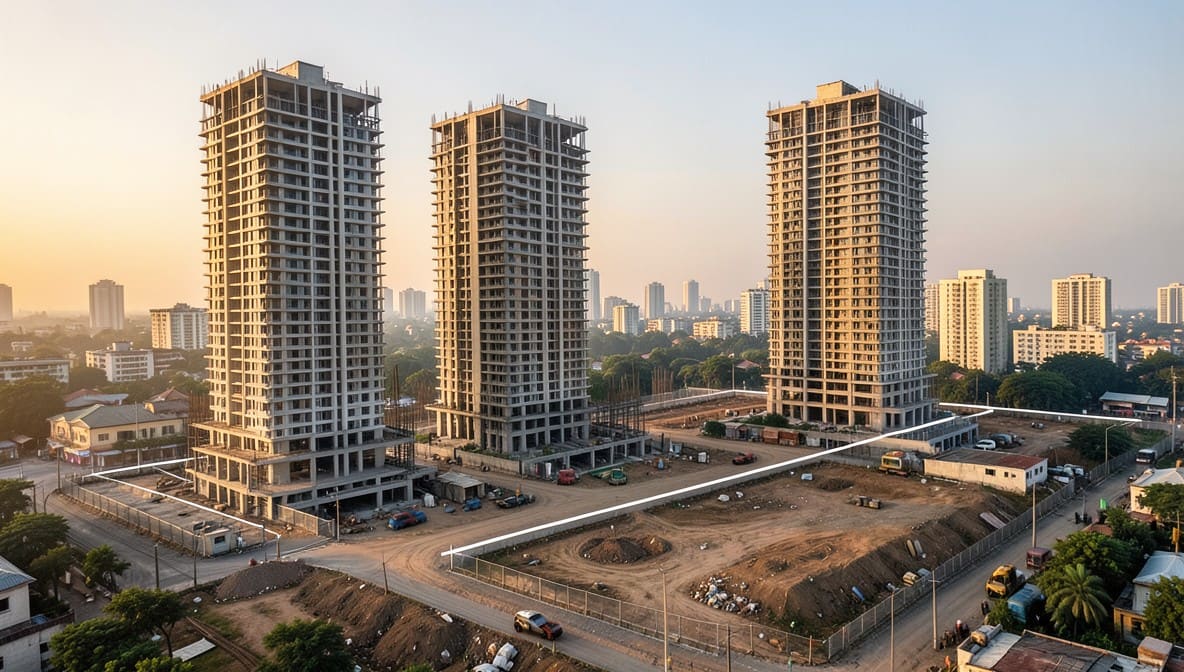
The dispute arose from the rejection of an application for registration of a commercial project named 'Samrajya' by the Uttar Pradesh Real Estate Regulatory Authority (UP RERA). The project was proposed to be developed on land owned by Udasin Sangat Rishi Aashram, a public charitable trust registered under Registration No. 275/2019 at the Sub-Registrar’s Office, Sadar, Ayodhya. The land, measuring 26,000.58 square meters and comprising Gata Nos. 309 and 328, was leased to M/s Maa Bhagwati Commercial Reality N Resorts LLP (the respondent) under a registered lease deed dated 29.09.2023 for a term of 29 years and 11 months, with an option for renewal by mutual consent. The annual lease consideration was Rs. 60,00,000, subject to a 5% increase every five years.
Key Facts
- The trust is the absolute owner of the land, as evidenced by Khatauni extracts and the trust deed.
- The lease deed, executed on 29.09.2023, explicitly grants the lessee the right to construct on the land and to sub-lease units to third parties, but contains no provision permitting sale of units.
- The respondent applied for RERA registration on 02.02.2025 under Application ID 1426755.
- UP RERA raised objections on 06.02.2025, 21.02.2025, and 03.03.2025, questioning whether the lessee had authority to grant sub-leasing rights and whether the trust had obtained permission under Section 92 of the Code of Civil Procedure, 1908.
- The respondent submitted the lease deed, trust deed, Khatauni extracts, and Sub-Registrar’s registration certificate in response.
- UP RERA rejected the application on 04.03.2025, citing lack of sale rights and non-compliance with Section 4(2)(l)(A) of RERA.
- The respondent filed an appeal before the Real Estate Appellate Tribunal (REAT), Lucknow, under Section 44 of RERA.
- REAT allowed the appeal on 25.09.2025, directing UP RERA to grant registration within seven days.
- UP RERA filed the present appeal under Section 58 of RERA before the Allahabad High Court on 28.03.2026.
Procedural History
- 29.09.2023: Registered lease deed executed between Udasin Sangat Rishi Aashram (lessor) and M/s Maa Bhagwati Commercial Reality N Resorts LLP (lessee).
- 02.02.2025: Application for RERA registration filed by respondent (Application ID: 1426755).
- 06.02.2025: UP RERA issued first objection notice.
- 11.02.2025: Respondent submitted reply with supporting documents.
- 21.02.2025: UP RERA reiterated objections.
- 03.03.2025: UP RERA issued final objection notice.
- 04.03.2025: UP RERA rejected registration application.
- 25.09.2025: REAT, Lucknow, allowed appeal and directed registration within seven days.
- 20.11.2025: Allahabad High Court admitted the appeal under Section 58 of RERA.
- 17.02.2026: Respondent filed Short Counter Affidavit admitting it is not a promoter under RERA.
- 08.05.2026: Judgment delivered by the High Court.
The Parties' Positions
Appellant (UP RERA): Argued that the respondent, as a lessee without right to sell, does not qualify as a promoter under Section 2(zk) of RERA. Contended that the project does not constitute a real estate project under Section 2(zn) because no sale of units is contemplated. Asserted that Section 4(2)(l)(A) requires legal title, which the lessee lacks.
Respondent (M/s Maa Bhagwati Commercial Reality N Resorts LLP): Initially contended before REAT that it was entitled to sub-lease under the Transfer of Property Act, 1882. However, in its Short Counter Affidavit dated 17.02.2026, it admitted that it does not have the right to sell units and therefore falls outside the definition of 'promoter' under Section 2(zk). It sought withdrawal of restrictive clauses in Form-D.
Relief Sought
The appellant sought to set aside the REAT order dated 25.09.2025 and uphold the rejection of registration. The respondent sought deletion of restrictive clauses in Form-D and confirmation that no registration under RERA was required.
The Legal Issue
The central question was whether a person who develops a real estate project on leased land but lacks the legal right to sell units can be classified as a 'promoter' under Section 2(zk) of the Real Estate (Regulation and Development) Act, 2016, and whether such a project qualifies as a 'real estate project' under Section 2(zn).
Arguments Presented
For the Appellant
The appellant, UP RERA, relied on the statutory definitions under Sections 2(zk) and 2(zn) to argue that the term 'promoter' requires an intent to sell. It emphasized that the respondent, as a lessee, could only create sub-leases and could not transfer ownership or execute conveyance deeds under Section 17 of RERA. It cited the preamble and objects of the Act, which focus on protecting consumers in transactions involving sale. It further contended that Section 4(2)(l)(A) requires proof of legal title, which the lessee does not possess.
For the Respondent
The respondent, through its Short Counter Affidavit dated 17.02.2026, conceded that it does not have the right to sell units and therefore does not fall within the statutory definition of 'promoter'. It acknowledged that its activity involves leasing and sub-leasing only, and that the project does not meet the criteria of a 'real estate project' under Section 2(zn). It requested the withdrawal of restrictive clauses in Form-D and affirmed that no registration under RERA was applicable.
The Court's Analysis
The Court undertook a detailed textual and purposive analysis of Section 2(zk) and Section 2(zn) of the Real Estate (Regulation and Development) Act, 2016. It observed that the definition of 'promoter' is exhaustive and hinges on the purpose of sale. The Court noted that the Act's preamble and statement of objects repeatedly emphasize the regulation of 'sale of plot, apartment or building' and the protection of consumers in such transactions.
"The expression 'real estate project' is defined under Section 2(zn) of the Act which reads as under: ... for the purpose of selling all or some of the said apartments or plots or building, as the case may be..."
The Court held that the element of 'sale' is indispensable. Mere development, construction, or sub-leasing without any intention or legal capacity to sell does not attract the Act. The lease deed dated 29.09.2023, particularly Clauses 4 and 7, explicitly permitted sub-leasing but contained no provision for sale. The respondent had no power to execute a registered conveyance deed under Section 17, nor could it transfer undivided title in common areas.
The Court rejected the respondent’s earlier contention before REAT that sub-leasing rights under the Transfer of Property Act, 1882, were sufficient. It emphasized that statutory definitions under RERA override general property law principles when they conflict with the Act’s purpose. The Court cited District Mining Officer v. Tata Iron & Steel Co. and Hardeep Singh v. State of Punjab to affirm that statutory language must be interpreted literally and purposively, without judicial rewriting.
It further held that Section 4(2)(l)(A) does not permit a lessee to circumvent the requirement of sale by merely producing documents of the owner’s title. The provision requires the promoter to have a legal basis to sell, not merely to develop. The Court concluded that the respondent’s activity was a commercial lease arrangement, not a real estate project under RERA.
The Verdict
The appeal was allowed. The Allahabad High Court set aside the REAT order dated 25.09.2025 and upheld the rejection of RERA registration. The Court held that the respondent is not a promoter under Section 2(zk) and the project is not a 'real estate project' under Section 2(zn) because no sale of units is contemplated. The UP RERA is directed to withdraw the restrictive clauses in Form-D prohibiting the respondent from marketing, promoting, or dealing with the project. No costs were awarded.
What This Means For Similar Cases
Sale Is the Threshold for RERA Registration
- Practitioners must now assess whether a developer has the legal right to sell units before advising on RERA compliance.
- Projects involving long-term leases, co-living spaces, or commercial rentals without sale intent are exempt from RERA registration.
- Developers relying on leasehold land must ensure their agreements explicitly permit sale; otherwise, registration will be invalid.
Leasehold Rights Do Not Confer Promoter Status
- A lessee with sub-leasing rights under the Transfer of Property Act, 1882, cannot be treated as a promoter under RERA.
- The distinction between lease and sale must be clearly documented in agreements and applications.
- Regulatory authorities cannot compel registration where the statutory definition of 'promoter' is not satisfied, even if the project is large-scale or commercial.
Form-D Restrictions Must Be Lifted for Non-Promoters
- RERA authorities must remove prohibitory clauses in Form-D for entities that are not promoters under the Act.
- Failure to do so may constitute an unlawful restriction on commercial activity.
- Legal notices or compliance demands issued to such entities under RERA are now legally unsustainable.