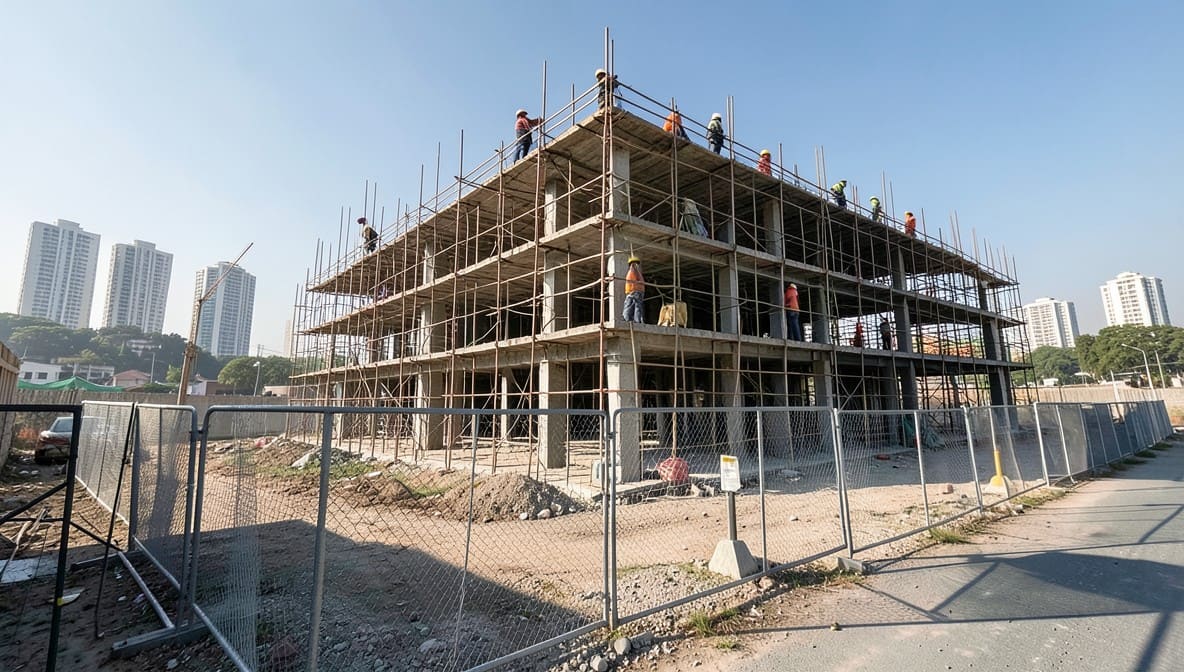
The National Company Law Appellate Tribunal has clarified that during a Corporate Insolvency Resolution Process, assets developed under a collaboration agreement cannot be excluded from the corporate debtor’s valuation merely because the agreement is not specifically enforceable. The ruling underscores the primacy of statutory protections for homebuyers and the continuity of contractual obligations under RERA, even when private disputes between parties remain unresolved.
Background & Facts
The Dispute
The dispute arises from a collaboration agreement dated 19.06.2010 between Ishan Singh, the landowner, and SP AZE Towers Pvt. Ltd. (the Corporate Debtor), for the development of a commercial project named "Spaze Arrow" on land located in Sector 78, Gurugram, Haryana. Under the agreement, the Corporate Debtor was granted development rights, while Ishan Singh retained ownership of the land. The project was registered with Haryana Real Estate Regulatory Authority (HARERA), and 147 units were allotted to homebuyers.
Key Facts
- The Collaboration Agreement included a clause making it irrevocable without prior approval from the Director-General, Town & Country Planning, Haryana.
- On 13.12.2018 and 21.12.2018, Ishan Singh issued notices cancelling the General and Special Powers of Attorney granted to the Corporate Debtor.
- The Corporate Debtor filed proceedings under Section 9 of the Arbitration and Conciliation Act, 1996, seeking interim injunction against cancellation of the Collaboration Agreement.
- On 09.04.2019, the Additional District Judge, Gurugram, issued an interim order restraining Ishan Singh from cancelling the Collaboration Agreement and interfering with construction.
- The Corporate Debtor initiated arbitration proceedings against Ishan Singh, who filed a counterclaim seeking declaration that the agreement was lawfully terminated and transfer of the project land to him.
- On 14.09.2022, the Arbitral Tribunal delivered an award rejecting the Corporate Debtor’s claim for specific performance and dismissing Ishan Singh’s prayer for transfer of the project land.
- The Tribunal held that the Collaboration Agreement was "inoperative" and could not be specifically enforced, but also found that it had not been lawfully terminated.
- On 09.02.2022, HARERA passed an order directing both Ishan Singh and the Corporate Debtor to jointly complete the project, recognizing both as promoters under RERA.
- On 19.05.2021, homebuyers filed a Section 7 application under the Insolvency and Bankruptcy Code, 2016, against the Corporate Debtor.
- On 21.10.2024, the National Company Law Tribunal admitted the Section 7 petition and appointed a Resolution Professional.
- On 18.01.2025, Ishan Singh filed IA 438/2025 seeking exclusion of the unsold inventory and subject property from the Information Memorandum and asset valuation.
- On 10.07.2025, the Adjudicating Authority rejected the application.
Procedural History
- 19.06.2010: Collaboration Agreement executed between Ishan Singh and SP AZE Towers Pvt. Ltd.
- 21.08.2008, 06.01.2011, 16.01.2014: General and Special Powers of Attorney executed in favor of Corporate Debtor.
- 13.12.2018, 21.12.2018: Notices of cancellation of Powers of Attorney issued by Ishan Singh.
- 09.04.2019: Additional District Judge issues interim injunction restraining cancellation of Collaboration Agreement.
- 25.08.2021: Complaint filed by 10 allottees before HARERA.
- 09.02.2022: HARERA issues order directing both parties to complete construction; recognizes both as promoters.
- 14.09.2022: Arbitral Tribunal awards Rs. 2 Crores to Ishan Singh; rejects specific performance and transfer of land; holds agreement inoperative but not terminated.
- 30.01.2024: Section 34 application against arbitral award dismissed by Additional District Judge.
- 19.05.2021: Section 7 application filed by homebuyers.
- 21.10.2024: NCLT admits Section 7 petition; appoints Resolution Professional; disposes of Ishan Singh’s separate Section 7 application with liberty to approach RP.
- 18.01.2025: IA 438/2025 filed by Ishan Singh seeking exclusion of unsold inventory and land from asset valuation.
- 10.07.2025: NCLT rejects IA 438/2025.
- 11.05.2026: NCLAT dismisses appeal.
The Parties' Positions
Appellant (Ishan Singh): Argued that the Arbitral Tribunal’s finding that the Collaboration Agreement was "inoperative" rendered the Corporate Debtor’s rights over the project and unsold inventory extinguished. Therefore, the assets should be excluded from the Information Memorandum and valuation under IBC.
Respondent (Resolution Professional): Contended that the agreement was never terminated, as confirmed by HARERA’s order and the Arbitral Tribunal’s refusal to grant a declaration of termination. The project was developed jointly, and homebuyers’ statutory rights under RERA must prevail.
Relief Sought
Ishan Singh sought:
- Exclusion of unsold inventory in Spaze Arrow from the valuation of the Corporate Debtor and Information Memorandum.
- Exclusion of the subject property (land) from the asset pool.
- Any other relief deemed fit in the interests of justice.
The Legal Issue
The central question was whether the unsold inventory and project land can be excluded from the Corporate Debtor’s asset pool during a Corporate Insolvency Resolution Process when the underlying collaboration agreement is held to be inoperative but not lawfully terminated, and both parties remain jointly obligated under RERA to complete the project.
Arguments Presented
For the Appellant
The Appellant relied on the Arbitral Tribunal’s observation that the Collaboration Agreement was "inoperative" and could not be specifically enforced. He argued that under A A Estates Pvt. Ltd. v. Kher Nagar Sukhsadan Co-operative Housing Society Ltd., the moratorium under Section 14 of the IBC cannot revive extinguished rights. Since the agreement was non-enforceable and the Corporate Debtor had no legal right to the land, its assets could not form part of the corporate estate. He further contended that the Adjudicating Authority erred in conflating "inoperative" with "operative" and ignored the binding arbitral award.
For the Respondent
The Resolution Professional argued that the Arbitral Tribunal explicitly refused to declare the Collaboration Agreement terminated, and HARERA’s order of 09.02.2022 treated both parties as joint promoters with statutory obligations to complete the project. The homebuyers’ rights under RERA are statutorily protected and cannot be subordinated to private contractual disputes. The Corporate Debtor had invested in construction, obtained approvals, and sold units - all actions predicated on the continued existence of the agreement. Excluding the assets would prejudice the homebuyers and defeat the objectives of IBC and RERA.
The Court's Analysis
The NCLAT undertook a detailed examination of the Arbitral Tribunal’s award and HARERA’s order to determine the legal status of the Collaboration Agreement. The Tribunal emphasized that while the Arbitral Tribunal held the agreement was "inoperative" and could not be specifically enforced, it explicitly rejected the Appellant’s claim that the agreement had been lawfully terminated. The Tribunal noted:
"The Arbitral Tribunal has refused the relief claimed by the Appellant for declaration that Collaboration Agreement has been lawfully terminated by the Appellant... The Agreement cannot be operated and no direction can be given by this Tribunal for specific performance of the Agreements. That being so, the Agreements are paper agreements along with the Powers of Attorney and they have no real meaning as such. Consequently, the Tribunal records that for all intents and purposes the various agreements between the parties are inoperable..."
However, the NCLAT clarified that "inoperative" does not equate to "terminated". The Arbitral Tribunal’s refusal to grant a declaration of termination, coupled with HARERA’s directive that both parties must jointly complete the project, confirmed the agreement’s continued legal existence.
The Court distinguished A A Estates Pvt. Ltd. on critical grounds: in that case, the corporate debtor never obtained physical possession or carried out any construction, and the development agreement was terminated prior to CIRP. Here, the Corporate Debtor had constructed significant portions of the project, obtained approvals, and sold 147 units - all actions predicated on the ongoing nature of the collaboration.
The NCLAT further held that RERA’s statutory framework, which imposes joint liability on landowners and developers for project completion, overrides private contractual disputes. The homebuyers’ rights are not contingent on the resolution of inter-se disputes between the promoter and landowner.
The Court concluded that the Adjudicating Authority correctly held that the unsold inventory and land, as integral components of a RERA-registered project developed jointly, must remain part of the Corporate Debtor’s asset pool for the purpose of resolution.
The Verdict
The appeal was dismissed. The NCLAT upheld the Adjudicating Authority’s order dated 10.07.2025 rejecting IA 438/2025. The unsold inventory and subject property in the Spaze Arrow project shall remain included in the Corporate Debtor’s asset valuation and Information Memorandum. The Resolution Professional is directed to proceed with the CIRP without exclusion of these assets. No monetary relief was granted or modified.
What This Means For Similar Cases
RERA Promoters’ Joint Liability Overrides Private Disputes
- Practitioners must treat landowners and developers as joint promoters under RERA during CIRP, even if their internal agreement is unenforceable.
- Assets developed under such joint arrangements cannot be excluded from the corporate estate merely because the landowner claims ownership.
- Homebuyers’ statutory rights under RERA take precedence over private contractual terminations.
"Inoperative" ≠ "Terminated" in Insolvency Context
- A contractual arrangement that is non-enforceable due to breach or lack of specific performance remains legally operative if not formally terminated.
- The IBC’s moratorium under Section 14 protects existing rights - not resurrected ones - but does not permit exclusion of assets where the underlying agreement remains legally alive.
- Arbitral awards must be read holistically: rejection of specific performance does not imply termination of rights.
Valuation Must Reflect Project Reality, Not Contractual Technicalities
- The Information Memorandum must reflect the actual state of the project, including construction progress and unit allotments.
- Excluding assets based on technical arguments about contractual enforceability undermines the commercial purpose of CIRP.
- Resolution Professionals must prioritize statutory obligations under RERA over private claims of land ownership.