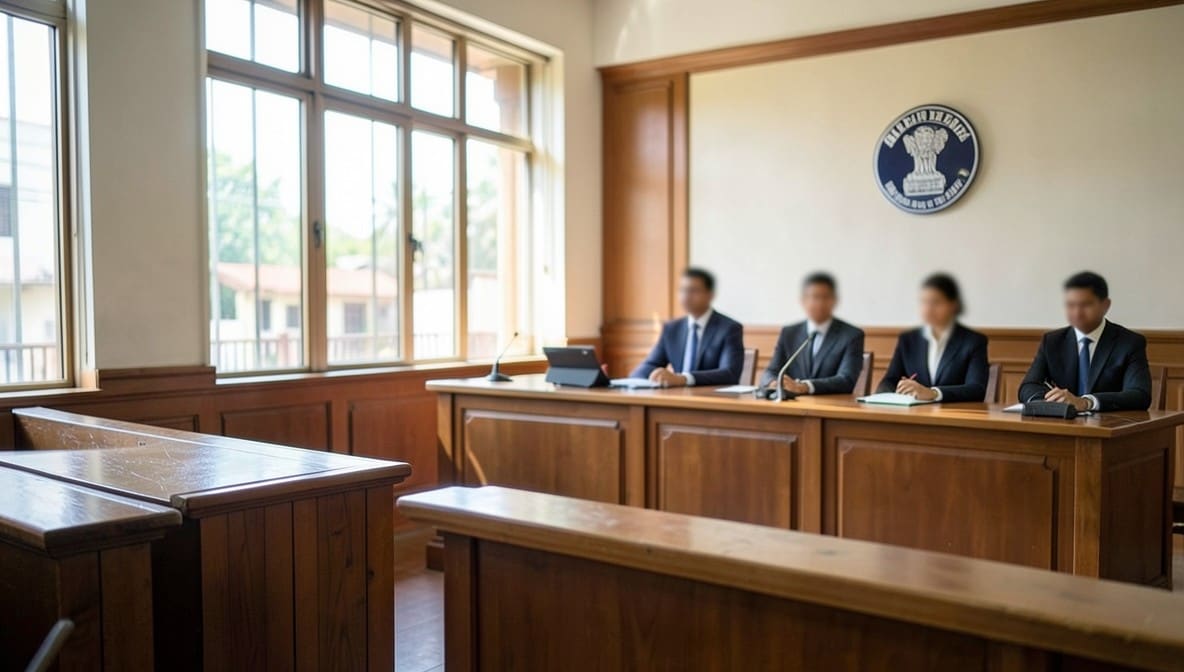
The Kerala High Court has affirmed that the absence of criminal antecedents and the near-completion of investigation are sufficient grounds to grant regular bail, even in cases involving fatal rash driving. This decision reinforces the principle that pre-trial detention must be justified by concrete risk factors, not merely the gravity of the alleged offence.
Background & Facts
The Dispute
The accused, Ullas H J, aged 30, is charged in Crime No. 216/2026 filed by Hosdurg Police Station, Kasargod, arising from a road accident on 22.03.2026. The incident occurred at approximately 23:20 hours in Chithari Village, when the accused, while driving a motor vehicle bearing registration No. KL-14-C-9607, allegedly drove in a rash and negligent manner from Kasaragod to Kanhangad, colliding with a two-wheeler bearing registration No. KL-10-BG-1903. The rider of the bike sustained grievous injuries and later died. The prosecution alleges the accused had consumed alcohol at the time of the incident.
Key Facts
- The accused is the driver of the vehicle involved in the collision.
- The victim, a bike rider, succumbed to injuries sustained in the accident.
- The accused was arrested on 22.03.2026 and remanded to judicial custody on the same day.
- The accused has no prior criminal record.
- The case is registered under Section 281 and Section 105 of the Bharatiya Nyaya Sanhita, 2023 (replacing IPC Sections 304A and 279) and Section 185 of the Motor Vehicles Act, 1988.
- The case diary and FIR (Annexure A1) confirm the sequence of events and the accused’s role as driver.
- The investigation is reported to be nearly complete.
Procedural History
- 22.03.2026: Incident occurred; accused arrested same day.
- 22.03.2026: Judicial custody order passed by Judicial First-Class Magistrate-1, Kasargod.
- 23.03.2026: FIR registered as Crime No. 216/2026.
- 26.03.2026: Magistrate’s order denying interim relief or bail (Annexure A2).
- 06.04.2026: Bail application filed under Section 483 of the Bharatiya Nagarik Suraksha Sanhita, 2023 before the High Court.
Relief Sought
The applicant sought regular bail on the grounds of no criminal antecedents, near-completion of investigation, and absence of evidence linking him to intentional wrongdoing. He requested release on reasonable bail conditions without undue restriction.
The Legal Issue
The central question was whether the accused, who has no prior criminal record and whose investigation is nearly complete, can be denied regular bail solely on the basis of the seriousness of the alleged offence under Section 281 and 105 of the Bharatiya Nyaya Sanhita, 2023, and Section 185 of the Motor Vehicles Act, 1988.
Arguments Presented
For the Appellant/Petitioner
The learned counsel submitted that the accused is innocent and falsely implicated. No material evidence on record connects him to intentional or malicious conduct. The investigation is nearly complete, and there is no risk of evidence tampering or flight. The accused has no criminal antecedents and is a first-time offender. Reliance was placed on the principle that bail is the rule and jail is the exception, especially where custody is not necessary for investigation or public order.
For the Respondent/State
The Senior Public Prosecutor contended that the alleged act constitutes a grave offence resulting in death due to rash driving while under the influence of alcohol. The nature of the crime, involving loss of human life, warrants continued detention to ensure justice is not undermined. The prosecution argued that granting bail at this stage may embolden reckless driving and undermine public confidence in road safety enforcement.
The Court's Analysis
The Court examined the nature of the allegations, the stage of investigation, and the personal circumstances of the accused. It noted that while the offence is serious, the Bharatiya Nagarik Suraksha Sanhita, 2023 mandates a balanced approach to bail, emphasizing proportionality and necessity of detention. The Court observed that the investigation is nearly complete, reducing the risk of evidence tampering or witness intimidation. The accused’s clean record and lack of prior criminality were decisive factors.
"The applicant has no criminal antecedents. For these reasons, I do not find any reason to hold that the continued detention of the applicant is required for any purpose."
The Court rejected the notion that gravity of offence alone justifies denial of bail where no other risk factors are present. It emphasized that Section 483 of the BNSS requires courts to consider whether detention is necessary for investigation, to prevent commission of further offences, or to ensure appearance in court. None of these conditions were substantiated in this case.
The Court further held that the accused’s cooperation with the investigation and compliance with reasonable conditions would adequately safeguard the interests of justice.
The Verdict
The bail application was allowed. The accused is released on bail upon executing a personal bond of Rs. 1,00,000 with two solvent sureties each for the same amount, to the satisfaction of the jurisdictional Magistrate. The accused must: (i) cooperate fully with the investigation; (ii) appear before the investigating officer every Saturday between 10:00 a.m. and 11:00 a.m.; (iii) not commit any similar offence while on bail; (iv) not contact or influence any prosecution witness; and (v) not leave the State of Kerala without prior permission of the trial court. Any application for modification or cancellation of bail must be filed before the jurisdictional court.
What This Means For Similar Cases
Bail Is Not Denied Solely on Gravity of Offence
- Practitioners must argue that Section 483 BNSS requires a case-specific assessment of risk, not automatic denial based on the nature of the crime.
- Courts must distinguish between offences requiring custody for investigation versus those where the accused poses no flight or tampering risk.
Clean Record and Near-Completion of Investigation Are Critical Factors
- In cases involving non-violent or accidental offences with no prior history, courts are likely to grant bail if investigation is nearing conclusion.
- The absence of criminal antecedents should be treated as a strong mitigating factor under Section 483 BNSS.
Procedural Compliance in Bail Conditions Is Mandatory
- Bail conditions must be specific, reasonable, and enforceable.
- Courts must avoid vague or excessive conditions; conditions like mandatory weekly appearances are permissible if tied to investigation needs.
The Burden Is on the State to Justify Detention
- The prosecution bears the burden of demonstrating why detention is necessary.
- Mere assertion of seriousness without concrete evidence of risk is insufficient to deny bail.
When Delay Defeats Remedy
- Prolonged pre-trial detention without justification violates the right to liberty under Article 21.
- Courts must act swiftly in bail applications where investigation is complete or nearly so.