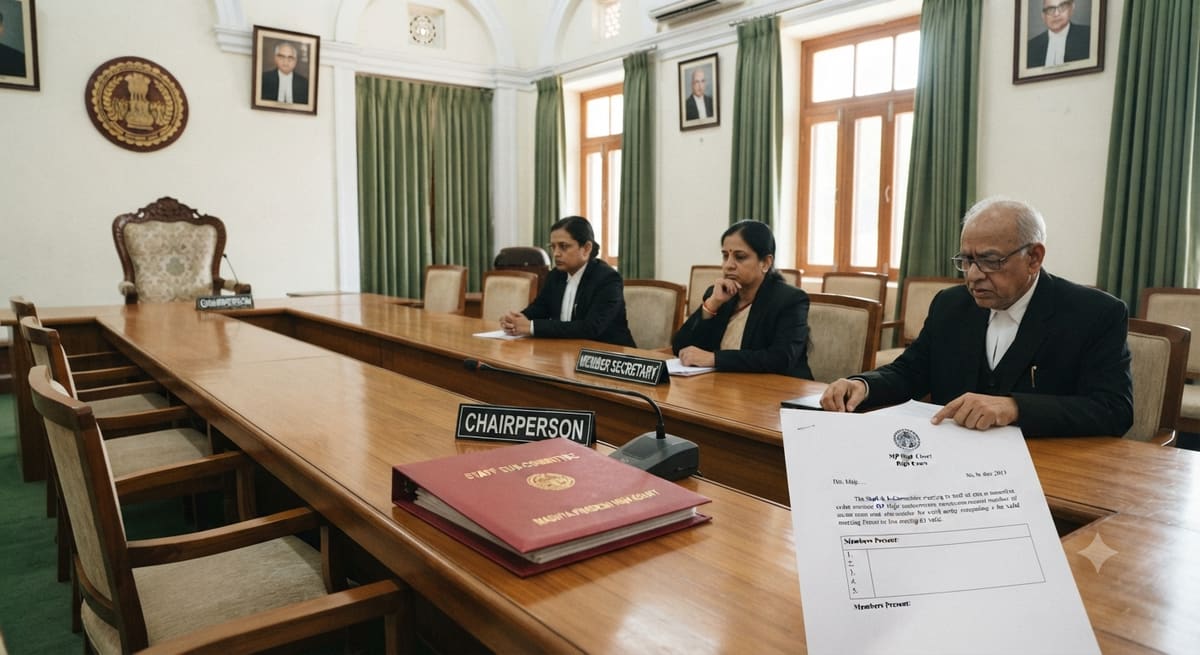
The Madhya Pradesh High Court recently underscored the critical importance of procedural compliance in disciplinary proceedings, quashing an order passed by a Staff Sub-Committee that lacked the requisite quorum. The judgment reinforces that natural justice and statutory quorum requirements are non-negotiable, even in internal administrative processes, and that jurisdictional defects cannot be cured by alternate remedies.
Background & Facts
The Dispute
The petitioners, employees of the District Cooperative Central Bank Ltd., challenged a disciplinary order dated 21.12.2021 (Annexure P/8) passed by the bank’s Staff Sub-Committee. The order pertained to alleged misconduct, though the specific allegations and the nature of the misconduct were not detailed in the impugned order. The petitioners contended that the proceedings leading to the order were vitiated by procedural irregularities.
Key Facts
The petitioners were subjected to disciplinary proceedings under the bank’s internal regulations.
A show-cause notice was issued, and the petitioners submitted a reply.
The impugned order was passed by the Staff Sub-Committee on 21.12.2021.
The petitioners alleged that no evidence was recorded and no documents were exhibited during the proceedings.
The order was signed by only two members of the Sub-Committee, despite the bank’s rules requiring the presence of three members for a valid quorum.
Procedural History
21.12.2021: Impugned order (Annexure P/8) passed by the Staff Sub-Committee.
2022: Writ Petition No. 64 of 2022 filed before the Madhya Pradesh High Court under Article 226 of the Constitution of India.
10.07.2026: Judgment delivered by the High Court.
The Parties' Positions
For the Petitioners
Quorum Deficiency: The petitioners argued that the impugned order was invalid as it was passed by only two members of the Staff Sub-Committee, violating clause 6.6.1 of the bank’s regulations, which mandates the presence of the Administrator (as Chairman), a nominee of the State Government, and the Managing Director/Chief Executive Officer.
Clause 6.6.4: Further reliance was placed on this clause, which explicitly requires the presence of all members for a valid meeting of the Staff Sub-Committee.
Denial of Natural Justice: The petitioners contended that the proceedings were flawed as no witnesses were examined and no documents were exhibited, depriving them of a fair opportunity to defend themselves.
Jurisdictional Defect: The order was challenged as being passed without jurisdiction due to the lack of quorum and procedural lapses.
For the Respondents
Affidavit Evidence: The respondents relied on an affidavit (Annexure R/1) stating that four members were present and signed the proceedings, though the impugned order itself bore only two signatures.
Opportunity of Hearing: It was submitted that a show-cause notice was issued, the petitioners’ reply was considered, and an opportunity of hearing was provided.
Deceased Employee: The respondents argued that since the concerned employee had expired, no fresh inquiry could be conducted, implying finality to the impugned order.
Alternate Remedy: At a later stage, the respondents contended that the petitioners had an alternate remedy of appeal, which should have been exhausted before approaching the High Court.
Relief Sought
The petitioners sought:
Quashing of the impugned order dated 21.12.2021.
A direction to the respondents to release all consequential benefits to the petitioners.
Liberty for the respondents to pass a fresh order, if necessary, in accordance with law.
The Legal Issue
The central question before the Court was whether a disciplinary order passed by a Staff Sub-Committee lacking the requisite quorum under its governing regulations could be sustained, and whether procedural lapses (such as the failure to record evidence) rendered the order void ab initio.
Arguments Presented
For the Petitioner
The impugned order was passed in violation of clauses 6.6.1 and 6.6.4 of the bank’s regulations, which mandate the presence of three members for a valid quorum.
The proceedings were procedurally flawed as no evidence was recorded, and no documents were exhibited, denying the petitioners natural justice.
The order was jurisdictionally defective and thus liable to be quashed.
For the Respondent
The respondents relied on an affidavit (Annexure R/1) claiming that four members were present, though the impugned order bore only two signatures.
It was argued that the petitioners were given a fair opportunity of hearing, including the issuance of a show-cause notice and consideration of their reply.
The respondents submitted that the petitioners had an alternate remedy of appeal, which should have barred the writ petition.
The Court's Analysis
The Court conducted a two-pronged analysis, examining both the quorum requirement and the procedural fairness of the disciplinary proceedings.
Quorum Requirement
The Court observed that clauses 6.6.1 and 6.6.4 of the bank’s regulations explicitly mandate the presence of three members for a valid meeting of the Staff Sub-Committee. The impugned order, however, bore the signatures of only two members, and an affidavit filed by the petitioners confirmed that only two members were present. The Court held:
"Considering Rule 6.6.1 and 6.6.4, three members ought to have been present in the meeting of the Sub-Committee. However, order has been signed by only two members. Three members have not signed the order. Further, an affidavit has been filed that only two members were present in the meeting of the committee."
The Court concluded that the lack of quorum rendered the impugned order void ab initio, as it was passed without jurisdiction. This defect could not be cured by the respondents’ reliance on an affidavit claiming the presence of four members, as the order itself bore only two signatures.
Procedural Fairness
The Court further noted that the disciplinary proceedings were procedurally deficient, as no witnesses were examined and no documents were exhibited. This deprived the petitioners of a fair opportunity to defend themselves, violating the principles of natural justice. The Court emphasized that procedural compliance is not a mere formality but a fundamental requirement for the validity of administrative orders.
Alternate Remedy
The respondents argued that the petitioners should have exhausted the alternate remedy of appeal before approaching the High Court. However, the Court rejected this contention, holding that where an order is passed without jurisdiction (as in this case), the availability of an alternate remedy does not bar the exercise of writ jurisdiction. The Court relied on the settled principle that jurisdictional defects cannot be cured by alternate remedies.
The Verdict
The Court allowed the writ petition and quashed the impugned order dated 21.12.2021. It directed the respondents to release all consequential benefits to the petitioners and granted them liberty to pass a fresh order, if required, in accordance with law. The Court did not impose any costs or specify a compliance timeline, leaving it to the respondents to act expeditiously.
What This Means For Similar Cases
Quorum Is Non-Negotiable
Statutory/Regulatory Quorum: Disciplinary or administrative bodies must strictly adhere to quorum requirements prescribed by their governing regulations or statutes. Failure to do so renders the order void ab initio, regardless of the merits of the case.
Affidavit Evidence Insufficient: Mere affidavits claiming the presence of members cannot cure the defect if the order itself lacks the requisite signatures or documentation.
Procedural Compliance Is Fundamental
Natural Justice: Even in internal disciplinary proceedings, recording of evidence and exhibition of documents are essential to ensure fairness. Orders passed without these safeguards are liable to be quashed.
No Shortcuts: Administrative bodies cannot bypass procedural requirements under the guise of expediency or finality.
Alternate Remedy Does Not Bar Writ Jurisdiction
Jurisdictional Defects: Where an order is passed without jurisdiction, the availability of an alternate remedy (such as an appeal) does not preclude the High Court from exercising its writ jurisdiction under Article 226.
Practitioner Takeaway: Lawyers challenging administrative orders should first scrutinize procedural compliance, as jurisdictional defects provide a strong ground for quashing, even if alternate remedies exist.