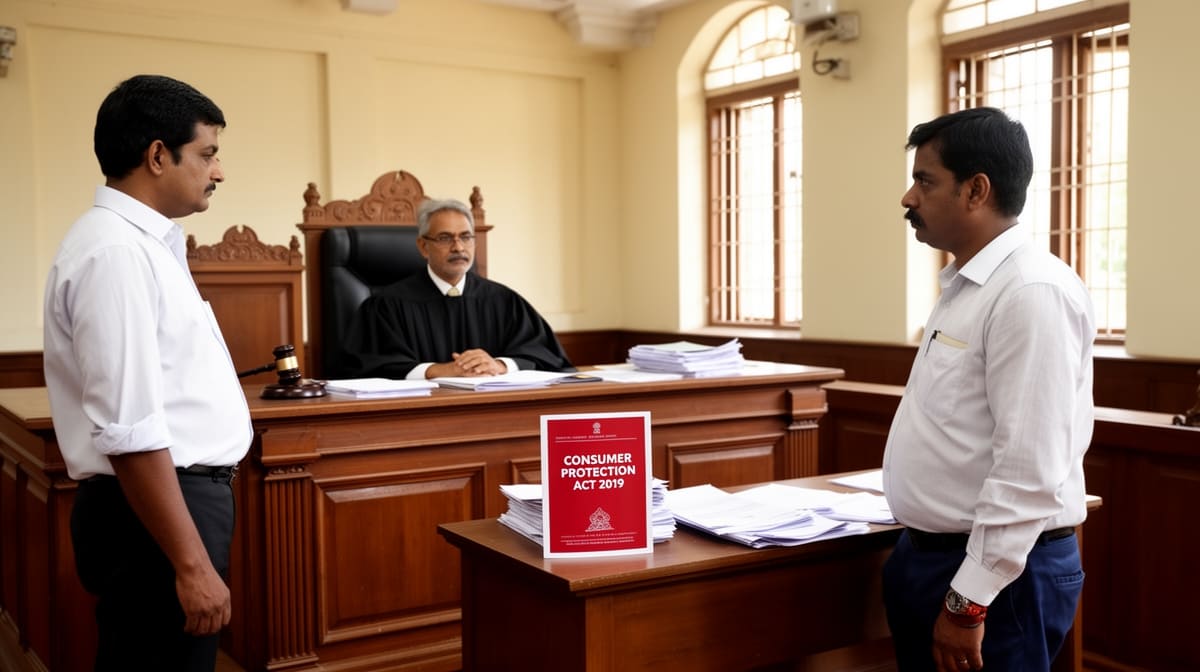
The Maharashtra State Consumer Disputes Redressal Commission held that a District Commission may issue public notice under Order 5 Rule 20(1-A) of the CPC when ordinary service of process fails, even if the respondent’s registered office is claimed to be closed and personal addresses of directors are unknown. The revision petition was allowed, the impugned order quashed, and the District Commission directed to permit service by newspaper advertisement.
Background & Facts
The Dispute
The petitioner, Nandkishor Motilal Agrawal, a retired individual aged 70 years, filed a consumer complaint before the District Consumer Forum, Hingoli, seeking the return of fixed deposits kept with Hingoli Urban Nidhi Ltd (a credit society) together with the maturity sums. After the complaint was admitted, notices sent to the respondents’ official address were returned undelivered with the postal remark ‘office is closed’. The petitioner, lacking the personal addresses of the directors who are respondents 2 to 4, moved an application for issuance of public notice. The District Commission rejected the application on the ground that the registered office of respondent No. 1 was stated to be closed and the personal addresses of the other respondents were not furnished, thereby refusing to allow public notice. It is against this order that the revision petition was filed.
Key Facts
- The petitioner is Nandkishor Motilal Agrawal, age 70 years, retired, residing at C/o Shri Emporium, Near Gramin Police Station, Hingoli-431513.
- The respondent is Hingoli Urban Nidhi Ltd, a credit society, with its registered office at New Mondha, Hingoli-431513; its directors are Jayesh Uttam Khajule, Santosh Narayan Dudhekar and Rohini Jayesh Kharjule.
- The underlying consumer complaint was registered as Complaint No. 89 of 2024 before the District Forum, Hingoli.
- Notices sent to the respondents’ official address were returned with the remark ‘office is closed’.
- The petitioner did not have the personal addresses of the directors (respondents Nos. 2-4).
- An application for public notice under Order 5 Rule 20 of the CPC was filed and rejected by the District Commission.
- The revision petition (RP/29/2025) was filed on 3 September 2025.
- The impugned order of the District Commission was dated (not specified in the judgment).
- The Maharashtra State Consumer Disputes Redressal Commission, Bench at Aurangabad, delivered its order on 10 September 2026.
Procedural History
- 03.09.2025: Revision petition filed before the Maharashtra State Consumer Disputes Redressal Commission.
- 10.09.2026: Order delivered allowing the revision petition, quashing the impugned order and directing issuance of public notice.
- The underlying complaint was filed in 2024 (Complaint No. 89/2024).
- After the Commission permitted public notice, the respondents did not appear, and the matter proceeded ex-parte.
Relief Sought
The petitioner sought:
- Allowance of the revision petition.
- Quashing and setting aside of the impugned order of the District Commission.
- A direction to the District Commission to permit issuance of public notice by advertisement in a daily newspaper circulating in the local area.
- Provision of a free copy of the judgment to both parties.
The Legal Issue
The central question was whether a District Commission may issue public notice under Order 5 Rule 20(1-A) of the CPC when ordinary service of process fails, despite the respondent’s registered office being asserted as closed and the personal addresses of its directors being unknown.
Arguments Presented
For the Petitioner
The petitioner, through Adv. P.N. Bhansali, contended that ordinary service had failed because notices returned undelivered and the personal addresses of the directors were not available. He relied on Section 38(9)(a) of the Consumer Protection Act, 2019, which confers on the District Commission the same powers as a civil court under the CPC, and on Order 5 Rule 20(1-A) of the CPC, 1908, which permits public notice when the court is satisfied that summons/notice cannot be served in an ordinary way. He argued that the District Commission’s refusal was contrary to law and that public notice by newspaper advertisement was the appropriate remedy.
For the Respondent
The respondents appeared ex-parte and did not file any written submissions. The District Commission, whose order was under challenge, had taken the view that because the registered office of respondent No. 1 was stated to be closed and the petitioner did not furnish the personal addresses of the other respondents, public notice could not be granted. The Commission’s reasoning was that public notice is permissible only when the ordinary mode of service is impossible, and that the closure of the registered office and lack of address details satisfied that condition, thereby justifying the rejection of the application.
The Court's Analysis
The Court examined the statutory framework. Section 38(9)(a) of the CPA, 2019 provides that for the purpose of hearing under that section, the District Commission shall have the same powers as are vested in a Civil Court under the CPC, pertaining to summoning and enforcing the attendance of any defendant. Order 5 Rule 2 of the CPC deals with service of summons on a corporation, allowing service at the registered office or place of business. When such service fails, Order 5 Rule 20(1-A) of the CPC steps in, permitting public notice by advertisement in a daily newspaper circulating in the locality where the court is satisfied that ordinary service cannot be effected.
The Court held that the District Commission’s reliance on the alleged closure of the registered office and the lack of the directors’ personal addresses was misplaced. The true test under Order 5 Rule 20(1-A) is whether ordinary service has failed, not whether the petitioner can furnish alternative addresses. Since the notices sent to the registered office were returned undelivered, ordinary service had failed, satisfying the condition for public notice. The impugned order, which refused public notice on the ground that the registered office was closed and addresses unknown, was therefore contrary to the statutory mandate and could not be sustained.
"The provisions of Order 5 Rule 20(1-A) of CPC provides that, where the court is satisfied that the summons/notice cannot be served in an ordinary way, public notice by way of advertisement in a daily newspaper circulating in the locality can be allowed."
Consequently, the Court set aside the impugned order and directed the District Commission to allow the petitioner to serve the respondents by public notice.
The Verdict
The revision petition filed on 3 September 2025 was allowed. The impugned order of the District Commission was quashed and set aside. The District Commission was directed to permit the petitioner to serve the respondents by way of public notice through an advertisement in a daily newspaper having circulation in the local area. A copy of the judgment dated 10 September 2026 is to be provided to both parties free of cost. No monetary compensation, interest or costs were awarded.
What This Means For Similar Cases
Public Notice as a Fallback Mechanism
The judgment clarifies that public notice under Order 5 Rule 20(1-A) CPC is available whenever ordinary service of process fails, irrespective of whether the petitioner can provide the personal addresses of a corporate respondent’s directors. Practitioners must first attempt service at the registered office or place of business; only after such attempts prove ineffective may they seek public notice.
District Commission’s Powers Equivalent to Civil Court
By invoking Section 38(9)(a) of the CPA, 2019, a District Commission steps into the shoes of a civil court for summoning purposes. This means that all procedural tools available to a civil court under the CPC - including substituted service and public notice - are accessible to the Commission when adjudicating consumer complaints.
Burden on Petitioner to Show Ineffectiveness of Ordinary Service
The burden lies on the petitioner to demonstrate that ordinary service has failed. Documentary evidence such as returned postal notices with remarks like ‘office is closed’ or ‘no such person at the address’ suffices to discharge this burden. Once failure is shown, the Commission must consider permitting public notice, and its refusal must be justified by a concrete finding that ordinary service remains possible.