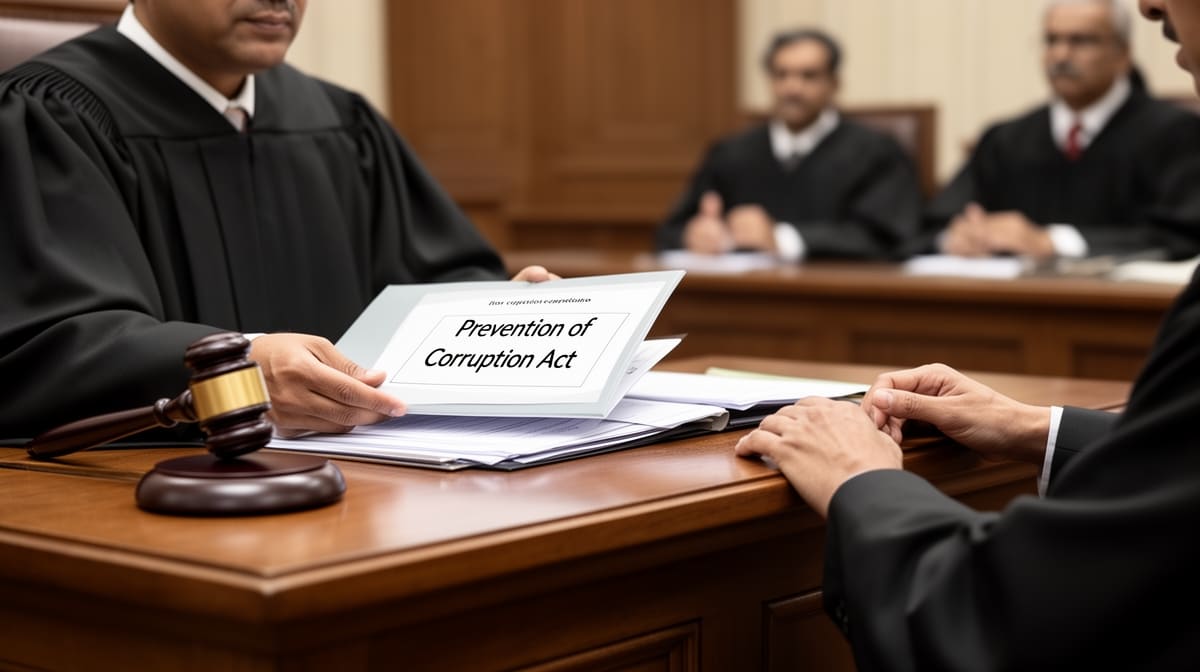
The Bombay High Court has reaffirmed that a conviction under the Prevention of Corruption Act cannot rest on ambiguous gestures or uncorroborated assertions. In a significant ruling, the Court rejected the State’s application for leave to appeal against an acquittal, emphasizing that proof of a clear, verbal demand for bribe is the sine qua non of prosecution under Section 7 of the PC Act.
Background & Facts
The Dispute
The case arose from a complaint by Amol Prabhakar Mundhe, an Assistant Engineer, who alleged that Vijaykumar Manikrao Deshmukh, a Head Clerk in the Majalgaon Project Division, demanded Rs.5,000 to clear his father’s medical bill and release his delayed salary for August 2015. The Anti-Corruption Bureau (ACB) conducted a trap, recording conversations and deploying a shadow pancha. However, the Special Judge acquitted the accused, finding that the prosecution failed to establish a concrete demand.
Procedural History
- 25 June 2015: Complaint filed by complainant with ACB
- 24 September 2015: Trap conducted based on alleged demand
- 28 August 2023: Special Judge (PC Act) acquitted the accused
- March 2026: State seeks leave to appeal before Bombay HC
Relief Sought
The State sought leave to appeal the acquittal, arguing that the trial court erred in rejecting the prosecution’s case on grounds of insufficient evidence of demand and flawed appreciation of sanction.
The Legal Issue
The central question was whether a bribe demand under Section 7 of the Prevention of Corruption Act can be established solely through non-verbal gestures, or whether a clear, verbal, or explicit demand is indispensable for conviction.
Arguments Presented
For the Appellant
The State relied on Dashrath v. State of Maharashtra to argue that sanction irregularities do not automatically vitiate prosecution. It contended that the recovery of tainted currency, coupled with the complainant’s testimony and pre-trap verification, established a prima facie case. The State asserted that the trial court misappreciated evidence by requiring an explicit verbal demand, contrary to the spirit of anti-corruption jurisprudence.
For the Respondent
The defense argued that no verbal or oral demand was made. Both the complainant and shadow pancha described only vague gestures without specifying their nature or meaning. Crucially, the complainant had not mentioned any demand during his departmental inquiry. Further, the accused had no authority to sanction medical bills or release salaries, undermining any motive for bribery. The defense emphasized that mere recovery of money without proof of demand is legally insufficient, citing repeated Supreme Court rulings.
The Court's Analysis
The Court undertook a meticulous review of evidence and precedent. It held that proof of demand is the foundational element in PC Act cases, and cannot be inferred from ambiguous conduct. The Court noted:
"There is no oral or verbal demand of Rs.5,000/-. What gestures were made and in what form is not stated by both these witnesses."
The absence of specificity in the alleged gestures rendered them legally meaningless. The Court further observed that the complainant’s silence during departmental proceedings cast serious doubt on the credibility of his trial testimony.
Regarding sanction, the Court distinguished Dashrath, noting that while that case addressed procedural lapses in sanction, here the sanctioning authority had no jurisdiction over the matter. The Investigating Officer admitted the accused lacked authority to clear bills or release salaries. The sanction order for the medical bill was dated 6 October 2015 - after the trap on 24 September 2015 - making the alleged demand temporally and functionally implausible.
The Court concluded that without a demonstrable demand, recovery of money is legally inert. The trial court’s acquittal was not only legally sound but also factually compelled by the evidence.
The Verdict
The State’s application for leave to appeal was rejected. The Court held that a bribe demand under the Prevention of Corruption Act must be clear, verbal, or explicitly communicable, and cannot be established through vague gestures or circumstantial inference. The acquittal was upheld.
What This Means For Similar Cases
Verbal Demand Is Non-Negotiable
- Practitioners must now ensure that prosecution evidence includes direct testimony of verbal demand - gestures alone are insufficient
- Cross-examination should focus on whether the complainant described the demand in concrete terms during prior proceedings
- Shadow pancha testimony must corroborate not just the recovery, but the nature and content of the demand
Authority and Motive Are Integral to Prosecution
- Prosecutors must establish the accused’s functional authority over the matter in question
- Delayed or post-facto sanction orders must be scrutinized for temporal inconsistency with the trap
- Absence of motive due to lack of authority can defeat even seemingly strong recovery evidence
Pre-Trial Silence Undermines Credibility
- Statements made during departmental inquiries or internal investigations must be compared with trial testimony
- Contradictions or omissions in prior statements will be treated as material contradictions under Section 145 of the Evidence Act
- Prosecution must anticipate and preemptively explain inconsistencies to avoid fatal credibility gaps