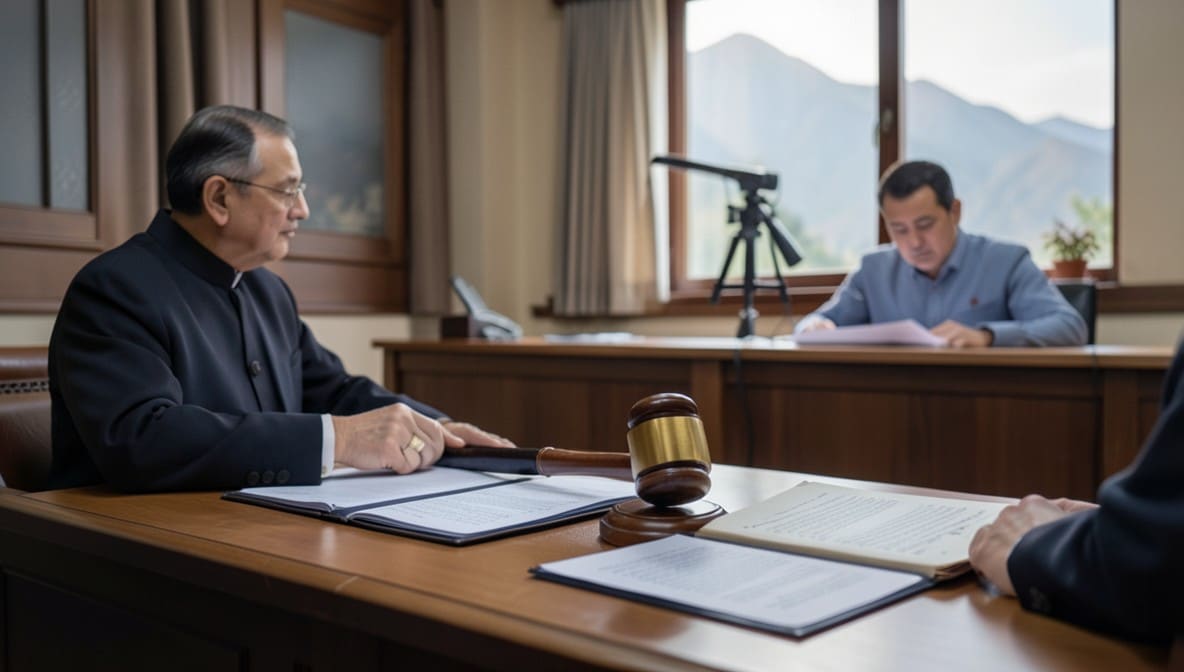
The Gauhati High Court has reaffirmed that the testimony of a minor sexual assault victim, if found credible and consistent, is sufficient to sustain a conviction under the POCSO Act, even in the absence of physical evidence or corroboration. This judgment reinforces the legal principle that the vulnerability of child victims demands judicial sensitivity, and procedural gaps cannot override the reliability of their testimony.
Background & Facts
The Dispute
The appellant, Lakhi Prasad Das, was convicted under Section 6 of the Protection of Children from Sexual Offences (POCSO) Act, 2012, and Section 376AB of the Indian Penal Code (IPC) for committing aggravated penetrative sexual assault on a 9-year-old girl, the daughter of his neighbor. The incident occurred on 21.12.2020 at the appellant’s residence in Dorikapar, Sivasagar, Assam. The prosecution alleged that the appellant lured the victim to his house under the pretext that his daughter had called her, then gagged her mouth with tape, tied her hands and legs with a gamosa (a traditional Assamese cloth), removed her panty, and inserted his penis into her vagina while applying his tongue to her genitalia. The assault was interrupted when the appellant’s daughter knocked on the door, allowing the victim to escape.
Key Facts
- The victim, aged 9 years, returned home after tuition at approximately 5:00 p.m. on 21.12.2020.
- She was lured into the appellant’s house under false pretenses.
- The victim reported that the appellant gagged her mouth, tied her limbs with a gamosa, and committed penetrative sexual acts.
- The appellant’s daughter, who was also the victim’s friend, knocked on the door twice, prompting the appellant to release the victim.
- The victim fled to her grandmother’s house (PW-4), who then informed her mother (PW-1).
- The mother and father of the victim (PW-1 and PW-3) confronted the appellant at around 7:00 p.m. on the same day and assaulted him, resulting in visible injuries.
- An FIR (Sivasagar P.S. Case No. 1488/2020) was lodged by PW-1 on 21.12.2020 under Section 376AB IPC read with Section 6 of the POCSO Act.
- The victim’s statement was recorded under Section 164 Cr.P.C. on 22.12.2020.
- A medical examination was conducted on 22.12.2020 by PW-5, the government doctor, who found no injuries on the genitalia, no signs of recent sexual intercourse, no spermatozoa, and a negative pregnancy test.
- No tape or gamosa was seized by the police.
- The appellant’s left hand showed signs of old injury with restricted movement.
- DW-1, the appellant’s 18-year-old daughter, filed an FIR on 22.12.2020 (Case No. 1491/2020) alleging assault by the victim’s parents, but did not mention any prior land dispute.
- The victim’s testimony before the trial court and under Section 164 Cr.P.C. was substantially consistent, with only minor variations in wording.
Procedural History
- 21.12.2020: FIR lodged by PW-1 (mother of victim) at Sivasagar Police Station.
- 22.12.2020: Medical examination of victim; DW-1 files counter-FIR.
- 22.12.2020: Investigation completed; charge-sheet filed by IO (PW-6).
- 07.07.2022: Additional Sessions Judge (POCSO), Sivasagar, convicts appellant under Section 6 of POCSO Act and Section 376AB IPC.
- Sentencing: 20 years rigorous imprisonment + fine of Rs. 10,000; default: 6 months R.I.
- 17.03.2026: Appeal heard by Gauhati High Court.
The Parties' Positions
Appellant’s Contentions:
- No tape or gamosa was seized, undermining the victim’s account.
- Medical report showed no injury or signs of sexual intercourse.
- Appellant’s left hand was disabled, making it physically impossible to gag or tie the victim.
- Enmity existed due to a land dispute, suggesting a false case.
- The counter-FIR by DW-1 proves retaliation.
- Conviction cannot rest on sole testimony of a minor without corroboration.
Respondent’s Contentions:
- Victim’s testimony was consistent between Section 164 Cr.P.C. statement and trial evidence.
- Absence of physical injury does not negate sexual assault, per State of Punjab v. Gurmit Singh.
- Minor discrepancies in wording (e.g., "insertion" vs. "touch") are immaterial given the victim’s age.
- DW-1’s testimony contradicted claims of enmity and land dispute.
- The assault on the appellant occurred after the sexual assault, indicating retaliation, not premeditation.
- The victim’s testimony is trustworthy and inspires confidence.
Relief Sought
The appellant sought quashing of the conviction and sentence, arguing that the trial court’s findings were unsustainable due to lack of corroboration, absence of physical evidence, and possibility of false implication.
The Legal Issue
Can a conviction under Section 6 of the POCSO Act, 2012, be sustained solely on the testimony of a minor victim, even when there is no physical evidence of penetration, no seizure of the alleged restraint materials, and the accused has a physical disability?
Arguments Presented
For the Appellant
The appellant’s counsel argued that the prosecution failed to establish the essential ingredients of aggravated penetrative sexual assault under Section 3(d) and Section 5(m) of the POCSO Act. He emphasized the absence of any seized evidence - tape or gamosa - which directly contradicted the victim’s account. He further relied on the medical report, which found no injury, no spermatozoa, and no signs of recent sexual intercourse, to argue that the act of penetration was not proven. He contended that the appellant’s restricted left hand made it physically impossible to gag or bind the victim. He also invoked the counter-FIR filed by DW-1 as proof of a pre-existing enmity and retaliatory motive, suggesting fabrication. He cited State of Punjab v. Gurmit Singh to argue that while corroboration is not mandatory, it becomes necessary when the testimony is inherently improbable or contradicted by medical evidence.
For the Respondent
The Additional Public Prosecutor and Legal Aid Counsel countered that the victim’s testimony was consistent, detailed, and free from material contradictions. They emphasized that the Supreme Court in Ganesan v. State has held that the testimony of a child victim, if credible, is sufficient for conviction. They argued that the medical report’s findings of no injury or spermatozoa are not dispositive, as penetration may occur without trauma, especially in prepubertal children. They pointed out that the trial court had observed the appellant’s physical condition and still found him capable of committing the act. They dismissed the land dispute claim as unsubstantiated, noting that DW-1, the only witness to allege enmity, never mentioned any property dispute. They argued that the assault on the appellant was a direct consequence of the sexual assault, not its cause.
The Court's Analysis
The Court undertook a meticulous review of the victim’s testimony, the medical evidence, and the defense claims. It noted that the victim’s statement under Section 164 Cr.P.C. and her trial testimony were materially consistent, with only minor variations in phrasing - such as "insertion" versus "touch" - which the Court held were inconsequential given the victim’s age and developmental stage. The Court observed that Section 3(a) of the POCSO Act defines penetrative sexual assault to include "insertion of any object or any part of the body" into the vagina, and Section 3(d) includes "application of mouth" to the vagina. The Court held that the appellant’s act of applying his tongue to the victim’s genitalia independently satisfied Section 3(d), thereby attracting Section 6.
"The slip up between the words ‘insertion’ and ‘touch’ of the appellant’s penis into her vagina does not take away the fact that Section 3(a) of the POCSO Act, 2012 is attracted to the facts of this case. In any event, as the appellant has put his mouth onto the victim’s vagina, Section 3(d) of POCSO Act, 2012 is attracted."
The Court rejected the defense’s argument regarding the appellant’s left hand disability. It noted that the trial court had observed the appellant’s physical condition during cross-examination and found that while movement was restricted, it did not preclude the use of the hand for the acts alleged. The Investigating Officer (PW-6) had no knowledge of any disability, and no medical certificate was produced to substantiate the claim.
The Court also dismissed the claim of enmity and land dispute. It held that DW-1’s testimony explicitly stated that relations between the families were cordial, despite occasional quarrels. The counter-FIR filed by DW-1 on 22.12.2020 was deemed an afterthought, filed in retaliation to the victim’s FIR, and not evidence of prior animosity.
The Court relied on State of Punjab v. Gurmit Singh (1996) 2 SCC 384 and Ganesan v. State (2020) 10 SCC 573 to affirm that the testimony of a child victim, if found truthful and trustworthy, does not require corroboration. The Court emphasized that the absence of physical evidence or medical confirmation does not invalidate the victim’s account, particularly in cases involving prepubertal children where trauma may not manifest visibly.
The Court further noted that the victim’s escape through the back door, corroborated by both PW-1 and PW-4, and the refusal of DW-1 to give a statement to the police, supported the credibility of the victim’s version.
The Verdict
The appeal was dismissed. The conviction of the appellant under Section 6 of the POCSO Act, 2012, and Section 376AB IPC was upheld. The sentence of 20 years rigorous imprisonment, a fine of Rs. 10,000, and in default, 6 months rigorous imprisonment, was confirmed. The Court directed the return of the Trial Court Record (TCR). In appreciation of her assistance, the High Court Legal Services Committee was directed to pay the fees of Ms. P. Saha, Legal Aid Counsel for respondent no. 2.
What This Means For Similar Cases
Sole Testimony of Minor Victim Is Sufficient for Conviction
- Practitioners must not rely on absence of physical evidence or medical corroboration to challenge POCSO convictions.
- Courts are bound to accept the testimony of child victims if it is consistent, detailed, and inspires confidence, per Gurmit Singh and Ganesan.
- Minor inconsistencies in terminology (e.g., "insertion" vs. "touch") are not fatal if the core narrative remains intact.
Medical Evidence Cannot Be Used to Discredit Child Testimony
- Absence of injury, spermatozoa, or signs of recent intercourse does not negate sexual assault in prepubertal children.
- Prosecution need not prove penetration through medical evidence alone; the victim’s account suffices.
- Defense arguments based on "no injury" must be countered with judicial precedents affirming the limitations of medical examination in child sexual assault cases.
Fabrication Claims Require Concrete Evidence
- Allegations of false implication due to enmity or land disputes must be substantiated with documented proof or credible testimony.
- A counter-FIR filed after the victim’s complaint, without prior evidence of animosity, is insufficient to prove fabrication.
- Courts will view retaliatory actions (e.g., assault on accused) as consequences of the crime, not its cause.