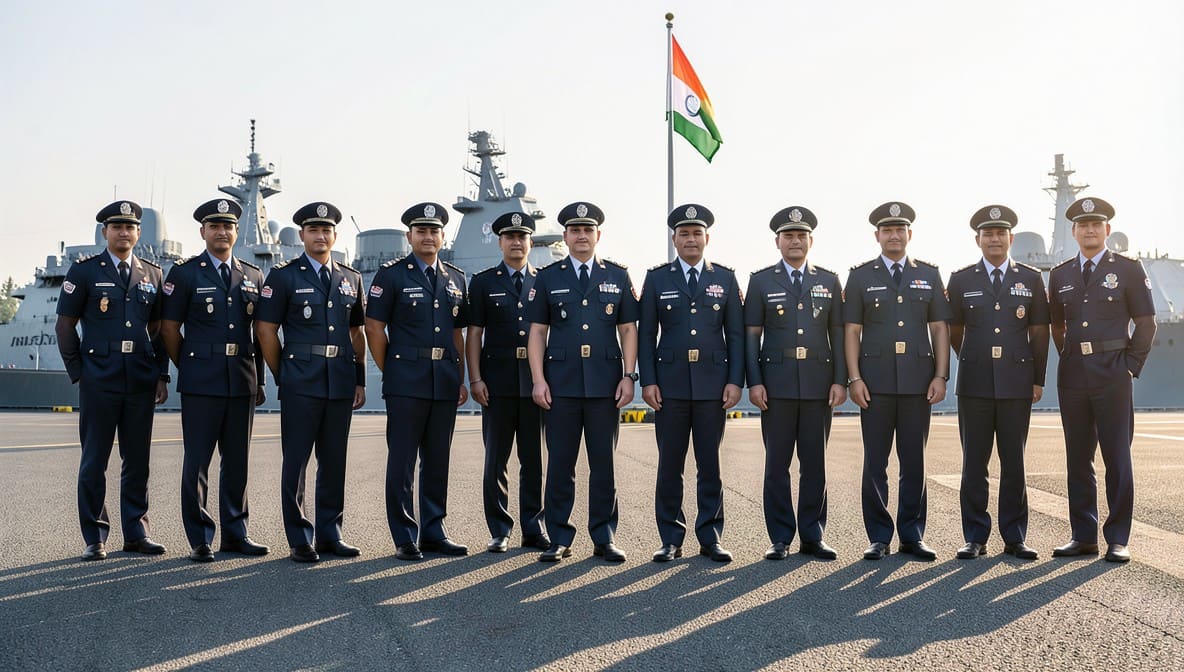
The Supreme Court has delivered a landmark ruling affirming that long-serving Short Service Commission Officers (SSCOs) in the Indian Navy, particularly women and those barred from Permanent Commission (PC) due to historical policy discrimination, are entitled to PC not as a matter of competitive selection, but as a remedial measure for systemic injustice. The judgment ends over two decades of litigation and establishes that procedural opacity and biased ACR evaluations cannot justify denial of career progression.
Background & Facts
The Dispute
This batch of appeals arises from a protracted dispute concerning the grant of Permanent Commission (PC) to Short Service Commission Officers (SSCOs) in the Indian Navy, predominantly women officers inducted between 1991 and 2011. Despite being inducted into the Navy under assurances of future eligibility for PC, these officers were systematically excluded from consideration due to gender-based and cadre-specific restrictions that persisted until 2008. Even after judicial intervention, their career advancement was stymied by opaque, non-transparent selection processes that relied on historically biased Annual Confidential Reports (ACRs).
Key Facts
- Women were first permitted to join the Navy as SSCOs on 26.10.1991, but only in Logistics, Law, and Education branches, with a five-year tenure (vs. seven years for men).
- A policy promise to formulate a PC grant mechanism for SSCWOs by 1997 was never implemented.
- On 06.11.1998, women were permitted to join all four branches of the Navy.
- The policy dated 26.09.2008 restricted PC eligibility to SSCWOs inducted after January 2009 in only three branches - Law, Education, and Naval Architecture.
- On 28.10.2009, the Navy introduced a formal column in ACRs for PC recommendation: "Recommended for PC" or "Not Recommended for PC".
- Officers ineligible for PC under policy were routinely marked "Not Recommended for PC" - not based on merit, but due to institutional assumption of ineligibility.
- The High Court of Delhi, in Babita Puniya v. Secretary (12.03.2010), held that SSCWOs in Army and Air Force were entitled to PC.
- In Annie Nagaraja v. Union of India (04.09.2015), the Delhi High Court held that SSCWOs inducted before 2009 were entitled to PC, quashing the prospective policy.
- The Supreme Court, in Union of India v. Annie Nagaraja (17.03.2020), upheld the High Court’s decision, quashing the 2008 policy and directing that all serving SSCOs be considered for PC under Regulation 203, irrespective of gender or induction date.
- A Selection Board was convened in December 2020 to consider 306 SSCOs for PC, using a "Dynamic Vacancy Model" that allocated vacancies based on a divisor of 15, resulting in only 80 selections out of 306.
- A second Selection Board in September 2022 granted PC to 21 additional officers.
- The Armed Forces Tribunal (AFT), in Lt. Cdr. Tarun v. Union of India (03.01.2022), upheld the methodology but identified procedural flaws.
- The Supreme Court, in Amit Kumar Sharma v. Union of India (07.11.2022), set aside the AFT’s 2022 judgment, holding that non-disclosure of evaluation criteria to officers violated natural justice.
- The AFT, in its Impugned Judgement dated 27.09.2024, directed a fresh Special Selection Board to reconsider all officers denied PC in 2020 and 2022.
- 7 Appellants have since retired; others remain in service under interim orders.
Procedural History
- 1991: Women permitted as SSCWOs in Logistics, Law, Education.
- 1998: Women permitted in all four branches.
- 2008: Policy restricts PC eligibility to SSCWOs inducted after January 2009 in three branches.
- 2009: ACR format amended to include PC recommendation column.
- 12.03.2010: Delhi HC in Babita Puniya holds SSCWOs entitled to PC.
- 04.09.2015: Delhi HC in Annie Nagaraja quashes prospective policy, directs PC for pre-2009 SSCWOs.
- 17.03.2020: Supreme Court upholds Annie Nagaraja, quashes 2008 policy, directs consideration under Regulation 203.
- 29.10.2020: Navy issues circular for Selection Board in December 2020.
- 24.08.2021: Supreme Court transfers Writ Petitions to AFT.
- 03.01.2022: AFT in Lt. Cdr. Tarun upholds vacancy model but identifies procedural gaps.
- 07.11.2022: Supreme Court in Amit Kumar Sharma sets aside AFT’s 2022 judgment for non-disclosure.
- 27.09.2024: AFT issues Impugned Judgement directing fresh Special Selection Board.
- 13.02.2025 & 06.03.2025: AFT issues Impugned Orders for specific officers.
- 24.03.2026: Supreme Court delivers final judgment.
The Parties' Positions
Appellants (SSCOs): Argued that ACRs were graded under the assumption of ineligibility for PC, rendering merit assessments inherently biased. Contended that the Dynamic Vacancy Model was arbitrary, vacancies were not computed at the "material time" (6th/7th year of service), and evaluation criteria were never disclosed, violating natural justice. Sought direct grant of PC and pensionary benefits for retired officers.
Respondents (Union of India): Defended the Dynamic Vacancy Model as a rational, one-time mechanism to manage cadre balance. Asserted that non-disclosure was procedural, not prejudicial, and that selection was merit-based. Argued that granting PC to all would disrupt operational readiness and age profile of the Navy.
Relief Sought
Appellants sought:
- Direct grant of Permanent Commission to all eligible SSCOs who were considered in the 2020 and 2022 Selection Boards but not selected.
- Deemed completion of 20 years of qualifying service for retired officers, entitling them to pension and consequential benefits.
- Payment of pension arrears from 01.01.2025.
- Mandatory disclosure of evaluation criteria and vacancy computation methodology for all future Selection Boards.
The Legal Issue
The central questions were: (1) Whether the ACRs of SSCOs, graded under the assumption of permanent ineligibility for PC, can validly be used to deny them PC after judicial recognition of their eligibility? (2) Whether the Dynamic Vacancy Model, which limited vacancies by dividing total deficiency by 15, is arbitrary and inconsistent with Regulation 203? (3) Whether non-disclosure of evaluation criteria and vacancy computation methodology prior to the Selection Board violates the principles of natural justice?
Arguments Presented
For the Appellant
The Appellants, represented by senior counsel Rekha Palli and Menaka Guruswamy, argued that the ACRs were not objective assessments but institutional records shaped by systemic discrimination. Officers were marked "Not Recommended for PC" not due to performance, but because policy barred them from consideration. This created a self-fulfilling prophecy: ineligibility led to poor ACRs, which then became grounds for denial. They cited Lt. Col. Nitisha v. Union of India to show that such bias in appraisal systems is unconstitutional. They further contended that the Dynamic Vacancy Model, with its divisor of 15, artificially suppressed vacancies and had no basis in policy or precedent. Crucially, they emphasized that the Navy never disclosed the criteria, marks allocation, or vacancy figures to officers before the Selection Board, unlike the Army and Air Force, thereby violating Article 14 and Article 21.
For the Respondent
The Respondent, represented by Additional Solicitor General Aishwarya Bhati, defended the Dynamic Vacancy Model as a rational, one-time mechanism to distribute limited vacancies across 24 batches while preserving the Navy’s pyramidal structure. They argued that the divisor of 15 corresponded to the approximate 15-year service life of a PC officer, ensuring long-term cadre balance. They maintained that non-disclosure was not intentional malice but administrative oversight, and that the AFT’s directions for a fresh board would cure any procedural defect. They also highlighted that SSCOs receive resettlement support, terminal gratuity, and employment quotas, rendering pensionary relief unnecessary.
The Court's Analysis
The Court undertook a rigorous doctrinal analysis of each issue, grounded in constitutional principles of equality, natural justice, and substantive fairness.
On the first issue - ACR grading - the Court held that the institutional assumption of ineligibility for PC during the formative years of service rendered the ACRs unreliable as measures of suitability. As the Court observed:
"The appraisal process was inevitably affected at its inception. Under a bell-curve-based system... higher gradings tend to be reserved for those perceived to have a future in the service... Officers who lacked eligibility for long-term progression were, therefore, routinely awarded average or middling grades, not on account of inferior performance, but because higher grading was perceived to serve no institutional purpose."
The Court drew a direct parallel to its own decision in Lt. Col. Pooja Pal v. Union of India (of even date), holding that such bias cannot be permitted to haunt officers once eligibility is judicially recognized. The use of ACRs to disqualify officers based on endorsements made when they were legally ineligible was held to be a "circularity" that distorted merit.
On the Dynamic Vacancy Model, the Court acknowledged the Respondents’ rationale - preserving age profile and operational readiness - and found the model rational and non-arbitrary. It accepted that the divisor of 15 was not capricious but aligned with the expected tenure of a PC officer. The Court also held that non-exhaustion of vacancies was permissible under Shankarsan Dash v. Union of India, as long as not discriminatory.
However, on the third issue - non-disclosure - the Court found the Navy’s conduct indefensible. Unlike the Army and Air Force, which publicly promulgated selection criteria, the Navy concealed its Approach Paper, vacancy computations, and evaluation parameters in sealed covers. The Court cited the AFT’s own observation:
"While they had the criteria... on record duly approved, the details were not known to the SSCOs being considered... This asymmetry in disclosure... undermined the transparency of the selection exercise."
The Court affirmed that transparency is not optional in public service appointments. The failure to disclose material before the Selection Board rendered the process fundamentally unfair.
Yet, the Court refused to endorse the AFT’s direction for yet another Selection Board. It noted that the Appellants had already endured three rounds of litigation over 15 years. A fourth round, under the same biased ACR regime, would be futile. The Court concluded:
"The result of another consideration by a Selection Board would still not yield any equitable or non-discriminatory result."
The Verdict
The Supreme Court allowed the appeals and modified the AFT’s directions as follows:
- The grant of PC to officers already selected in the December 2020 and September 2022 Selection Boards shall not be disturbed.
- As a one-time measure, the following categories of officers shall be granted Permanent Commission, subject to medical fitness and vigilance clearance: a. SSCWOs inducted into the Navy prior to January 2009; b. SSCWOs inducted after January 2009 in branches excluding Law, Education, and Naval Architecture; c. Male SSCOs barred from PC consideration under their initial terms of service.
- Retired officers who would have fallen within the above categories shall be deemed to have completed 20 years of substantive qualifying service and shall be entitled to pension and all consequential benefits, except arrears of pay.
- Pension shall be calculated from the date of completion of 20 years of service, with arrears payable only with effect from 01.01.2025.
- For all future Selection Boards, the Respondents shall issue General Instructions prior to the conduct of the Board, disclosing vacancies, evaluation criteria, mark allocation, and methodology.
- The Respondents shall undertake the policy review directed by the AFT in Paragraph 66(e) of the Impugned Judgement forthwith.
What This Means For Similar Cases
ACRs Cannot Be Used to Penalize Past Discrimination
- Practitioners must now challenge any service evaluation that relies on historical records shaped by discriminatory policies.
- Where institutional bias has influenced ACRs, courts may disregard them as unreliable and grant relief based on tenure and equity.
- This principle extends beyond the Navy - applicable to Army, Air Force, and civil services where appraisal systems are tied to promotion eligibility.
Non-Disclosure of Selection Criteria Is a Fundamental Violation
- Public sector selection processes must disclose all criteria, weightage, and methodology in advance.
- Sealed cover submissions to tribunals without disclosure to affected parties violate natural justice and will be set aside.
- This judgment reinforces the doctrine that transparency is not a procedural formality but a substantive right under Article 14.
Judicial Remedies Must Be Final, Not Cyclical
- Courts will not permit endless litigation cycles when systemic injustice is evident.
- Where a process is irredeemably flawed, courts may grant direct relief rather than remand for another flawed iteration.
- This sets a precedent for service law cases involving delayed justice - the remedy must be meaningful, not merely procedural.
Pensionary Benefits for Retired Officers Are Now Recognized as Equitable Relief
- Retired officers denied PC due to systemic bias may now claim deemed qualifying service for pension.
- The Court’s recognition of 20 years as the threshold for pension eligibility, even without formal PC, is a significant expansion of service rights.
- This may be invoked in other service disputes where officers are discharged without pension due to technicalities.
Future Selection Boards Must Be Transparent by Design
- All future Selection Boards must publish General Instructions before commencement.
- The Navy’s failure to do so will now be treated as a procedural nullity.
- This requirement applies to all branches of the Armed Forces and public sector recruitment.
Key Takeaways for Practitioners
- Always challenge ACRs that reflect institutional bias, not individual performance.
- Demand disclosure of selection criteria at the earliest opportunity - failure to disclose is a ground for setting aside the entire process.
- Argue for direct relief when litigation has been prolonged and the process is inherently flawed.
- Cite Annie Nagaraja and this judgment to establish that equity overrides rigid procedural timelines in service matters.