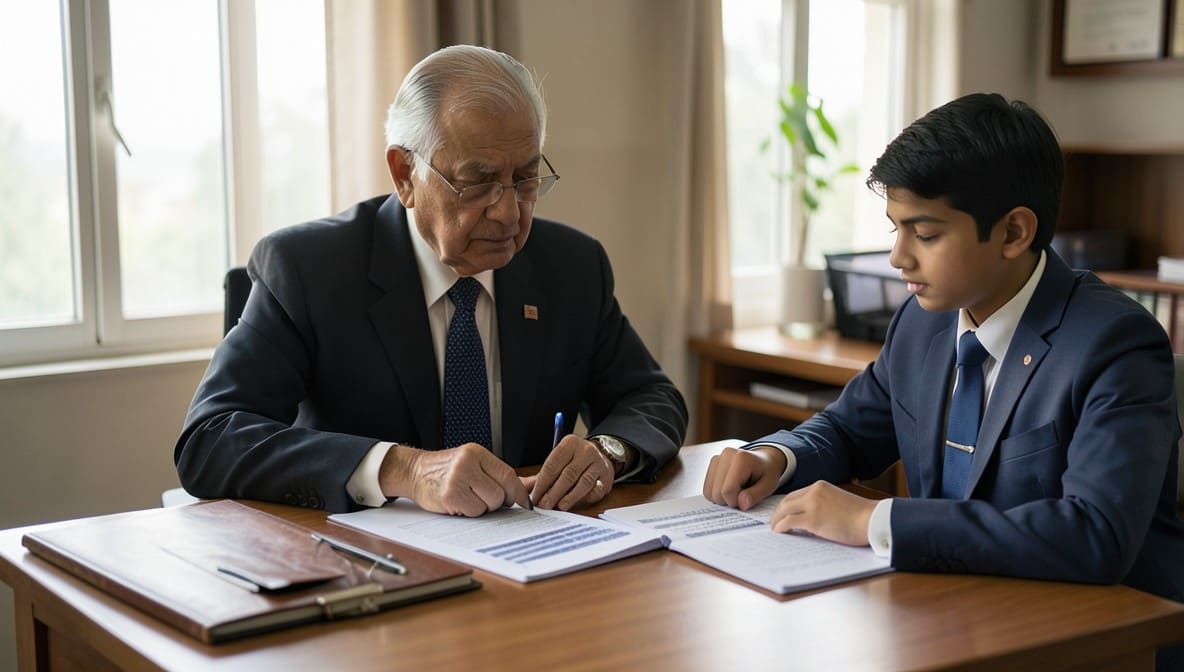
The Madhya Pradesh High Court has decisively affirmed that discriminatory pay classifications under state pay revision rules cannot override constitutional guarantees of equal treatment. In a streamlined order, the Court extended the benefit of the 7th Pay Commission to a petitioner whose claim was squarely covered by a prior binding judgment, ensuring prompt payment of arrears with interest.
Background & Facts
The Dispute
The petitioner, Amar Aahire, sought the implementation of the 7th Central Pay Commission benefits under the M.P. Revision of Pay Rules, 2017. He contended that he was being denied the minimum pay scale applicable to his category of employment - classified as skilled, semi-skilled, or unskilled - due to a discriminatory provision in Rule 2(b)(VIII) of the Rules, which allegedly excluded certain categories of employees from parity with their counterparts.
Key Facts
- The petitioner is a government employee in Madhya Pradesh, employed in a position falling under one of the three categories: skilled, semi-skilled, or unskilled
- He was not granted the revised minimum pay scale under the M.P. Revision of Pay Rules, 2017, despite the 7th Pay Commission recommendations
- Rule 2(b)(VIII) of the Rules was alleged to create an arbitrary distinction among employees performing similar duties
- The petitioner had no recourse to departmental remedies and directly approached the High Court under Article 226
Procedural History
- 17 September 2025: Division Bench of this Court delivered judgment in Writ Petition No. 14925/2024, declaring Rule 2(b)(VIII) of the M.P. Revision of Pay Rules, 2017 as ultra vires and discriminatory
- In that case, the Court held that all three categories - skilled, semi-skilled, and unskilled - must be placed in their corresponding minimum pay scales under the revised rules
- The Court directed payment of arrears to all affected petitioners in that case
- 17 March 2026: Present writ petition filed by Amar Aahire, seeking identical relief
Relief Sought
The petitioner sought:
- Inclusion in the revised minimum pay scale under the M.P. Revision of Pay Rules, 2017
- Payment of arrears from the effective date of the 7th Pay Commission
- Interest at a reasonable rate on the arrears
The Legal Issue
The central question was whether the petitioner, whose case is identical to one already decided by this Court, is entitled to the same relief under the M.P. Revision of Pay Rules, 2017, after Rule 2(b)(VIII) has been declared ultra vires.
Arguments Presented
For the Petitioner
Counsel for the petitioner, Ms. Shweta Gupta, submitted that the issue was already conclusively decided in Writ Petition No. 14925/2024, where the Division Bench held that Rule 2(b)(VIII) violated Article 14 of the Constitution by creating an unreasonable classification. She argued that the principle of res judicata by necessary implication and the doctrine of stare decisis compelled the Court to grant identical relief to the petitioner without requiring fresh arguments.
For the Respondent
The Government Advocate, Shri Kamal Singh Baghel, and counsel for respondents 2 to 5, Ms. Seema Kewat, did not file any written reply. They appeared in court but did not contest the petitioner’s claim, acknowledging the binding nature of the earlier judgment.
The Court's Analysis
The Court observed that the factual and legal matrix of the present petition was indistinguishable from that in Writ Petition No. 14925/2024. The earlier judgment had already declared Rule 2(b)(VIII) ultra vires and directed that all employees in the three categories be placed in their respective minimum pay scales under the M.P. Revision of Pay Rules, 2017. The Court emphasized that judicial pronouncements bind all similarly situated persons, and the State cannot deny relief to one petitioner merely because he filed a separate petition.
"Since issue in this case is covered, therefore, no further time is granted to respondents for filing their reply."
The Court further noted that the State had not raised any new legal or factual ground to distinguish the present case. The petitioner’s entitlement flowed directly from the binding precedent. The Court held that delay in implementation of constitutional rights cannot be permitted, and the State must act promptly to rectify past discrimination.
The Verdict
The writ petition is allowed. The State of Madhya Pradesh and other respondents are directed to grant the petitioner the benefit of the 7th Pay Commission in accordance with the M.P. Revision of Pay Rules, 2017. All three categories of employees - skilled, semi-skilled, and unskilled - shall be placed in their corresponding minimum pay scales. Arrears shall be calculated from the effective date of the 7th Pay Commission and paid with interest at 8% per annum. The order shall be complied with within 60 days from the date of receipt of the certified copy of this judgment.
What This Means For Similar Cases
Identical Claims Must Be Granted Without Fresh Litigation
- Practitioners representing similarly situated employees need not file duplicate writ petitions if a binding precedent exists on identical facts
- Courts may summarily dispose of such petitions under Article 226, saving judicial time and reducing litigation burden
- The doctrine of stare decisis operates as a substantive right in public law matters
Arrears with Interest Are Non-Negotiable in Pay Discrimination Cases
- Interest at 8% per annum has now been judicially recognized as the standard for delayed payment of pay revision benefits in MP
- This rate applies from the effective date of the 7th Pay Commission until actual payment
- Failure to comply within 60 days may attract contempt proceedings
Rule-Based Discrimination Is Constitutionally Unacceptable
- Any rule that creates arbitrary distinctions among employees performing similar duties violates Article 14
- Classification must be based on intelligible differentia with a rational nexus to the object of the law
- Pay revision rules must align with central pay commission recommendations unless a compelling state interest justifies deviation