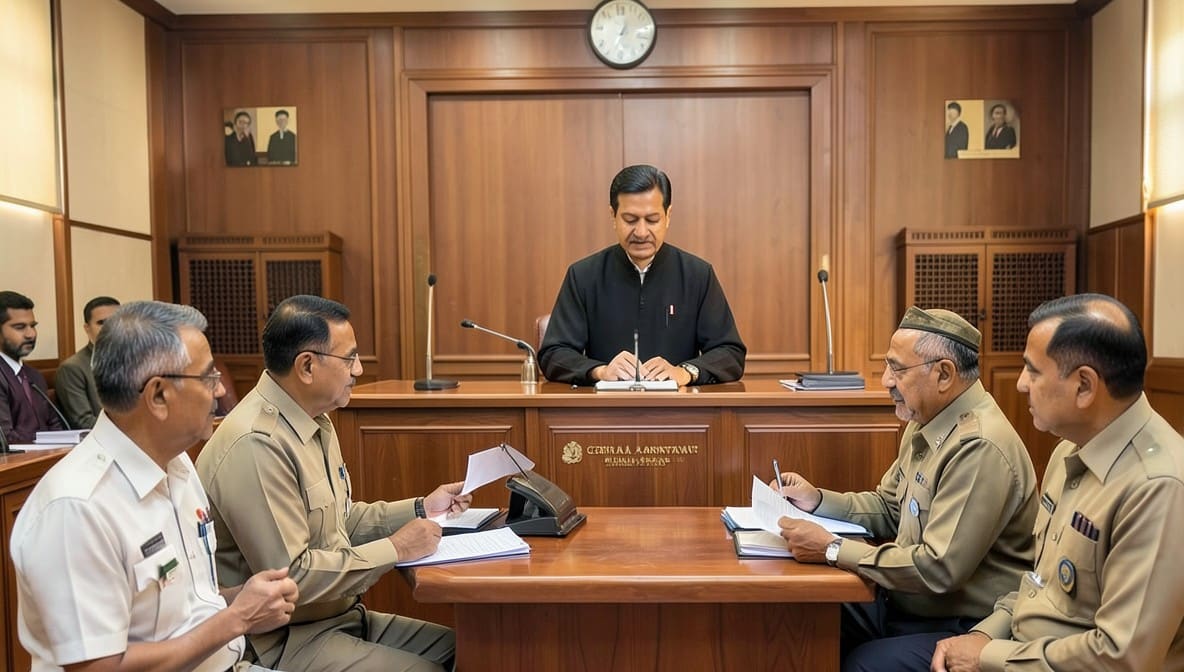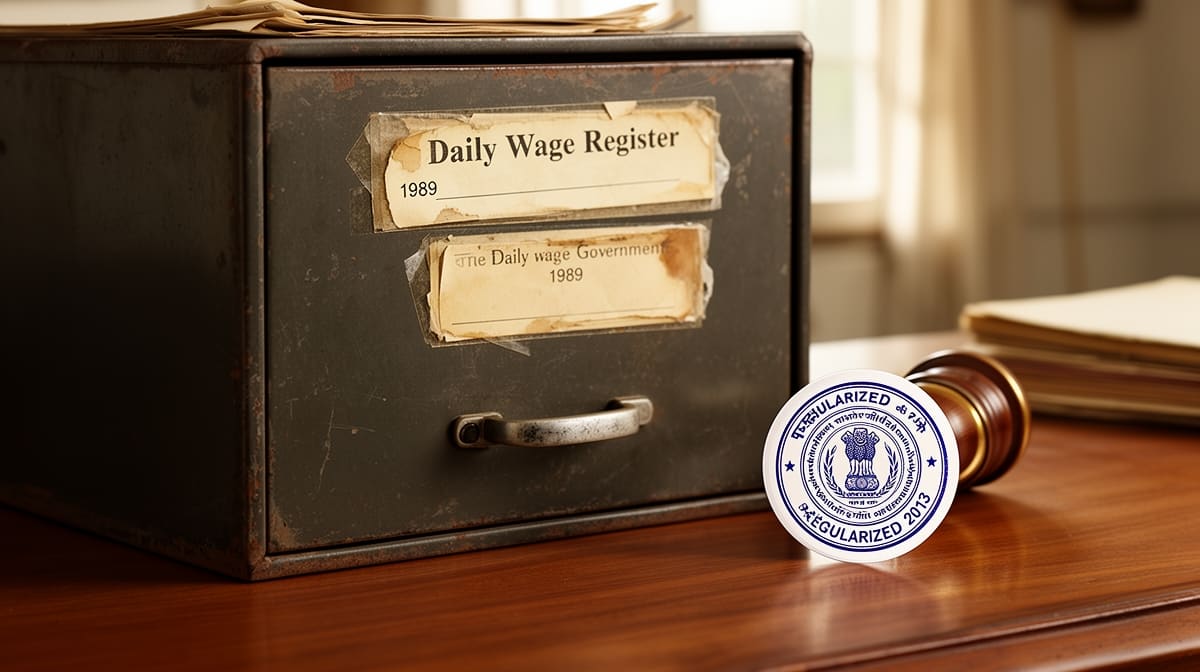
A landmark ruling by the Delhi High Court has affirmed that senior government officers cannot be penalized for administrative failures that result in junior officers drawing higher pay. The Court held that when pay anomalies arise due to the state’s inaction - not the officer’s omission - the principle of pay parity under Fundamental Rule 23 must be enforced to uphold equity in service conditions.
Background & Facts
The Dispute
The petitioners, Shri Ram Kunwar Singh and Shri Kulvir Singh Malik, both retired or serving Deputy Commandants (DC) in the Central Industrial Security Force (CISF), challenged the rejection of their representations seeking pay revision to match that of junior officers - Md. Abdus Salam and Ashwani Kumar - who were drawing higher basic pay despite being junior in seniority. The anomaly stemmed from inconsistent application of pay fixation rules across officers appointed in the same batch.
Key Facts
- Both petitioners were appointed as Sub-Inspectors (Executive) in CISF w.e.f. 04.07.1984 under pay scale Rs.380-12-500-EB-15-560.
- Petitioner No.1 was promoted to Inspector on 12.03.1992 and later to Assistant Commandant (AC) on 01.03.2013 (proforma), repatriated on 28.11.2014. He was promoted to DC on 26.06.2021 and superannuated on 30.09.2021.
- Petitioner No.2 was promoted to Inspector on 01.01.1993 and to AC in 2013, then to DC on 12.11.2021. He remains in service.
- Md. Abdus Salam (CISF No.8501001), appointed in the same batch, was granted an ante-dated increment w.e.f. 01.03.1986 (instead of 01.07.1986) at par with another officer, Geeta Singh.
- Ashwani Kumar, appointed on 30.06.1987, was granted 3rd Financial Upgradation (FUG) under MACP w.e.f. 30.06.2017 and later promoted to AC on 02.02.2019.
- As of July 2021, petitioners drew basic pay of Rs.93,800/-, while Md. Abdus Salam drew Rs.96,600/- and Ashwani Kumar drew Rs.92,700/-.
- The petitioners submitted representations on 08.02.2021 and 23.02.2021 seeking pay parity.
Procedural History
- 22.07.2021: Respondents issued two impugned orders rejecting the petitioners’ requests.
- 25.07.2021: Petitioners received the rejection letters.
- 23.03.2022: Writ Petition (W.P.(C) No.2549/2022) filed before the Delhi High Court.
- 20.04.2026: Judgment delivered by the Division Bench.
The Parties' Positions
Petitioners: Argued that the pay disparity was entirely due to administrative failure - specifically, non-implementation of ante-dating benefits and non-grant of option to revise increment dates under FR 23 and DoPT OM 26.10.2016. They were not at fault for not availing benefits; the department failed to notify or process their claims.
Respondents: Contended that the petitioners did not apply for ante-dating of increments, and that the juniors’ higher pay resulted from valid exercise of options under FR 22 and MACP rules. They claimed the anomaly was not attributable to departmental lapse but to individual inaction.
Relief Sought
- Quash the orders dated 22.07.2021.
- Direct respondents to fix petitioners’ pay at par with Md. Abdus Salam and Ashwani Kumar w.e.f. the date the juniors started drawing higher pay.
- Grant arrears of pay and consequential benefits.
- Revise the PPO of Petitioner No.1 to reflect corrected pay for retiral benefits.
The Legal Issue
The central question was whether Fundamental Rule 23 mandates stepping up of pay for a senior government servant when a junior, appointed in the same cadre and holding an identical post, draws higher pay due solely to administrative inaction by the department, and not due to any fault or omission by the senior.
Arguments Presented
For the Petitioner
Mr. Ankur Chhibber submitted that the pay disparity arose exclusively due to the department’s failure to extend the benefit of ante-dating increments under Proviso 2 to Rule 8 of CCS (RP) Rules, 2008, which was available to all officers in the batch. He relied on Tejbir Singh Dagar v. Union of India (2014 SCC OnLine Del 45) and Vijayan VV v. Union of India (W.P.(C) No.4448/2016), where the Delhi High Court held that delay cannot defeat a continuing wrong arising from pay anomalies. He emphasized that FR 23 obligates the state to correct such disparities, regardless of whether the senior applied for the benefit, as the duty to ensure equitable pay lies with the employer. He further cited DoPT OM dated 26.10.2016, which reiterated the principle of pay parity for officers promoted after 01.01.2016.
For the Respondent
Mr. Farman Ali, CGSC, argued that the petitioners never applied for ante-dating of increments, and that the juniors’ higher pay resulted from valid exercise of options under FR 22 and MACP rules. He contended that the petitioners were not denied any benefit - they simply failed to avail options that were available to them. He relied on DoPT OM dated 22.10.2019 (S.No.20), which permits stepping up only if specific conditions are met, including identical pay levels and concurrent grant of MACP. He asserted that since Petitioner No.2 was in Level 11 and Ashwani Kumar in Level 9, the conditions were not satisfied, and thus no parity could be granted.
The Court's Analysis
The Court rejected the respondents’ argument that the petitioners’ failure to apply for ante-dating absolved the state of its duty. It observed that the very premise of FR 23 is to correct anomalies caused by departmental administration, not individual negligence. The Court noted that the impugned orders admitted that the benefit of ante-dating was available to the petitioners but their applications were not received - "for reasons best known to the concerned units." This admission, the Court held, was tantamount to acknowledging administrative failure.
"The state cannot permit a junior to benefit from a policy meant for equity, while leaving the senior to suffer the consequences of its own inaction. The duty to ensure parity under FR 23 is not contingent on the senior’s vigilance."
The Court distinguished DoPT OM 22.10.2019 as applicable only to MACP cases where both officers are in the same pay level. In this case, the anomaly arose from pre-MACP pay fixation errors in the 1980s and 1990s, squarely falling under FR 23 and DoPT OM 26.10.2016. The Court further held that the pay fixation issue is a continuing wrong, and thus not barred by limitation, as affirmed in Union of India v. Tarsem Singh (2008) and Shriniwas v. Union of India (2016).
The Court emphasized that the department had, in fact, corrected the pay of Ashwani Kumar under the same rules, proving that the mechanism existed and was applied selectively. The failure to extend the same to the petitioners was arbitrary and violative of Article 14 of the Constitution.
The Verdict
The petition succeeded. The Delhi High Court set aside the orders dated 22.07.2021. The respondents are directed to fix the pay of both petitioners at par with Md. Abdus Salam and Ashwani Kumar w.e.f. the date each junior started drawing higher pay, on a notional basis. Arrears shall be paid for the three years preceding the rejection of the representation, i.e., from 22.07.2021, and shall continue thereafter. The PPO of Petitioner No.1 shall be revised to reflect corrected retiral benefits. The respondents shall comply within eight weeks from the date of judgment, with interest at 6% per annum on all arrears.
What This Means For Similar Cases
Pay Parity Is a State Obligation, Not a Privilege
- Practitioners must argue that FR 23 imposes a non-delegable duty on the state to correct pay anomalies arising from administrative delay, regardless of whether the senior officer filed a formal application.
- The burden shifts to the department to prove that the senior was aware of the benefit and deliberately chose not to apply.
Continuing Wrong Doctrine Applies to Pay Fixation
- Any pay disparity traceable to systemic departmental failure constitutes a continuing wrong, making claims immune to limitation defenses.
- Courts will not permit the state to use procedural lapses as a shield against substantive equity.
MACP Rules Do Not Override FR 23
- DoPT OM 22.10.2019 (MACP conditions) cannot be invoked to deny parity where the anomaly predates MACP and falls squarely under FR 23.
- Officers must be compared based on identical posts and cadres, not merely pay levels at the time of MACP.
Actionable Takeaways for Practitioners
- In service cases involving pay disparity, always plead FR 23 and cite Tejbir Singh Dagar and Vijayan VV.
- Demand production of seniority lists, pay fixation records, and departmental circulars to prove selective application of benefits.
- Seek arrears for three years prior to the rejection of representation, as held in this judgment.