The Bombay High Court has delivered a stern rebuke to litigants who attempt to fabricate property rights through post-hoc alterations and procedural manipulation. In a case marked by conflicting claims over a divided flat, the Court emphasized that legal ownership cannot be conjured from unverified assertions, undocumented conversions, or strategic litigation delays. The judgment reinforces the primacy of documentary evidence and procedural integrity in cooperative housing disputes.
Background & Facts
The Dispute
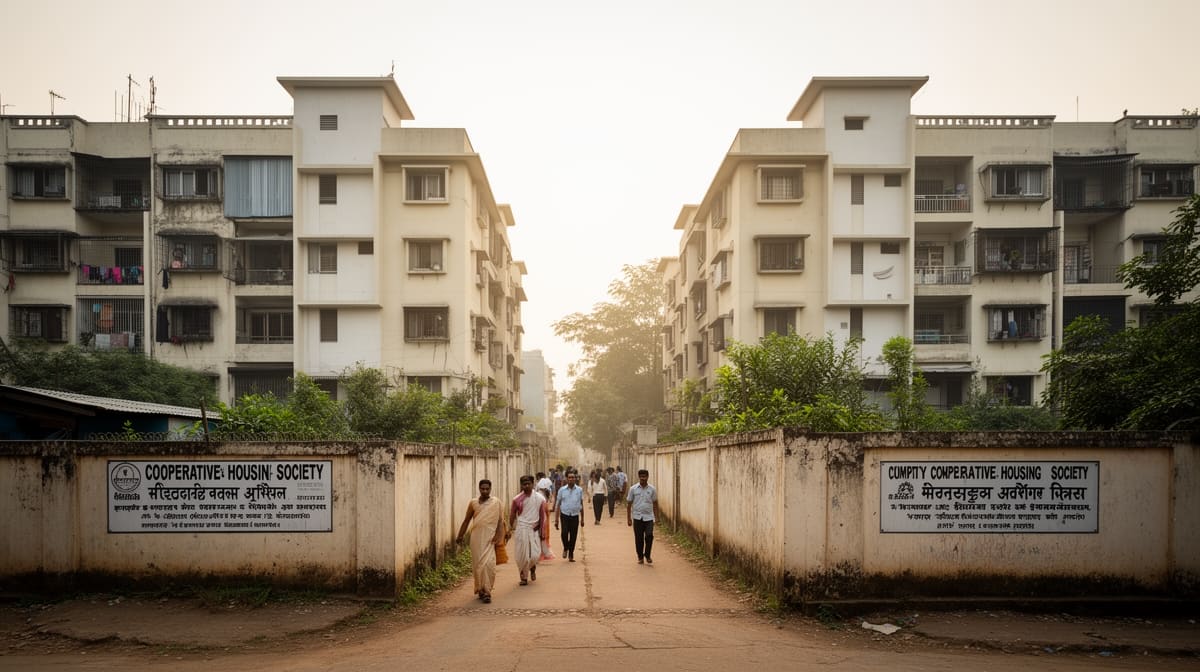
The dispute centers on Flat No. 702 in the Suyog Darshan Co-operative Housing Society, Mumbai. Respondent No. 5, a government employee, was entitled to Flat No. 402 but was wrongly allotted Flat No. 702, which was illegally occupied by another party. After a Cooperative Court award directed the Society to provide him an alternative flat of equivalent size, Flat No. 702 was identified as the suitable replacement. However, Appellant No. 1, a businessman, claimed ownership of Flat No. 702, asserting that he had purchased Flat No. 701 (1500 sq. ft.) in 2008 and subsequently divided it into two units: Flat No. 701 and Flat No. 702.
Procedural History
The case progressed through multiple forums:
- 2004: The Society filed Suit No. 5751 of 2004 against original owner Snehalata Jaiswal, alleging fraudulent allotment of multiple flats, including Flat No. 701 and 702. The suit was dismissed in 2010.
- 2009: Respondent No. 5 filed a claim before the Cooperative Court seeking possession of Flat No. 402. The Court awarded him an alternative flat.
- 2010: The Appellate Court, in Appeal No. 34/2009, directed the Society to hand over vacant possession of Flat No. 702 to Respondent No. 5. When the Society failed to comply, a Court Receiver was appointed.
- 2010: Appellant No. 1, who had never been impleaded in the proceedings, filed M.A. 151/2010 seeking review of the Appellate Court’s orders. The application was dismissed on grounds of non-maintainability and lack of ownership proof.
- 2011: Appellant No. 1 filed Writ Petition No. 1461 of 2011 before the Single Judge, challenging the dismissal. The petition was dismissed on the ground that ownership disputes must be resolved in appropriate civil forums.
- 2011 - 2024: Letters Patent Appeal was filed, dismissed for non-prosecution, and later restored.
Relief Sought
Appellant No. 1 sought recall of the Appellate Court’s orders, restoration of possession of Flat No. 702, and quashing of the Court Receiver’s appointment. He claimed ownership based on a sale deed for Flat No. 701 and alleged that the division into two flats was legitimate. Respondent No. 5 sought enforcement of the Appellate Court’s order granting him possession.
The Legal Issue
The central question was whether a party can claim ownership of a flat based solely on a sale deed for a different unit, coupled with an unverified assertion of physical division, without any approval from the housing society or documentary evidence of structural alteration.
Arguments Presented
For the Appellant
Appellant No. 1 contended that:
- He was not given notice or opportunity to be heard before the Appellate Court passed orders affecting his rights, violating principles of natural justice.
- The sale deed dated 16 January 2008 for Flat No. 701 (1500 sq. ft.) entitled him to the entire unit, and the division into two flats was a legitimate structural modification.
- The Leave and License agreements with Kayur Shastri and others established his de facto control and possession.
- The Appellate Court’s orders were obtained by suppression of facts, particularly the dismissal of Suit No. 5751 of 2004.
For the Respondent
Respondent No. 5 and the State countered that:
- The sale deed explicitly pertained only to Flat No. 701, not Flat No. 702.
- The Society’s approved plan showed Flat No. 701 as 600 sq. ft., not 1500 sq. ft., rendering the division claim false.
- Appellant No. 1 never sought membership for Flat No. 702, nor obtained society approval for subdivision.
- The F.I.R. filed in 2005 referenced Flat No. 702 as existing prior to 2008, contradicting the claim of post-purchase division.
- The Appellant’s conduct demonstrated mala fide intent to delay justice and deprive a bona fide government employee of his rightful accommodation.
The Court's Analysis
The Court conducted a meticulous review of documentary evidence and procedural history. It found that Appellant No. 1 had no title deed, society resolution, or municipal approval for the alleged division of Flat No. 701 into two units. The Court emphasized that ownership in cooperative housing societies is governed by bylaws, membership records, and approved plans - not unilateral acts of partition.
"The applicant is claiming to be the owner of flat no.702, but sale deed filed by him shows that, he is owner of flat No.701. Nobody is concerned with flat no.701, because here the dispute is only for flat no. 702... Except mentioning in the sale deed that flat no.701 of having 1500 sq.ft. the applicant has not filed a single authenticated document to show that flat no.701 is of 1500 sq.ft."
The Court rejected the argument that lack of notice to Appellant No. 1 in the Appellate Court proceedings invalidated the orders. It held that natural justice applies only when a person has a legitimate interest in the subject matter. Since Appellant No. 1 could not establish any legal right over Flat No. 702, his absence from proceedings did not constitute a violation.
The Court further dismissed the claim of fraud by the Society, noting that the dismissal of Suit No. 5751 of 2004 did not validate Appellant No. 1’s claim. The F.I.R. filed in 2005, which referenced Flat No. 702 as an existing unit, directly contradicted his narrative of post-2008 creation. The Court characterized the Leave and License agreements as sham transactions designed to create a facade of possession.
The Court also scrutinized the approved building plan submitted by Respondent No. 5, which confirmed Flat No. 701’s original area as 600 sq. ft., not 1500 sq. ft. This rendered Appellant No. 1’s entire theory of division baseless. The Court concluded that the burden of proving ownership lies with the claimant, and mere assertion without corroboration is insufficient.
The Verdict
The Appellant lost. The Bombay High Court upheld the Single Judge’s order dismissing the writ petition. The Court held that ownership of a flat in a cooperative society cannot be established through unapproved structural division or post-hoc documentation. The Appellant’s claims were found to be unsubstantiated, and his conduct was deemed mala fide. The Court Receiver’s appointment remained valid, and Respondent No. 5 was entitled to possession.
What This Means For Similar Cases
Documentary Proof Is Non-Negotiable
- Practitioners must insist on verified documents: approved building plans, society membership records, and municipal sanction for structural changes.
- Sale deeds must precisely match the unit claimed; vague references to "composite flats" will not suffice.
- Oral testimony or possession alone cannot override registered documents or society records.
Natural Justice Does Not Protect Baseless Claims
- A party without a prima facie interest in property cannot invoke natural justice to challenge orders affecting that property.
- Courts will not entertain review applications from parties who deliberately avoided joining original proceedings.
- Delay in raising ownership claims, especially after possession has been transferred, will be viewed as tactical litigation.
Fraud Allegations Require Concrete Evidence
- Mere allegations of suppression or fraud must be supported by contemporaneous documents or credible testimony.
- Courts will not entertain speculative claims of fraud to overturn orders where the claimant has no underlying title.
- The burden of proving fraud rests squarely on the party alleging it, and mere suspicion is inadequate.