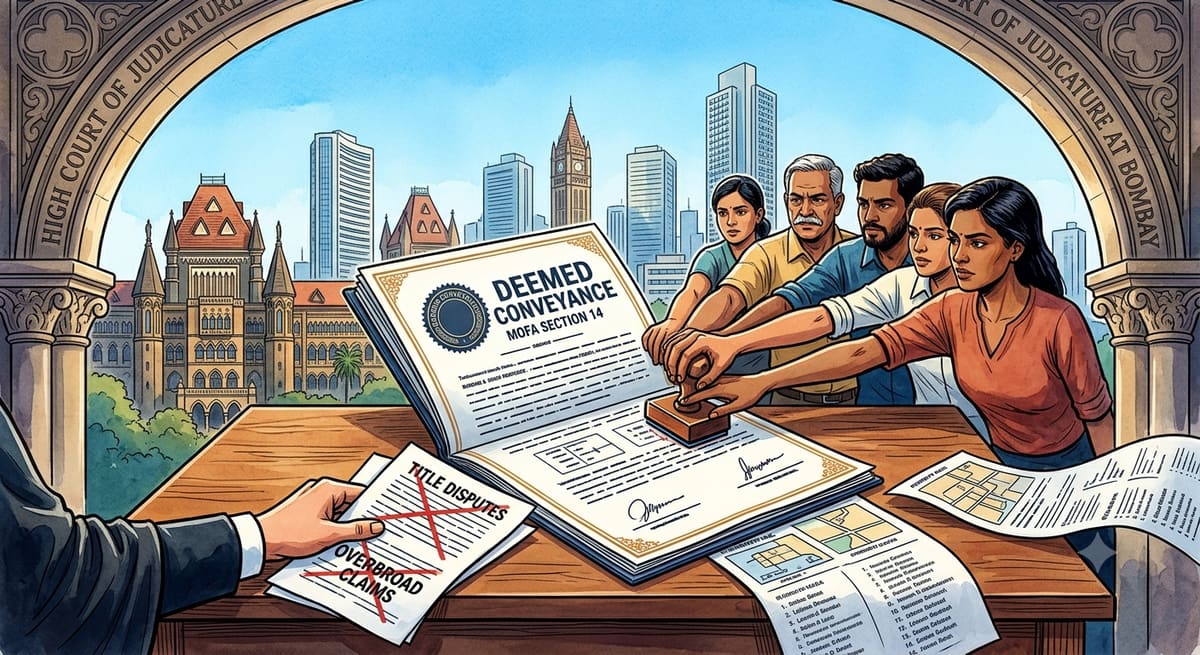
The Bombay High Court has clarified a critical procedural safeguard under Section 34 of the Specific Relief Act, 1963: a suit filed solely for declaration of title cannot be expanded into a decree for specific performance or conveyance without an explicit prayer. The judgment underscores that courts cannot grant reliefs beyond the pleadings, even under statutory obligations like The Maharashtra Ownership Flats Act, 1963 (MOFA).
Background & Facts
The Dispute
The appellants, legal heirs of Waman Narayan Bhave (deceased), challenged concurrent decrees passed by the trial court and first appellate court in favour of Dev Bappa Co-operative Housing Society Ltd. The society had filed a suit seeking a declaration that it was the owner of a plot of land admeasuring 1,166 square yards (Tikka No. 5, City Survey Nos. 67-P and 68-P, Kharkarali, Thane) along with the building constructed thereon. The trial court not only declared the society as the owner but also directed the original defendant (Bhave) to execute a conveyance deed in favour of the society and its members.
Key Facts
- The society relied on an agreement dated 20.01.1977, allegedly executed by Bhave, agreeing to sell the land for Rs. 2,30,000. The society claimed to have paid Rs. 500 as advance but alleged Bhave had no intention of completing the contract.
- The society also relied on individual agreements executed under MOFA for flats occupied by its members. However, Bhave contended that most members failed to make payments, rendering the agreements unenforceable.
- The society had earlier filed Special Civil Suit No. 8 of 1981 for recovery of Rs. 1,99,570, which was partly decreed (Rs. 93,316 with interest). This decree was later set aside in Civil Appeal No. 252 of 2000 for lack of evidence.
Procedural History
- 1981: Society files Regular Civil Suit No. 9 of 1981 for declaration of title.
- 31.08.1989: Trial court decrees the suit, declaring the society as owner and directing Bhave to execute conveyance.
- 04.12.2002: First appellate court (II Additional District Judge, Thane) dismisses Bhave’s appeal (Civil Appeal No. 299 of 1990).
- 20.06.2003: Second Appeal (SA No. 425 of 2003) admitted by Bombay High Court on substantial questions of law.
- 11.07.2001: Bhave’s Civil Revision Application No. 1022 of 2000 (challenging the amendment to add conveyance prayer) disposed of after society withdraws the amendment application.
- 08.06.2026: Bombay High Court allows the second appeal, setting aside the impugned decrees.
The Parties' Positions
- Appellants: Argued that the society’s suit was solely for declaration of title, with no prayer for conveyance. Without proof of compliance with individual flat agreements under MOFA, the society was not entitled to conveyance. The trial and appellate courts erred by granting specific performance without a prayer.
- Respondent (Society): Contended that Section 4A of MOFA entitled it to conveyance based on individual agreements executed under MOFA. It argued that Bhave failed to complete construction, forcing the society to incur costs, and thus Section 34 of the Specific Relief Act justified the decree.
Relief Sought
The appellants sought:
- Quashing of the decrees dated 31.08.1989 and 04.12.2002.
- Dismissal of Regular Civil Suit No. 9 of 1981.
- No order as to costs.
The Legal Issue
The central questions were:
- Whether a suit filed solely for declaration of title under Section 34 of the Specific Relief Act can be converted into a decree for specific performance or conveyance without an explicit prayer?
- Whether the provisions of MOFA override the procedural requirements of the Specific Relief Act, allowing courts to grant reliefs not sought in the plaint?
Arguments Presented
For the Appellants
- The society’s plaint contained no prayer for conveyance or specific performance. The trial court erred by granting reliefs beyond the pleadings.
- Section 34 of the Specific Relief Act bars courts from granting reliefs not sought, especially when the plaintiff could have prayed for further relief but omitted to do so.
- The society’s withdrawal of its amendment application (to add conveyance prayer) during the revision proceedings estopped it from claiming such relief later.
- Individual agreements under MOFA did not confer title on the society, as most members failed to comply with payment terms.
For the Respondent
- The society relied on Section 4A of MOFA, which mandates conveyance of land to the society once construction is complete.
- The agreement dated 20.01.1977 and individual MOFA agreements entitled the society to conveyance, as Bhave failed to complete construction.
- The society incurred costs to complete the building, justifying the decree under Section 34 of the Specific Relief Act.
The Court's Analysis
The High Court held that the trial and appellate courts misapplied the law by granting reliefs not sought in the plaint. Key observations:
-
Pleadings Define Relief:
"A perusal of the entire plaint does not reveal any pleadings or cause of action to seek conveyance under the provisions of MOFA." The society’s suit was solely for declaration of title, with no prayer for conveyance or specific performance. Courts cannot grant reliefs beyond the pleadings, even under statutory obligations like MOFA.
-
Section 34 of the Specific Relief Act: The proviso to Section 34 bars courts from granting declarations where the plaintiff could have sought further relief but omitted to do so. The society’s withdrawal of its amendment application to add a conveyance prayer was fatal to its case.
-
MOFA Does Not Override Procedural Safeguards: While MOFA imposes obligations on promoters to convey land to societies, it does not dispense with the procedural requirements of the Specific Relief Act. The society’s failure to pray for conveyance in its plaint precluded the courts from granting it.
-
No Valid Title: The society relied on individual agreements under MOFA and an agreement dated 20.01.1977, but there was no valid title document in its favour. The courts erred by assuming entitlement to conveyance based on incomplete agreements.
-
Perverse Findings: The trial and appellate courts exceeded their jurisdiction by granting a decree for specific performance in a suit solely for declaration. Their findings were perverse and beyond the scope of the pleadings.
The Verdict
The Bombay High Court allowed the second appeal, setting aside the impugned decrees:
- Judgment and Decree dated 04.12.2002 (II Additional District Judge, Thane, in Civil Appeal No. 299 of 1990) and Judgment and Decree dated 31.08.1989 (IInd Joint Civil Judge, Thane, in Regular Civil Suit No. 9 of 1981) were quashed and set aside.
- Civil Appeal No. 299 of 1990 was allowed, and Regular Civil Suit No. 9 of 1981 was dismissed.
- No order as to costs was passed.
What This Means For Similar Cases
Courts Cannot Grant Reliefs Not Prayed For
- Practitioners must ensure that pleadings strictly match the relief sought. Courts cannot grant reliefs beyond the plaint, even under statutory obligations like MOFA.
- Amendment applications must be pursued diligently. Withdrawal of an amendment to add a prayer (e.g., for conveyance) can estop the plaintiff from claiming that relief later.
Section 34 of the Specific Relief Act Is a Procedural Safeguard
- Section 34’s proviso is a non-negotiable bar: if a plaintiff could have sought further relief (e.g., specific performance) but omitted to do so, courts cannot grant a declaration.
- This judgment reinforces that statutory obligations (e.g., under MOFA) do not override procedural requirements of the Specific Relief Act.
Evidence of Title and Compliance Is Critical
- Individual agreements under MOFA do not automatically confer title on a society. Compliance with payment terms and construction obligations must be proved.
- Photocopies of agreements (e.g., Exhibit-35) are insufficient to establish title. Plaintiffs must produce original title documents or valid conveyance deeds.
- Recovery suits (e.g., for construction costs) must be backed by cogent evidence. Dismissal of such suits for lack of evidence can weaken the plaintiff’s position in related proceedings.