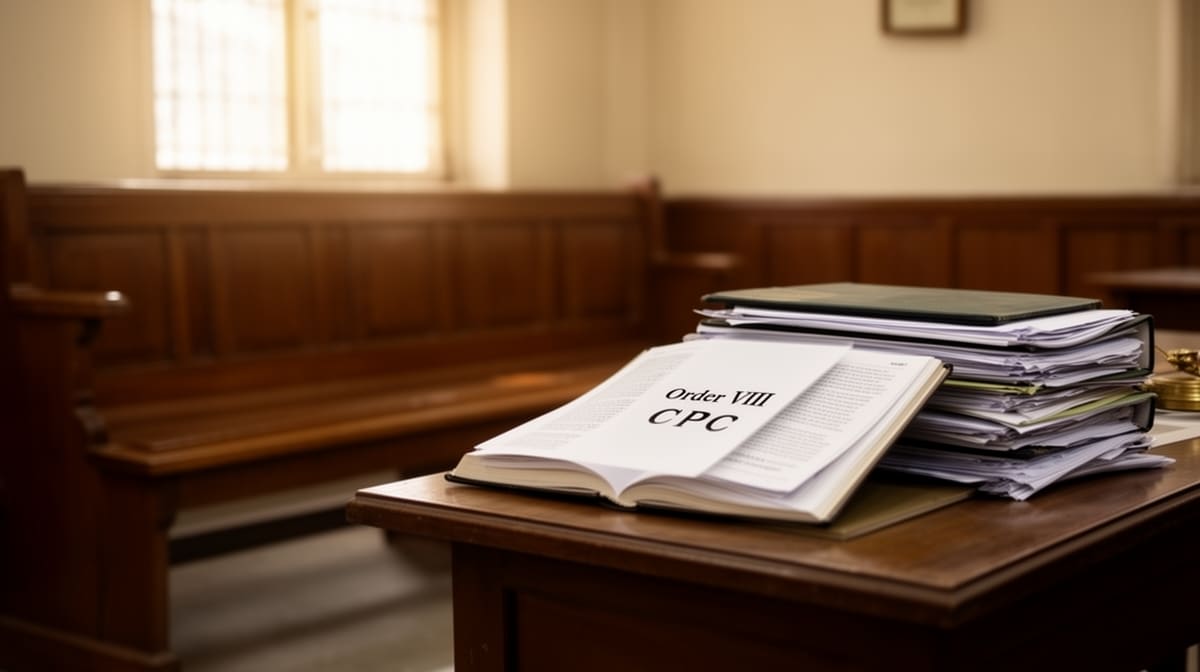
The Bombay High Court has reaffirmed that courts must evaluate the substance of explanations for non-appearance in civil suits, not merely their formal compliance. In a significant ruling under Order IX Rule 9 of the Code of Civil Procedure, the Court restored a suit dismissed in default due to a technical oversight, emphasizing that procedural rigidity must not override substantive justice.
Background & Facts
The Dispute
The appellant, M/s. Timekeepers the Watch Boutique, filed Original Suit No. 1113 of 2017 against the Municipal Corporation of Greater Bombay seeking relief related to property rights and municipal obligations. The suit remained pending for nearly nine years, with multiple hearings and interim applications.
Key Facts
- The suit was filed on 15.04.2017
- An interim order dated 25.04.2017 was granted in favor of the plaintiff
- The matter was listed for hearing on 21.02.2026
- On that date, the plaintiff had withdrawn instructions from his advocate of record but had engaged new counsel
- The advocate who appeared on 21.02.2026 was duly authorized and informed the court of the change in representation
- Despite this, the Trial Court dismissed the suit in default on 18.03.2026
- The dismissal was based solely on the ground that the affidavit-in-support filed by the plaintiff did not explicitly state the reason for non-appearance on 21.02.2026
- The affidavit, however, contained detailed explanations regarding the change of counsel, communication delays, and steps taken to ensure representation
Procedural History
- 15.04.2017: Original Suit No. 1113 of 2017 filed before the City Civil Court, Mumbai
- 25.04.2017: Interim order granted in favor of plaintiff
- 21.02.2026: Hearing date; plaintiff’s advocate appeared and informed court of change in representation
- 18.03.2026: Trial Court dismissed suit in default under Order IX Rule 9 CPC, citing failure to disclose reason for non-appearance in affidavit
- 26.02.2026: Notice of Motion No. 942 of 2026 filed for restoration of suit
- 18.03.2026: Notice of Motion dismissed by Trial Court
- 26.03.2026: Appeal from Order No. 8622 of 2026 filed before Bombay High Court
Relief Sought
The appellant sought: (1) setting aside of the order dated 18.03.2026 dismissing the suit; (2) restoration of the suit and the interim order dated 25.04.2017; and (3) directions for expeditious disposal of the suit.
The Legal Issue
The central question was whether the Trial Court was justified in dismissing a suit under Order IX Rule 9 of the Code of Civil Procedure, 1908 solely because the affidavit-in-support did not explicitly state the reason for non-appearance on one hearing date, despite the affidavit containing substantive explanations for the absence.
Arguments Presented
For the Appellant
Mr. Amogh Singh, learned Advocate for the appellant, submitted that the affidavit-in-support filed by the plaintiff contained detailed and credible reasons for non-appearance, including the withdrawal of instructions from the previous counsel and the engagement of new counsel who appeared in court. He relied on S. R. Batra v. S. R. Batra and K. S. Puttaswamy v. Union of India to argue that courts must adopt a liberal interpretation of Order IX Rule 9 to prevent injustice caused by technicalities. He emphasized that the advocate who appeared was duly authorized and had informed the court, thereby fulfilling the spirit of the rule.
For the Respondent
The respondent, Municipal Corporation of Greater Bombay, did not appear before the High Court and filed no written submissions. The Court proceeded ex parte, noting the absence of any counter-argument.
The Court's Analysis
The Court examined the affidavit-in-support appended at page 27 of the appeal record and found that it contained a clear, chronological account of the events leading to the non-appearance. The plaintiff explained that he had terminated the services of his previous advocate on 19.02.2026 and engaged new counsel, who appeared on 21.02.2026 and apprised the court of the change. The Trial Court, however, ignored these substantive facts and focused exclusively on the absence of a specific phrase in the affidavit.
"Prima facie when the said Affidavit is seen, substantive reasons have been given. Hence, this Court fails to understand as to why and how the learned Trial Court has assumed that Plaintiff has failed to satisfy the Court about sufficient cause."
The Court held that Order IX Rule 9 CPC requires the court to assess whether sufficient cause has been shown, not whether the affidavit uses particular words. The presence of detailed factual narration, coupled with the actual appearance of a duly authorized advocate, constituted sufficient cause under the rule. The Trial Court’s mechanical application of the rule, without considering the context, amounted to a failure to exercise judicial discretion.
The Court further noted the extraordinary delay of nearly nine years in the pendency of the suit and emphasized that justice delayed is justice denied. It observed that the suit was ripe for adjudication and that further delay would prejudice the rights of the parties.
The Verdict
The appeal was allowed. The order dated 18.03.2026 dismissing the suit in default was set aside. Notice of Motion No. 942 of 2026 was allowed. Original Suit No. 1113 of 2017 and the interim order dated 25.04.2017 were restored to the record. The Trial Court was directed to dispose of the suit within ten months from the date of this order. The plaintiff was directed not to seek adjournments on frivolous grounds, and any such request may be summarily denied unless grave exigency is shown. The interim application was disposed of as infructuous.
What This Means For Similar Cases
Substantive Compliance Trumps Formal Deficiencies
- Practitioners must ensure affidavits under Order IX Rule 9 contain detailed factual narratives, not just boilerplate language
- Courts must evaluate the totality of circumstances, including actual appearance of counsel and communication with the court
- A failure to use the exact phrase "reason for non-appearance" does not invalidate an affidavit if the substance is clear
Judicial Discretion Must Be Exercised Liberally
- Dismissal in default should be a last resort, not a default response
- Courts must balance procedural compliance with the right to a fair hearing
- Delay in adjudication weighs heavily in favor of restoration, especially in long-pending suits
Procedural Fairness Over Technicality
- The appearance of a duly authorized advocate who informs the court of representation changes satisfies the intent of Order IX Rule 9
- Judges must avoid mechanical application of rules that lead to substantive injustice
- This judgment reinforces the principle that procedural law serves substantive justice, not the reverse