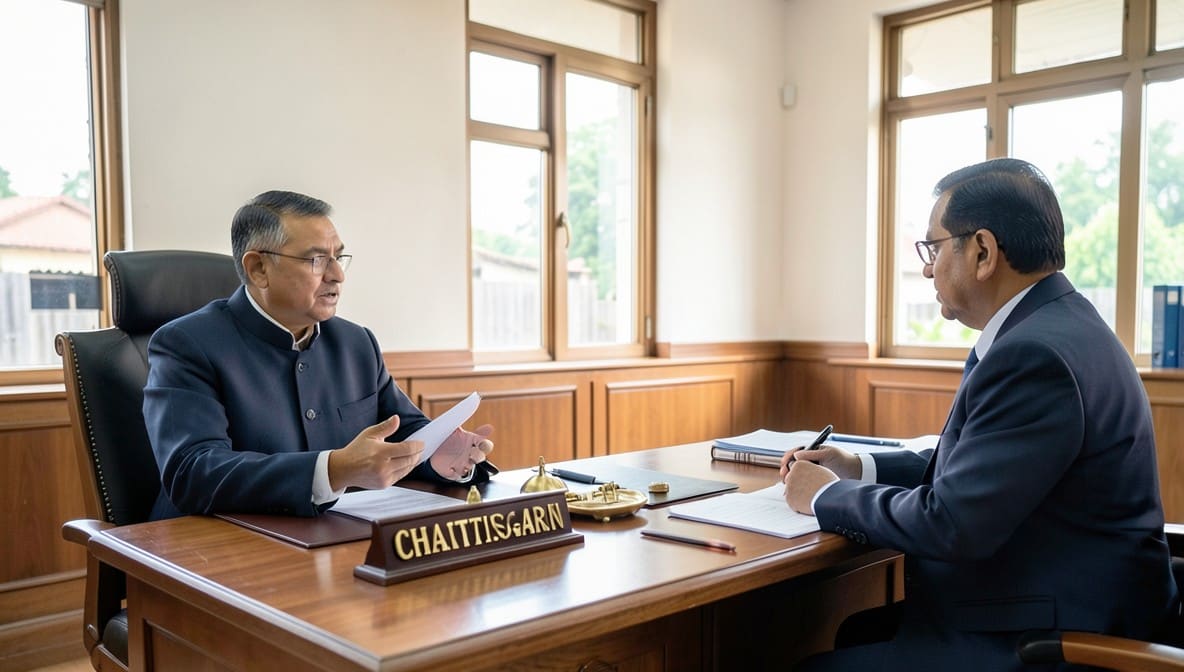
The Chhattisgarh High Court has reaffirmed the narrow scope of review jurisdiction under the Code of Civil Procedure, holding that a review petition cannot serve as a substitute for appeal or a mechanism to reargue factual and legal conclusions already decided. This judgment underscores the finality of judicial orders and the strict limits on reopening settled matters.
Background & Facts
The Dispute
The dispute arose over title to agricultural land in Village Kerju, Tahsil Sitapur, District Surguja, Chhattisgarh. The plaintiffs claimed ownership based on long possession and mutation entries, while the defendants asserted continuous possession since 1951-52. The suit was filed in 1989, more than three decades after the alleged dispute arose in 1962. The plaintiffs sought declaration of title and permanent injunction.
Key Facts
- Defendants have been in continuous possession of the suit land since 1951-52
- The suit was filed in the year 1989
- The alleged dispute between parties commenced in 1962
- Plaintiffs relied on oral testimony and mutation entries to establish title and limitation
- No documentary evidence of title or possession prior to 1989 was produced by plaintiffs
- Mutation entries were relied upon to show possession and adverse claim
Procedural History
- 1989: Original suit filed in the Court of Civil Judge (Junior Division), Sitapur
- 2005: Trial Court dismissed the suit, holding plaintiffs failed to prove title or possession
- 2008: First Appeal filed before District Judge, Surguja; dismissed on same grounds
- 2014: Second Appeal No. 204 of 2014 filed before the High Court of Chhattisgarh
- 23.02.2026: High Court dismissed the Second Appeal, holding that long possession and mutation entries do not confer title; possession was found to be permissive in nature
- 30.01.2025: Chhabil Sai, one of the original petitioners, died; his legal representatives were brought on record by court order
- 24.03.2026: Review Petition No. 81 of 2026 filed seeking review of the judgment dated 23.02.2026
Relief Sought
The review petitioners sought review of the judgment dated 23.02.2026 on the grounds that:
- The court relied solely on oral evidence to decide the issue of limitation
- No documentary proof of limitation was produced by plaintiffs
- The court failed to properly consider the dispute arising in 1962
- The judgment required rehearing on merits
The Parties' Positions
For the Petitioners
The petitioners contended that the High Court erred in dismissing the Second Appeal without requiring documentary evidence to substantiate the claim of limitation. They argued that the reliance on oral testimony and mutation entries was legally unsustainable and that the court overlooked the fact that the suit was clearly barred by limitation under Article 65 of the Limitation Act, 1963.
For the Respondent (State)
The State supported the judgment, arguing that the High Court had correctly applied settled principles of law regarding title, possession, and the non-conclusive nature of mutation entries. It emphasized that the review petition was an attempt to re-agitate issues already decided.
The Legal Issue
Can a review petition under Order 47 Rule 1 of the Code of Civil Procedure be entertained to reappreciate evidence, reargue factual findings, or challenge the sufficiency of documentary proof when the original judgment has already considered all pleadings and evidence?
Arguments Presented
For the Appellant/Petitioner
The petitioners relied on the absence of documentary evidence to prove limitation and argued that the High Court’s reliance on oral testimony alone rendered the judgment legally flawed. They contended that the court failed to apply the principle that limitation must be affirmatively pleaded and proved by documentary evidence, and that mutation entries cannot substitute for title deeds. They cited the long possession since 1951-52 and the filing of the suit in 1989 as clear evidence of limitation barring the claim.
For the Respondent/State
The State countered that the High Court had thoroughly examined all pleadings, evidence, and submissions in the Second Appeal. It emphasized that the court had correctly held that possession was permissive and that mutation entries are fiscal in nature and do not confer title, as per Suraj Bhan v. Financial Commissioner. The State argued that the review petition was an impermissible attempt to convert a failed appeal into a review proceeding.
The Court's Analysis
The Court undertook a detailed examination of the scope of review jurisdiction under Order 47 Rule 1 of the CPC. It held that review is not an appeal in disguise and cannot be used to reappreciate evidence or reargue points already decided.
"An error which is not self evident and has to be detected by a process of reasoning, can hardly be said to be an error apparent on the face of the record justifying the court to exercise its power of review under Order 47 Rule 1 CPC."
The Court noted that the judgment dated 23.02.2026 had already addressed the petitioners’ arguments regarding limitation, possession, and the evidentiary value of mutation entries. The court had explicitly held that reliance on oral testimony and mutation entries did not establish title or adverse possession, and that possession was permissive in nature. The judgment had also cited Suraj Bhan v. Financial Commissioner to reinforce that mutation entries are not title documents.
The Court further relied on M/s Northern India (India) Ltd. v. Lt. Governor of Delhi, where the Supreme Court observed that a review petition is "like asking for the moon" if it merely seeks to reargue a defeated case. It cited Sajjan Singh v. State of Rajasthan to affirm that judgments must attain finality unless compelling reasons exist.
The Court emphasized that the petitioners’ grievance - that documentary evidence was lacking - was not an error apparent on the face of the record, but a disagreement with the court’s appreciation of evidence. Such a grievance falls squarely within the domain of appeal, not review.
"The jurisdiction under review does not permit an erroneous decision to be reheard and corrected."
The Court also rejected the argument that subsequent judicial developments or changes in legal interpretation could justify review, citing Beghar Foundation v. K.S. Puttaswamy, and held that the mere fact that a party is dissatisfied with the outcome does not constitute a ground for review.
The Verdict
The review petition was dismissed. The Court held that no ground under Order 47 Rule 1 CPC was made out. The judgment dated 23.02.2026 in Second Appeal No. 204 of 2014 stands affirmed. No costs were awarded.
What This Means For Similar Cases
Review Is Not a Second Appeal
- Practitioners must understand that review petitions cannot be used to reargue factual disputes or challenge evidentiary appreciation
- If a party disagrees with the court’s weighing of oral vs documentary evidence, the remedy lies in appeal, not review
- Any attempt to reframe an appeal as a review petition will be summarily dismissed
Documentary Evidence Is Not Always Mandatory - But Its Absence Can Be Fatal
- While oral evidence may suffice to establish facts, its insufficiency cannot be raised as an error apparent on the face of the record
- Courts are entitled to rely on the totality of evidence, including oral testimony, if it is credible and uncontradicted
- The absence of documentary proof does not automatically render a judgment erroneous unless the record shows the court ignored mandatory statutory requirements
Finality of Judgments Is Paramount
- Once a judgment is delivered after full hearing, it attains finality unless set aside through appeal or review on strictly limited grounds
- Review petitions must be confined to clerical errors, patent omissions, or self-evident mistakes
- Delayed attempts to reopen cases under the guise of review will be viewed with skepticism and dismissed