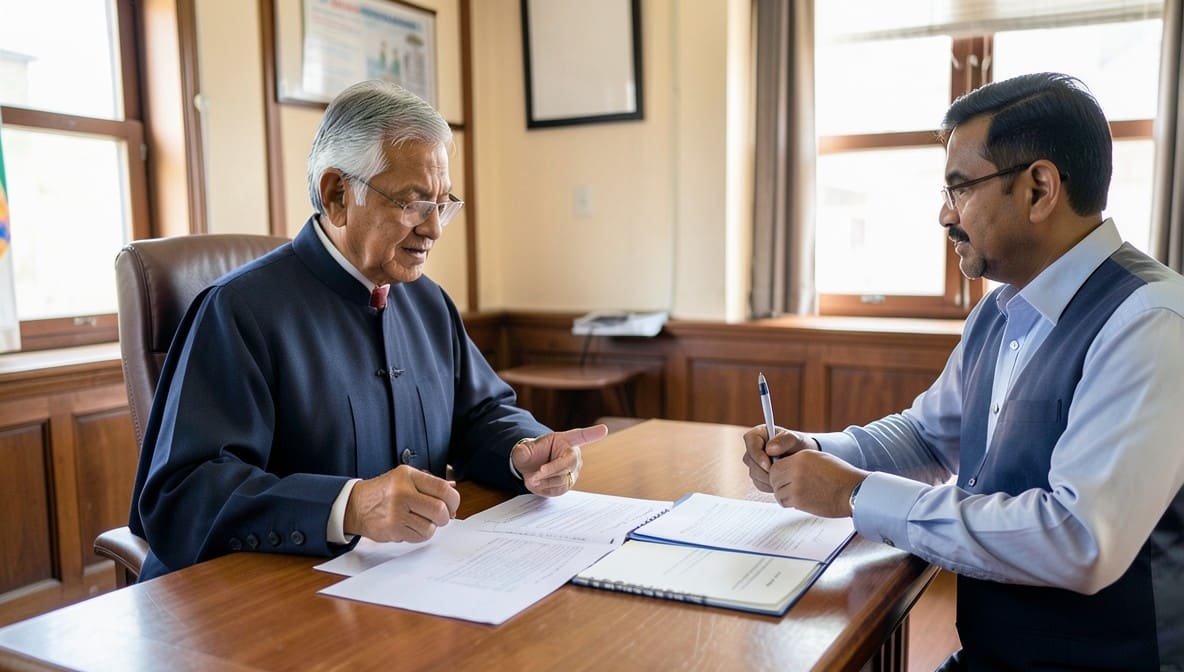
The Himachal Pradesh High Court has reaffirmed that oral examination under Order 10 Rule 2 CPC is a procedural tool to clarify matters in controversy, not a mechanism to bypass formal evidence recording. The judgment underscores the boundary between elucidation and evidentiary proceedings, offering critical guidance to practitioners navigating pre-trial stages.
Background & Facts
The Dispute
The plaintiff, Ajay Kaushal, filed Civil Suit No. 94 of 2016 against M/S Rajpura Hydra Power Private Limited and others, seeking payment for construction work allegedly performed pursuant to a work order dated 25.04.2014. The plaintiff claimed that despite completion of the work, the defendants failed to make full payment. The suit was initially filed against three defendants, but defendant No. 3 was later deleted from the array. Defendant No. 2, originally named M/S Rajpura Hydra Power Private Limited, subsequently changed its name to M/S Rajanya Infrastructure Private Limited and altered its directorship. The plaintiff alleged that these changes were made to evade liability.
Key Facts
- Work order dated 25.04.2014 awarded construction work to the plaintiff
- Plaintiff completed the work as per specifications
- Defendant No. 2 admitted in a reply to the legal notice dated prior to 2016 that liability existed
- Defendant No. 5, who signed the reply, was later removed from the company through an ante-dated resolution
- Defendant No. 2 filed a written statement denying all liability and claiming full payment had been made
- No payment receipts or bank records were produced by Defendant No. 2 in support of its claim
- The plaintiff sought to summon Defendant No. 2’s director for oral examination under Order 10 Rule 2 CPC to compel disclosure of payment records
Procedural History
- 25.04.2014: Work order issued to plaintiff
- 2016: Civil Suit No. 94 of 2016 filed
- 2016 - 2025: Multiple pleadings exchanged; defendant changed name and directors
- 02.04.2026: Application under Order 10 Rule 2(2) CPC filed by plaintiff
- 06.05.2026: Judgment delivered by Single Judge
The Parties' Positions
For the Plaintiff
- Argued that Defendant No. 2, as a corporate entity handling crores in construction, has maintained detailed payment records
- Contended that the absence of any payment documentation in the written statement raises suspicion
- Alleged that Defendant No. 5’s admission in the legal notice reply was deliberately nullified through retroactive director removal
- Sought oral examination of Defendant No. 2’s director to elicit details of payments and production of complete payment records
For Defendant No. 2
- Opposed the application as premature and beyond the scope of Order 10 Rule 2 CPC
- Stated that pleadings were complete and framing of issues was imminent
- Denied any outstanding liability and asserted that all dues were settled
- Argued that corporate name and director changes are matters of public record with the Registrar of Companies
- Contended that the legal notice reply was superseded by the written statement and cannot be relied upon
Relief Sought
The plaintiff sought an order summoning the director of Defendant No. 2 for oral examination under Order 10 Rule 2(2) CPC, along with production of complete records of all payments made to the plaintiff.
The Legal Issue
Can a party invoke Order 10 Rule 2 CPC to compel the opposing party’s director to appear for oral examination and produce complete payment records, when the suit is at the stage of framing issues and no evidence has been recorded?
Arguments Presented
For the Appellant/Petitioner
The plaintiff relied on the broad language of Order 10 Rule 2 CPC, arguing that the court’s power to examine any person accompanying a party includes corporate directors who are privy to financial records. He contended that the absence of payment documentation in the written statement created ambiguity requiring elucidation. He cited Kapil Corepacks (P) Ltd. v. Harbans Lal to assert that Rule 2 permits examination beyond pleadings to uncover the truth. He further argued that the defendant’s failure to produce records, coupled with the timing of director removal, justified the court’s intervention to prevent obstruction of justice.
For the Respondent/State
Defendant No. 2 countered that Order 10 Rule 2 is strictly limited to elucidating matters in controversy through oral questioning, not to compel document production or conduct pre-trial discovery. It cited A. Shanmugam v. Ariya Kshatriya Rajakula Vamsathu Madalaya Nandhavana Paripalanai Sangam to emphasize that the purpose of Rule 2 is to narrow issues, not to record evidence. It argued that summoning payment records amounts to seeking discovery, which is governed by Order 11 and Order 12, not Order 10. The defendant also stressed that the legal notice reply was superseded by the written statement and could not be used to establish liability.
The Court's Analysis
The Court undertook a detailed examination of the scope of Order 10 Rule 2 CPC, drawing upon binding precedents from the Supreme Court and the Madras High Court. It emphasized that the rule is not a substitute for evidence-taking under Order 18, nor a mechanism to compel document production.
"The object of oral examination under Rule 2 of Order 10 is to ascertain the matters in controversy in suit, and not to record evidence or to secure admissions. The statement made by a party in an examination under Rule 2 is not under oath, and is not intended to be a substitute for a regular examination under oath under Order 18 of the Code."
The Court noted that while the plaintiff’s concerns regarding non-production of payment records were valid, the remedy lay in invoking Order 11 (interrogatories) or Order 12 (notice to admit facts), not Order 10 Rule 2. The Court observed that directing the director to produce complete payment records would effectively convert the oral examination into a discovery tool, which is expressly prohibited under settled law.
The Court further held that the change in corporate name and directorship, even if strategically timed, did not alter the legal position. Corporate records are accessible through the Registrar of Companies, and any suspicion of manipulation must be addressed through formal discovery or cross-examination at trial, not through an Order 10 Rule 2 application.
The Court also clarified that while the court may ask questions suggested by parties under Rule 2(3), it cannot use this power to cross-examine or confront a party with documents not yet admitted into evidence. The power under Rule 2 is investigative in nature, not adversarial.
The Verdict
The application under Order 10 Rule 2(2) CPC was dismissed. The Court held that summoning the director for oral examination with production of complete payment records exceeds the permissible scope of Rule 2. The plaintiff’s remedy, if any, lies in seeking discovery under Order 11 or raising the issue during trial. No costs were awarded.
What This Means For Similar Cases
Oral Examination Is Not Discovery
- Practitioners cannot use Order 10 Rule 2 CPC to compel production of financial records, bank statements, or payment ledgers
- Any request for documents must be made under Order 11 (interrogatories) or Order 12 (notice to admit facts)
- Courts will reject applications that seek to use oral examination as a proxy for discovery
Timing Matters: Pre-Framing Stage Is Not a Free-for-All
- Applications under Order 10 Rule 2 must be filed before framing of issues
- Once pleadings are closed, the court’s power under Rule 2 is limited to clarifying ambiguities in existing pleadings
- Attempts to introduce new factual disputes at this stage will be deemed an abuse of process
Corporate Changes Do Not Shield Liability
- Changes in corporate name or directorship do not extinguish liability
- Such changes must be disclosed in pleadings but cannot be used to evade scrutiny
- Suspicion of manipulation must be proven through formal evidence, not speculative applications