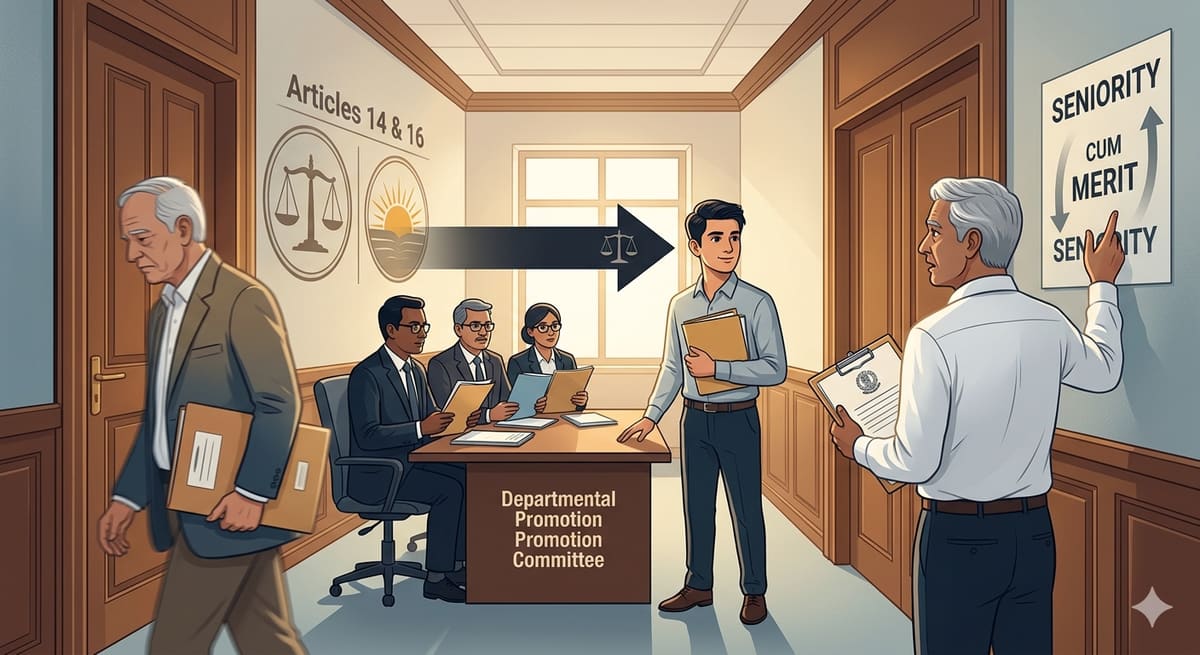
The Bombay High Court has clarified that public employees who voluntarily accept a lower pay-scale during inter-district transfer cannot be compelled to repay salary differential earned during prior service. This ruling reinforces the principle that voluntary demotion for personal convenience does not invalidate prior lawful promotions, and recovery of wages already paid is unlawful absent proof of wrongful grant.
Background & Facts
The Dispute
The petitioner, Shivaji s/o Vishvambar Birkale, was appointed as a Shikshan Sevak (teacher) in the Zilla Parishad, Beed. After completing three years of service, he was confirmed in his post by order dated 16.01.2012. In 2015, he completed his graduation and was subsequently upgraded to the position of Primary Graduate Teacher, placing him in a higher pay-scale. Seeking relief from domestic difficulties, he applied for an inter-district transfer to the Zilla Parishad, Aurangabad, through the online transfer system.
Key Facts
- The petitioner was appointed on 01.06.2009 and confirmed on 16.01.2012
- He completed graduation in 2015 and was upgraded to higher pay-scale effective from 01.04.2015
- He applied for inter-district transfer on 10.03.2017
- His name appeared in the transfer list dated 13.06.2017
- The transfer policy permitted inter-district transfer on request with demotion to lower pay-scale
- Respondent No. 2 (CEC, Beed Zilla Parishad) demanded recovery of Rs. 2,04,358/- as the difference between higher and lower pay-scale
- The petitioner was directed to deposit the amount and submit an indemnity affidavit before being relieved
- The affidavit was submitted on 20.06.2017, but relief was withheld
- The petitioner filed a representation on 26.07.2017 seeking relief without recovery, which remained unaddressed
- The petitioner was not included in the list of 172 teachers identified on 14.12.2017 for wrongful promotion and demotion
Procedural History
- 13.06.2017: Petitioner’s name included in inter-district transfer list
- 20.06.2017: Petitioner submitted indemnity affidavit
- 26.07.2017: Representation filed seeking relief without recovery
- 28.06.2018: Interim order passed by this Court directing relief and transfer to Aurangabad
- 16.04.2026: Final judgment delivered
The Parties' Positions
Petitioner: Argued that inter-district transfer on voluntary demotion does not imply prior promotion was illegal. Relied on official communications dated 07.07.2017 and 14.07.2017 from the State Government, which explicitly prohibited recovery of salary differential in such cases. Emphasized that his promotion was lawful and his name was absent from the list of wrongly promoted teachers.
Respondents: Contended that the petitioner had accepted a lower pay-scale and therefore must repay the difference. Relied on Government Resolution dated 24.04.2017 and an undertaking signed by the petitioner. Also cited communication dated 19.01.2016 and judgment in Vd. Ganesh Sitaram Magar v. State of Maharashtra to justify recovery.
Relief Sought
The petitioner sought quashing of the recovery order for Rs. 2,04,358/-, declaration that the demand was illegal, and direction to refund any amount already recovered.
The Legal Issue
The central question was whether a public servant who voluntarily accepts a lower pay-scale during inter-district transfer can be compelled to repay the salary differential earned during prior lawful service, absent proof that the initial promotion was granted erroneously.
Arguments Presented
For the Petitioner
The petitioner relied on two key government communications: (1) the letter dated 07.07.2017 from the Secretary, Rural Development Department, directing that teachers transferred on inter-district basis be relieved without recovery of salary differential; and (2) the communication dated 14.07.2017 from the Deputy Secretary, clarifying that recovery is permissible only where promotion was granted wrongly. He emphasized that his promotion was lawful, as confirmed by his inclusion in the regular promotion list and absence from the 172-name list of wrongly promoted teachers dated 14.12.2017. He further argued that the indemnity affidavit was signed under duress and cannot override statutory and policy safeguards.
For the Respondent
The respondents relied on Government Resolution dated 24.04.2017, which permitted transfer on lower pay-scale, and interpreted it as authorizing recovery of differential pay. They also cited the petitioner’s undertaking and a communication dated 19.01.2016 from the Assistant Secretary, which they claimed supported recovery. They relied on Vd. Ganesh Sitaram Magar v. State of Maharashtra to argue that undertakings given by employees are binding, even if financially disadvantageous.
The Court's Analysis
The Court undertook a careful review of the policy framework and the factual context of the petitioner’s transfer. It noted that the Government Resolution dated 24.04.2017, Clause 3.3, explicitly permitted inter-district transfer on request with demotion to a lower pay-scale, but contained no provision authorizing recovery of past salary. The Court observed that the respondents conflated two distinct scenarios: (1) recovery for wrongful promotion, and (2) voluntary acceptance of lower pay-scale upon transfer.
"Action of recovery from the persons who were wrongly promoted is different than the persons who were transferred on their request, who accepted lower pay-scale/post. Present case is not a case of wrong promotion."
The Court examined the list of 172 teachers identified for wrongful promotion and confirmed that the petitioner’s name was not included. This was decisive: if the promotion had been illegal, the petitioner would have been among those targeted for demotion and recovery. His exclusion proved the lawfulness of his prior pay-scale.
The Court further rejected the reliance on Vd. Ganesh Sitaram Magar, distinguishing it on two grounds: first, that case involved Ayurvedic doctors not classified as Class III/IV employees; second, that the petitioner here was a Class III employee, making State of Punjab v. Rafiq Masih applicable, which held that recovery of wages already paid without proof of error is violative of Article 14 and Article 300A of the Constitution.
The Court also held that the indemnity affidavit, signed under pressure to secure transfer, was not a voluntary waiver of statutory rights and could not override the State’s own policy directives.
The Verdict
The writ petition was allowed. The Court directed the respondents not to recover the salary differential of Rs. 2,04,358/- from the petitioner. Any amount already recovered must be refunded to the petitioner within six months from the date of judgment. No costs were awarded.
What This Means For Similar Cases
Recovery of Salary Differential Is Illegal Without Proof of Wrongful Promotion
- Practitioners must challenge any recovery demand against transferred employees unless the employer can produce a formal order declaring the prior promotion as erroneous
- Absence from a government-issued list of wrongly promoted employees is conclusive evidence of lawful pay-scale
- Recovery based on voluntary demotion alone violates Article 300A (right to property) and Article 14 (equality)
Policy Communications Override Administrative Discretion
- Official circulars and letters from State Departments bind subordinate authorities, even if local officers act contrary to them
- Employees may rely on such communications to resist unlawful demands
- Administrative practices inconsistent with written policy are ultra vires
Undertakings Signed Under Duress Are Not Enforceable
- Affidavits or undertakings extracted as a condition for transfer are voidable
- Courts will not uphold such instruments where they conflict with statutory rights or government policy
- The burden lies on the employer to prove voluntary consent, not on the employee to disprove coercion