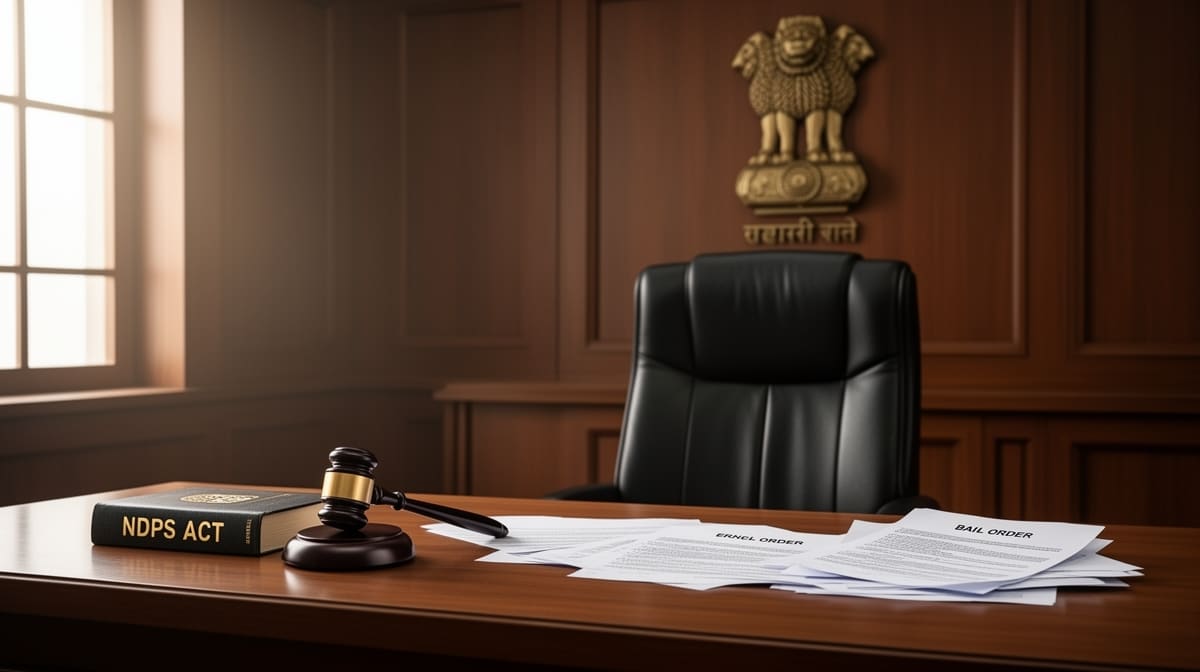
The Andhra Pradesh High Court has reaffirmed the stringent approach under the Narcotic Drugs and Psychotropic Substances Act, 1985 (NDPS Act), denying bail to an accused caught with 2.17 kilograms of ganja. The judgment underscores that even quantities below commercial thresholds can justify continued incarceration when coupled with criminal antecedents and societal harm, distinguishing precedents like Arnesh Kumar v. State of Bihar that advocate restraint in mechanical arrests for minor offenses.
Background & Facts
The Dispute
The petitioner, Md. Yusaf Khan alias Dilli, was arrested on 05.04.2026 by the Gopalapatnam Police Station, Visakhapatnam, for allegedly transporting 2.170 kilograms of ganja near North Simhachalam Railway Quarters. The contraband was seized under a panchnama, and the petitioner was charged under Sections 20(b)(ii)(B) read with 8(c) of the NDPS Act. The petitioner sought bail under Sections 480 and 483 of the Bharatiya Nagarik Suraksha Sanhita, 2023 (BNSS), arguing that the quantity seized was below commercial thresholds and that his confession to police was inadmissible.
Key Facts
- 05.04.2026: Petitioner apprehended near North Simhachalam Railway Quarters, Visakhapatnam, while carrying a bag containing ganja
- Seizure Details: 2.170 kilograms of ganja procured from Paduva, Odisha, for Rs. 3,000/-, intended for unlawful sale
- Confession: Petitioner confessed to police during interrogation, though such statements are inadmissible under Tofan Singh v. State of T.N.
- Quantity Classification: 2.170 kilograms of ganja qualifies as intermediate quantity under the NDPS Act, not small quantity
- Criminal Antecedents: Petitioner is a rowdy sheet holder with three prior NDPS cases (Cr.No.14/2026, 208/2023, 68/2023) and three IPC cases
Procedural History
- 05.04.2026: Arrested in Cr.No.98/2026 of Gopalapatnam Police Station for NDPS Act offenses
- 05.04.2026 to 17.06.2026: Petitioner in judicial custody for 73 days
- 17.06.2026: Criminal Petition No. 4452/2026 filed before the Andhra Pradesh High Court seeking bail
The Parties' Positions
For the Petitioner
- Argued that the prosecution case is concocted, relying solely on an inadmissible confession and a false report
- Contended that 2.170 kilograms of ganja is below commercial quantity, and continued incarceration is unjustified under Arnesh Kumar v. State of Bihar
- Emphasized that the petitioner is a law-abiding citizen with permanent abode, and investigation is practically complete
- Cited Tofan Singh v. State of T.N. to argue that confessional statements before police are inadmissible
For the Respondent
- Opposed bail, arguing that the offense is grave and serious, with pernicious effects on society, particularly youth
- Highlighted that 2.170 kilograms of ganja is an intermediate quantity, attracting stringent punishment under the NDPS Act
- Noted that the recovery was conducted under due procedure with independent mediators, and the confession corroborates the seizure
- Stressed the petitioner’s criminal antecedents (three prior NDPS cases and three IPC cases), establishing habitual involvement in criminal activities
- Contended that granting bail would hamper investigation and embolden the accused, posing a threat to public order
Relief Sought
The petitioner sought enlargement on bail, arguing that the quantity seized was not commercial and that his continued detention was unwarranted.
The Legal Issue
The central question was whether intermediate quantity seizures under the NDPS Act, coupled with criminal antecedents, justify denial of bail despite precedents like Arnesh Kumar v. State of Bihar that advocate restraint in mechanical arrests for minor offenses.
Arguments Presented
For the Petitioner
- Relied on Arnesh Kumar v. State of Bihar ((2014) 8 SCC 273) to argue that mechanical arrests for small quantities are impermissible
- Cited Tofan Singh v. State of T.N. ((2021) 4 SCC 1) to contend that confessional statements before police are inadmissible
- Argued that the investigation is complete and no custodial interrogation is required
For the Respondent
- Distinguished Arnesh Kumar on the ground that 2.170 kilograms is an intermediate quantity, not a small quantity
- Emphasized the societal harm of narcotics offenses, citing Union of India v. Ram Samujh ((1999) 9 SCC 429) and Durand Didier v. State (UT of Goa) ((1990) 1 SCC 95)
- Highlighted the petitioner’s criminal antecedents and habitual involvement in similar offenses
The Court's Analysis
The Court undertook a balancing exercise between the gravity of the offense and the petitioner’s right to liberty, ultimately prioritizing societal interest over individual rights in narcotics cases. Key observations include:
-
Intermediate Quantity Justifies Stringent Approach: The Court noted that 2.170 kilograms of ganja qualifies as intermediate quantity under the NDPS Act, attracting stringent punishment. This distinguished the case from precedents like Arnesh Kumar, which dealt with small quantities.
"The offence alleged against the Petitioner involves possession and transportation of narcotic drugs of intermediate quantity, which is a serious crime under the NDPS Act, with grave consequences for society."
-
Societal Harm Overrides Individual Liberty: Relying on Union of India v. Ram Samujh and Durand Didier, the Court emphasized that narcotics offenses destroy vulnerable lives and have a deadly impact on society, justifying strict adherence to legislative mandates.
"In murder cases the harm is limited to one or two individuals, whereas narcotics offences destroy numerous vulnerable lives and have a deadly impact on society; offenders involved in drug trafficking pose a continuous hazard and are likely to persist in their illicit activities if released, and therefore strict adherence to the legislative mandate is essential."
-
Criminal Antecedents and Habitual Offending: The Court highlighted the petitioner’s rowdy sheet status and six prior criminal cases (three under NDPS Act and three under IPC), concluding that he is a habitual offender likely to continue unlawful activities if released.
-
Nascent Stage of Investigation: The Court noted that the investigation is at a nascent stage, with material witnesses yet to be examined, and no substantial portion of the investigation completed. This further justified denial of bail.
The Verdict
The Andhra Pradesh High Court dismissed the bail petition, holding that:
- The petitioner’s continued incarceration is justified due to the intermediate quantity of ganja seized and his criminal antecedents
- The investigation is incomplete, and custodial interrogation may still be required
- The societal harm of narcotics offenses outweighs the petitioner’s right to bail at this stage
What This Means For Similar Cases
Intermediate Quantity Seizures Trigger Stringent Scrutiny
- Bail applications for intermediate quantities under the NDPS Act will face higher scrutiny than those for small quantities
- Courts may distinguish precedents like Arnesh Kumar where the quantity seized is not negligible but falls short of commercial thresholds
- Practitioners must argue the specific quantity and its classification under the NDPS Act to counter bail denials
Criminal Antecedents Can Tip the Balance
- Habitual offenders with multiple prior cases (even unrelated) are less likely to secure bail in NDPS matters
- Rowdy sheet holders or those with adverse antecedents will face uphill battles in bail hearings
- Defense counsel should address criminal history proactively, distinguishing irrelevant or stale cases from recent or similar offenses
Investigation Stage Matters
- Early-stage investigations (where witnesses are yet to be examined) may justify bail denial even if the accused has been in custody for extended periods
- Prosecution can leverage incomplete investigations to oppose bail, arguing that custodial interrogation is still necessary
- Defense counsel should press for expedited investigation or seek specific timelines for completion to counter such arguments
Societal Harm as a Deciding Factor
- Courts are increasingly prioritizing societal harm over individual liberty in narcotics cases, even for intermediate quantities
- Public interest arguments (e.g., impact on youth, addiction crises) can override procedural safeguards like those in Arnesh Kumar
- Defense counsel must rebut societal harm claims by contextualizing the offense (e.g., personal use vs. commercial trafficking, first-time offender vs. habitual offender)