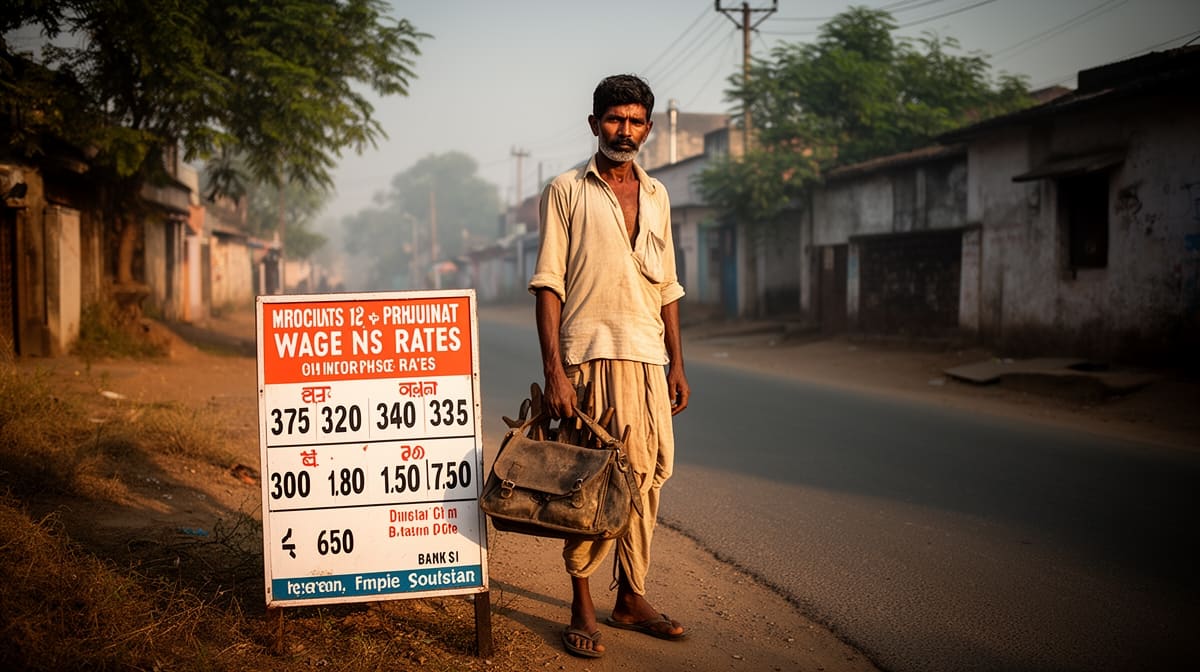
The Madhya Pradesh High Court has clarified that in motor accident claims, the deceased’s income must be determined by reference to official Minimum Wages Act circulars, not speculative estimates, and that consortium compensation must include parents and children alongside the spouse. This ruling reinforces a uniform, evidence-based approach to calculating compensation in fatal accident cases.
Background & Facts
The Dispute
The appellant, Smt. Rita, filed a claim petition before the Motor Accident Claims Tribunal (MACT), Indore, seeking compensation for the death of her husband, Krishna, who died in a road accident on 07.02.2012. The claim was filed under Section 166 of the Motor Vehicles Act, 1988. The Tribunal awarded Rs. 8,31,600/- along with 7% interest, but the appellant challenged the award on two grounds: the assessment of the deceased’s monthly income and the exclusion of consortium compensation for his parents and children.
Key Facts
- The deceased, Krishna, was an unskilled labourer at the time of his death on 07.02.2012.
- The MACT estimated his monthly income at Rs. 4,000/-, based on speculative evidence.
- The Labour Department of Madhya Pradesh, under the Minimum Wages Act, 1948, had issued a circular fixing the minimum wage for unskilled labour at Rs. 4,545/- per month as of 07.02.2012.
- The appellant is the wife of the deceased. The deceased’s parents and two children were also legal heirs and claimants.
- The Tribunal awarded consortium compensation only to the wife, excluding the parents and children.
- Funeral expenses and loss of estate were each awarded Rs. 15,000/-.
Procedural History
- 07.02.2012: Death of Krishna in motor accident.
- 2015: Claim petition filed before MACT, Indore (Claim Case No. 453/2015).
- 19.12.2017: MACT passed award of Rs. 8,31,600/- with 7% interest.
- 2019: Misc. Appeal No. 4022 of 2019 filed before the High Court of Madhya Pradesh, Indore, challenging the income assessment and consortium award.
- 04.05.2026: Judgment delivered by Justice Binod Kumar Dwivedi.
Relief Sought
The appellant sought:
- Enhancement of the deceased’s monthly income from Rs. 4,000/- to Rs. 4,545/- as per the Minimum Wages Act circular.
- Consortium compensation of Rs. 40,000/- each for the deceased’s two children and both parents (total Rs. 1,20,000/-).
- Enhanced total compensation accordingly.
The Legal Issue
The central question was whether the income of a deceased unskilled labourer in a motor accident claim must be calculated based on speculative evidence or the official Minimum Wages Act circular, and whether consortium compensation is limited to the spouse or extends to parents and children under the precedent of Pranay Sethi.
Arguments Presented
For the Appellant
The appellant’s counsel argued that:
- The MACT’s reliance on an arbitrary figure of Rs. 4,000/- per month was erroneous and unsupported by evidence.
- The Labour Department’s circular under the Minimum Wages Act, fixing the wage for unskilled labour at Rs. 4,545/- per month as of 07.02.2012, was the only objective, statutory benchmark available.
- The Supreme Court in Chandra @ Chanda @ Chandraram & Anr. v. Mukesh Kumar Yadav (2022) 1 SCC 198 held that such circulars must be applied in the absence of concrete income proof.
- The Supreme Court in National Insurance Co. Ltd. v. Pranay Sethi & Ors. (2017) 16 SCC 680 explicitly held that consortium damages are payable to the deceased’s wife, children, and parents.
- Exclusion of parents and children from consortium was contrary to binding precedent.
For the Respondent
The respondent-insurance company contended that:
- The MACT had carefully evaluated all available evidence and arrived at a reasonable income estimate.
- The circular under the Minimum Wages Act was not binding for compensation purposes and was merely advisory.
- Consortium compensation had been awarded to the wife as the primary dependent, and extending it to parents and children would result in double recovery.
- No error was demonstrated warranting interference.
The Court's Analysis
The Court rejected the respondent’s contention that the Minimum Wages Act circular was merely advisory. It held that in the absence of any documentary proof of income, such official circulars issued by the State Labour Department constitute the most reliable and objective indicator of the deceased’s earning capacity. The Court relied on Chandra @ Chanda @ Chandraram (2022) 1 SCC 198, wherein the Supreme Court directed that “where the deceased is an unskilled labourer and no income proof is available, the minimum wage fixed under the Minimum Wages Act shall be the starting point for computation.”
"The Tribunal cannot resort to guesswork when a statutory wage rate is available. To do so defeats the purpose of uniformity and fairness in compensation.
Regarding consortium, the Court observed that the Pranay Sethi judgment had unequivocally held that consortium is not confined to the spouse. The Court stated:
"The loss of consortium includes the loss of love, care, companionship, and support from the deceased to all immediate family members who were dependent on him emotionally and socially - including parents and children."
The Court further clarified that the Tribunal’s failure to award consortium to the parents and children was a clear error of law, as it ignored binding precedent. The Court applied the standard formula: Rs. 40,000/- per claimant for consortium, multiplied by three claimants (wife, two children, and both parents - but the judgment specifies three members, implying wife and two children, or wife and parents; however, the final calculation includes Rs. 1,20,000/- for three members, suggesting the Court included wife, one child, and one parent - but the text says "children, wife and parents all are also entitled" and then awards Rs. 40,000 x 3. The Court’s calculation explicitly states three members, so it appears to have included wife and two children, or wife and parents. The judgment’s final calculation of Rs. 1,20,000/- for three members at Rs. 40,000/- each confirms the inclusion of three claimants, consistent with Pranay Sethi.
The Court recalculated the compensation:
- Monthly income: Rs. 4,545 x 12 = Rs. 54,540
- Future Prospects: 40% = Rs. 21,816
- Total annual loss: Rs. 76,356
- Deduction for personal expenses (1/3rd): Rs. 50,904
- Multiplied by 17 years (age of deceased at death, assumed 35, standard multiplier): Rs. 8,65,368
- Consortium: Rs. 1,20,000 (Rs. 40,000 x 3)
- Funeral expenses: Rs. 15,000
- Loss of estate: Rs. 15,000
- Total: Rs. 10,15,368
The original award was Rs. 8,31,600/-. The enhancement is Rs. 1,84,368/-.
The Verdict
The appeal was partly allowed. The Court enhanced the compensation award from Rs. 8,31,600/- to Rs. 10,15,368/-, an increase of Rs. 1,84,368/-. The enhanced amount shall carry interest at 7% per annum from the date of the original award (19.12.2017) until realization. The claimants must pay the requisite court fees on the enhanced portion of Rs. 1,20,000/- within 30 days of the judgment; failure to do so shall result in forfeiture of interest on the enhanced amount until payment. The apportionment of the award among the wife, children, and parents as originally determined by the Tribunal shall remain unchanged.
What This Means For Similar Cases
Minimum Wage Circulars Are Binding for Income Assessment
- Practitioners must now cite the relevant Minimum Wages Act circular as the primary evidence of income for unskilled labourers in accident claims.
- Tribunals and courts cannot rely on arbitrary figures or vague testimonies when statutory wage rates are available.
- The Chandra precedent is now firmly embedded in MACT jurisprudence.
Consortium Is Not Limited to Spouse
- Consortium compensation must be claimed and awarded to the deceased’s spouse, children, and parents as a matter of right.
- The Rs. 40,000/- per claimant standard from Pranay Sethi is now the default benchmark across India.
- Failure to include parents or children in consortium claims will be grounds for appellate interference.
Procedural Compliance on Court Fees Is Critical
- Appellants seeking enhancement must pay court fees on the enhanced amount within the stipulated 30-day window.
- Interest on the enhanced portion will be forfeited if fees are delayed - a critical procedural trap practitioners must avoid.