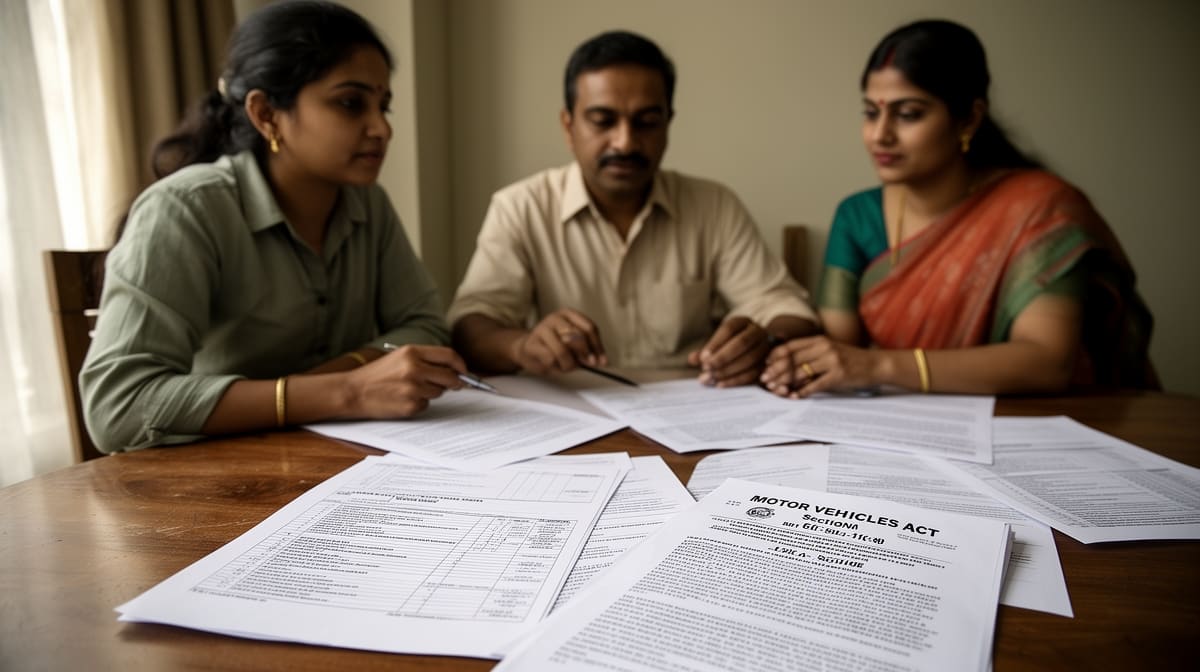
The Karnataka High Court has affirmed that legal representatives of a deceased road accident victim - including married children - are entitled to compensation for loss of dependency even in the absence of proven financial dependence, reinforcing the Supreme Court’s evolving jurisprudence on equitable relief under the Motor Vehicles Act. This judgment provides critical clarity for claimants and insurers alike in cases involving elderly victims engaged in informal labor.
Background & Facts
The Dispute
The claim petition was filed by the legal representatives of Devi @ Devi Velu, a 72-year-old woman who died in a road traffic accident on 16.12.2018. The accident involved a motorcycle bearing registration No. KA-08/V-9572, allegedly driven rashly and negligently. The claimants - four children of the deceased, including one son and three married daughters - sought compensation under the Motor Vehicles Act, 1988, for loss arising from her death.
Key Facts
- The deceased, Devi @ Devi Velu, was aged 72 years at the time of death on 16.12.2018.
- She was engaged in coolie work and earned an estimated Rs.15,000 per month, though no formal documentation was produced.
- The Tribunal adopted a notional monthly income of Rs.12,500 based on the State Legal Services Authority’s settlement chart for Lok Adalath.
- The claimants are the deceased’s only legal heirs: one son (R1) and three married daughters (R2-R4).
- The deceased operated a flour mill, which continued to be run by the claimants after her death.
- The claimants were not shown to be financially dependent on her income, but asserted entitlement based on familial contribution and shared economic enterprise.
Procedural History
- 16.12.2018: Road traffic accident resulting in death of Devi @ Devi Velu.
- 2019: Claim petition (MVC No.299/2019) filed before III Additional District and Sessions Judge, Kolar (sitting at KGF).
- 23.12.2022: Tribunal awarded compensation of Rs.9,71,500/- with 6% interest per annum from the date of petition.
- 2023: Appellant-insurer filed Miscellaneous First Appeal No.2325/2023 before the Karnataka High Court.
- 16.06.2026: Judgment delivered by the Karnataka High Court.
The Parties' Positions
For the Appellant (United India Insurance Co. Ltd.)
- Argued that the claimants, being major and married, were not financially dependent on the deceased.
- Contended that award of loss of love and affection was duplicative since loss of consortium was already granted.
- Sought reduction or dismissal of dependency claim.
For the Respondents (Claimants R1-R4)
- Relied on Jitender Kumar v. Sanjay Prasad and National Insurance Co. Ltd. v. Birender to assert that legal representatives need not prove financial dependence.
- Emphasized that the deceased contributed to family income through labor and managed a flour mill, the proceeds of which were inherited and operated by the claimants.
- Argued that the Tribunal’s award was consistent with statutory intent and equitable principles.
Relief Sought
The claimants sought compensation for:
- Transportation and funeral expenses
- Loss of estate
- Loss of love and affection
- Filial consortium
- Loss of dependency
The insurer sought reduction of the award, particularly on the grounds of lack of dependency and duplication of heads.
The Legal Issue
The central question was whether married children of a deceased victim, who are legal representatives under the Motor Vehicles Act, are entitled to compensation for loss of dependency even in the absence of proof of financial dependence, and whether loss of love and affection may be awarded separately when filial consortium has already been granted.
Arguments Presented
For the Appellant
The insurer contended that under settled principles, compensation for loss of dependency requires proof of actual financial dependence. Since the claimants were married adults with independent means, and no evidence showed they relied on the deceased’s income, the award under this head was unjustified. The insurer further argued that the Tribunal erred in awarding both loss of love and affection and filial consortium, which are overlapping heads of compensation.
For the Respondent
The claimants relied on the Supreme Court’s decision in Jitender Kumar v. Sanjay Prasad, which held that legal representatives - including married children - are entitled to claim compensation irrespective of financial dependence. They emphasized that the deceased’s labor sustained the household and that the flour mill, a family asset, continued under their management. The claimants argued that the Tribunal’s award was consistent with the spirit of the Motor Vehicles Act and the Supreme Court’s directive to adopt a liberal approach in favor of victims’ families.
The Court's Analysis
The Court undertook a detailed review of the Supreme Court’s recent jurisprudence, particularly Jitender Kumar v. Sanjay Prasad (Civil Appeal No.7199/2025), which clarified that the right to claim compensation under the Motor Vehicles Act is not contingent upon proving financial dependence. The Court quoted the Supreme Court’s holding:
"It is thus settled by now that the legal representatives of the deceased have a right to apply for compensation. Having said that, it must necessarily follow that even the major married and earning sons of the deceased being legal representatives have a right to apply for compensation and it would be the bounden duty of the Tribunal to consider the application irrespective of the fact whether the legal representative concerned was fully dependent on the deceased and not to limit the claim towards conventional heads only."
The Karnataka High Court affirmed that this principle applies equally to married daughters. The Court noted that the deceased’s role in managing the flour mill and contributing to household income, even informally, established her economic contribution to the family unit. The fact that the business continued under the claimants’ control further supported the inference of shared economic interest.
Regarding the duplication of heads, the Court held that loss of love and affection and filial consortium are distinct compensatory heads. However, where consortium is awarded as a comprehensive recognition of familial loss, an additional award for love and affection constitutes double recovery. The Court observed:
"As claimants have been awarded loss of consortium, they are not entitled to loss of love and affection separately as awarded by the Tribunal..."
The Court also applied the standard deduction of 50% of the deceased’s notional income for personal and living expenses, as mandated in Jitender Kumar. The loss of dependency was recalculated as Rs.12,500 x 50% x 12 months x 5 years = Rs.3,75,000/-.
The Verdict
The appeal was allowed in part. The Karnataka High Court reduced the compensation from Rs.9,71,500/- to Rs.5,84,000/-, comprising:
- Transportation and funeral expenses: Rs.16,500/-
- Loss of estate: Rs.16,500/-
- Filial consortium: Rs.1,76,000/-
- Loss of dependency: Rs.3,75,000/-
The insurer is directed to pay the amount with interest at 6% per annum from the date of the claim petition until realization. If payment is not made within six weeks, interest shall accrue at 9% per annum from the date of this judgment. The insurer may recover the amount from the vehicle owner. The claimants are entitled to equal shares in the compensation. The amount shall be deposited with the Tribunal and released to the claimants.
What This Means For Similar Cases
Legal Representatives Need Not Prove Financial Dependence
- Practitioners may now confidently argue that married children, whether earning or not, are entitled to claim loss of dependency under the Motor Vehicles Act without proving financial dependence.
- Tribunals must consider claims from all legal representatives, irrespective of marital status or employment, as affirmed by Jitender Kumar.
- Evidence of shared economic activity (e.g., continuation of family business) strengthens the claim but is not mandatory.
Loss of Consortium Precludes Separate Award for Love and Affection
- Loss of consortium is a comprehensive head covering emotional and familial loss.
- Awarding loss of love and affection in addition to consortium constitutes double recovery and must be avoided.
- Practitioners should structure claims to avoid overlapping heads and focus on quantifiable heads: dependency, consortium, funeral, and estate.
Notional Income and 50% Deduction Are Standard
- Where income is unproven, Tribunals may rely on State Legal Services Authority’s notional income charts.
- The 50% deduction for personal expenses is now mandatory in all dependency calculations, per Jitender Kumar.
- Calculations must be transparent: monthly income × 50% × 12 × years of dependency.