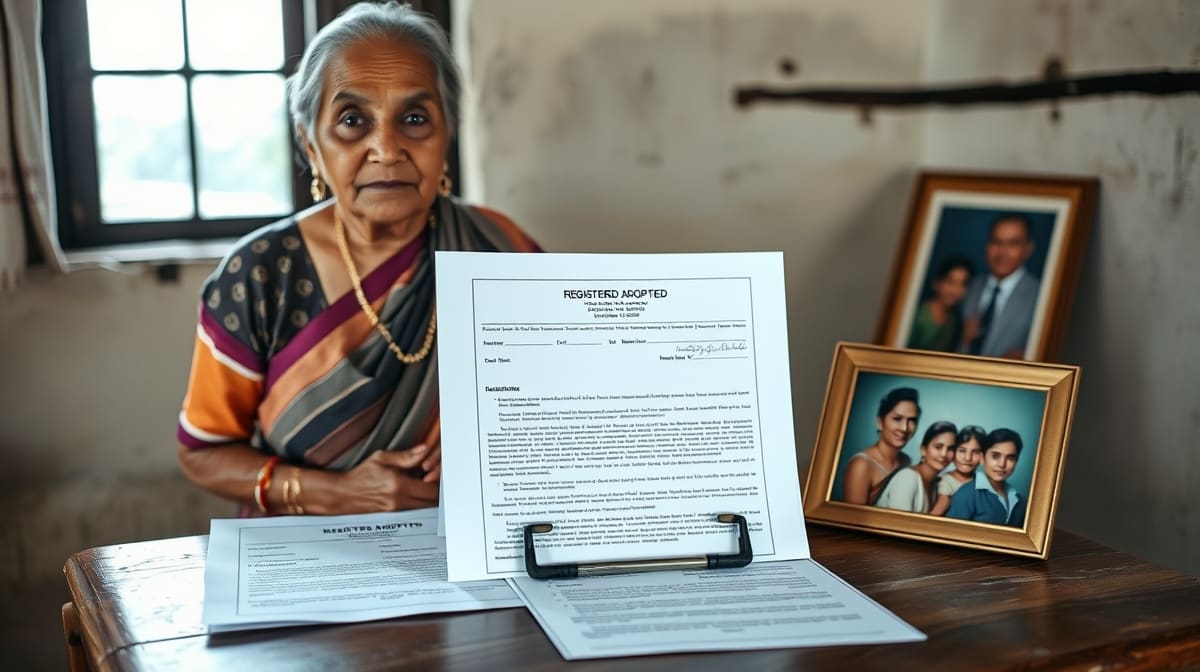
The Punjab and Haryana High Court has clarified that under the customary law of the Meo community, a widow’s adoption of a child without the consent of her husband’s collaterals is valid, extinguishing the reversionary rights of distant relatives. This ruling reinforces the secular and flexible nature of customary adoption in Punjab, distinguishing it from rigid Hindu legal formalities.
Background & Facts
The Dispute
The dispute centers on the succession rights to ancestral property originally held by Zahur Khan, son of Rustam, who belonged to the Meo community in Nuh, Haryana. Upon Zahur Khan’s death, his widow, Smt. Asgari, inherited the property as a limited owner under customary law. The appellants, who are collaterals of Zahur Khan, claimed that upon Smt. Asgari’s death, the property would revert to them as reversioners. They challenged the adoption of defendant No. 2, the daughter’s son of Smt. Asgari, executed via a registered adoption deed dated 04.02.1991, arguing that it was invalid for lack of consent from Zahur Khan’s collaterals and because the adoptee was not from the husband’s lineage.
Key Facts
- Zahur Khan died intestate, leaving behind his widow, Smt. Asgari, as the limited owner of ancestral property
- A prior decree dated 22.01.1981 restrained Smt. Asgari from alienating the property without consent of Zahur Khan’s collaterals, a finding upheld by the High Court
- Smt. Asgari adopted defendant No. 2, her daughter’s son, by a registered adoption deed dated 04.02.1991
- The adoption was witnessed and attested by the natural father of the adoptee, the scribe, and two other witnesses
- The adoptee was treated as Smt. Asgari’s son in social and familial conduct post-adoption
- The appellants filed a suit for declaration on 15.03.1993, seeking to set aside the adoption and claim reversionary rights
Procedural History
- 15.03.1993: Suit filed by appellants before the Court of Additional Senior Sub Judge, Nuh
- 25.11.1995: Trial Court decreed the suit, holding the adoption invalid for want of consent and non-compliance with customary norms
- 23.03.1997: First Appellate Court reversed the trial court’s decree, upholding the validity of the adoption
- 27.03.2026: Second appeal filed before the Punjab and Haryana High Court under RSA-1655-1997
Relief Sought
The appellants sought a declaration that the adoption dated 04.02.1991 was void, that they were entitled to succeed to the property as reversioners, and that defendant No. 2 had no legal right to claim succession.
The Legal Issue
The central question was whether, under the customary law of the Meo community, a widow’s adoption is invalid if performed without the consent of her husband’s collaterals or if the adoptee is not from the husband’s lineage.
Arguments Presented
For the Appellant
Counsel for the appellants relied on the prior decree of 22.01.1981, which imposed a restriction on alienation, and argued that the same principle of collective consent should extend to adoption. They contended that under Meo customary law, adoption is a devolutionary act requiring the approval of the deceased husband’s kin, as the property remains within the lineage. They cited the ancestral nature of the property and the appellants’ status as reversioners to assert that the adoption, lacking consent, was void ab initio.
For the Respondent
Counsel for the respondents relied on Hem Singh v. Harnam Singh (1954 AIR (SC) 581), which held that customary adoption in Punjab is secular in nature and functions as an appointment of an heir. They argued that requirements such as consent of collaterals, ceremonial formalities, or lineage preference are directory, not mandatory. They emphasized that the adoption deed was registered, properly attested, and the adoptee was treated as the widow’s son in practice, fulfilling the essential elements of a valid customary adoption.
The Court's Analysis
The Court undertook a detailed review of the nature of customary adoption among the Meo community, distinguishing it from classical Hindu law. It noted that the adoption under Punjab customary law is not a sacramental act but a pragmatic mechanism to secure succession, particularly when a widow has no natural heir.
"Customary adoption among Meos is primarily a mode of appointing an heir and does not strictly adhere to the rigours of classical Hindu law."
The Court affirmed the findings of the First Appellate Court that the requirements of consent and lineage preference are directory, not mandatory. It held that the Supreme Court’s decision in Hem Singh v. Harnam Singh remains binding and has been consistently followed by this Court. The absence of consent from collaterals does not invalidate the adoption, nor does the fact that the adoptee is the daughter’s son constitute a legal disqualification.
The Court further emphasized that the registered adoption deed dated 04.02.1991 was duly proved by the testimony of the executant, the natural father, the scribe, and attesting witnesses. The subsequent conduct of the parties, including recognition of defendant No. 2 as the adopted son, reinforced the validity of the adoption.
The earlier decree restraining alienation was held irrelevant to adoption, as it did not prohibit the appointment of an heir. The Court concluded that once a valid adoption is established, the adopted son steps into the shoes of a natural-born son, extinguishing the reversionary rights of collaterals.
The Verdict
The appeal was dismissed. The Court upheld the validity of the adoption dated 04.02.1991, confirmed that defendant No. 2 is the lawful heir of Smt. Asgari, and held that the appellants, as collaterals, have no claim to the property. The judgment of the First Appellate Court dated 23.03.1997 stands affirmed.
What This Means For Similar Cases
Customary Adoption Trumps Formal Consent Requirements
- Practitioners must now argue that under Punjab customary law, adoption is valid even without consent of collaterals, provided the deed is registered and the adoption is recognized in practice
- The burden shifts to the challenger to prove the adoption was fraudulent or non-existent, not that consent was lacking
Reversionary Rights Are Not Absolute
- Reversioners cannot claim property if a valid adoption exists, regardless of lineage or kinship ties
- This applies even where prior decrees restrict alienation, as adoption is not an alienation but a succession mechanism
Documentary Evidence and Conduct Are Decisive
- Registered adoption deeds, supported by witness testimony and post-adoption conduct, are sufficient to establish validity
- Oral testimony about customary norms without documentary corroboration will not override a registered instrument
Precedent of Hem Singh v. Harnam Singh Is Controlling
- Any challenge to adoption under Punjab customary law must now confront the binding precedent that ceremonial and procedural requirements are directory
- Courts will not entertain challenges based on non-compliance with non-essential formalities
Adoption Is Not Restricted by Lineage
- Adoptees need not be from the husband’s lineage; a widow may adopt her daughter’s son, a grandson, or even a non-blood relative
- The choice of adoptee lies within the discretion of the adopter under customary law