The Bombay High Court’s dismissal of a criminal revision application underscores a critical affirmation: biological paternity, once established through scientific evidence, is sufficient to trigger the statutory obligation of maintenance under Section 125 CrPC, irrespective of marital status or spousal claims.
Background & Facts
The Dispute
The respondent-wife, Janabai, filed a petition under Section 125 of the Code of Criminal Procedure seeking maintenance for herself and her minor son, Abhishek, aged six at the time of filing. The petitioner, Bhagawat Shinde, denied both the existence of a valid marriage and the paternity of the child. He contested the claim through a detailed written statement, challenging the legitimacy of the relationship and the child’s biological connection to him.
Procedural History
The Family Court, Beed, heard the matter over multiple hearings and evaluated oral testimony alongside documentary evidence including marriage photographs and community acknowledgments. Despite the petitioner’s denials, the court found insufficient grounds to reject the child’s claim but dismissed the wife’s maintenance petition due to lack of conclusive proof of marriage. It ordered the petitioner to pay Rs. 10,000 per month as maintenance for the minor son.
The petitioner filed a criminal revision application before the Bombay High Court, Aurangabad Bench, challenging the order on grounds of erroneous appreciation of evidence and failure to consider his denial of paternity.
Relief Sought
The petitioner sought quashing of the maintenance order for the child, arguing that without proven paternity, no legal obligation arose. The respondents sought affirmation of the Family Court’s order, asserting the child’s right to support under Section 125 CrPC.
The Legal Issue
The central question was whether Section 125 CrPC permits a court to grant maintenance to a minor child based solely on biological paternity established post-trial, even when the marital relationship between the parents remains unproven.
Arguments Presented
For the Appellant/Petitioner
Counsel argued that Section 125 CrPC requires a legally recognized marital relationship to impose maintenance liability on a man for a child. He contended that the Family Court erred in granting maintenance without conclusive proof of marriage or paternity, and that the child’s claim was speculative. He relied on precedents emphasizing the necessity of establishing a legal family unit before invoking maintenance.
For the Respondent/State
Counsel for the respondents submitted that Section 125 CrPC is a social welfare provision designed to prevent destitution. They argued that the statute does not condition maintenance on marital validity but on the biological or legal parent-child relationship. The child’s right to sustenance, they asserted, is independent of the parents’ marital status and is protected under Article 21 of the Constitution.
The Court's Analysis
The Court examined the legislative intent behind Section 125 CrPC, noting its humanitarian purpose to ensure that no child is left without means of support. It observed that while the wife’s claim failed due to insufficient evidence of marriage, the child’s claim stood on a separate and more robust foundation: biological paternity.
"The fact that the child is born out of the wedlock of the revision petitioner and respondent no.1, and that DNA analysis conclusively establishes biological parentage, removes any doubt regarding the petitioner’s obligation under Section 125 CrPC."
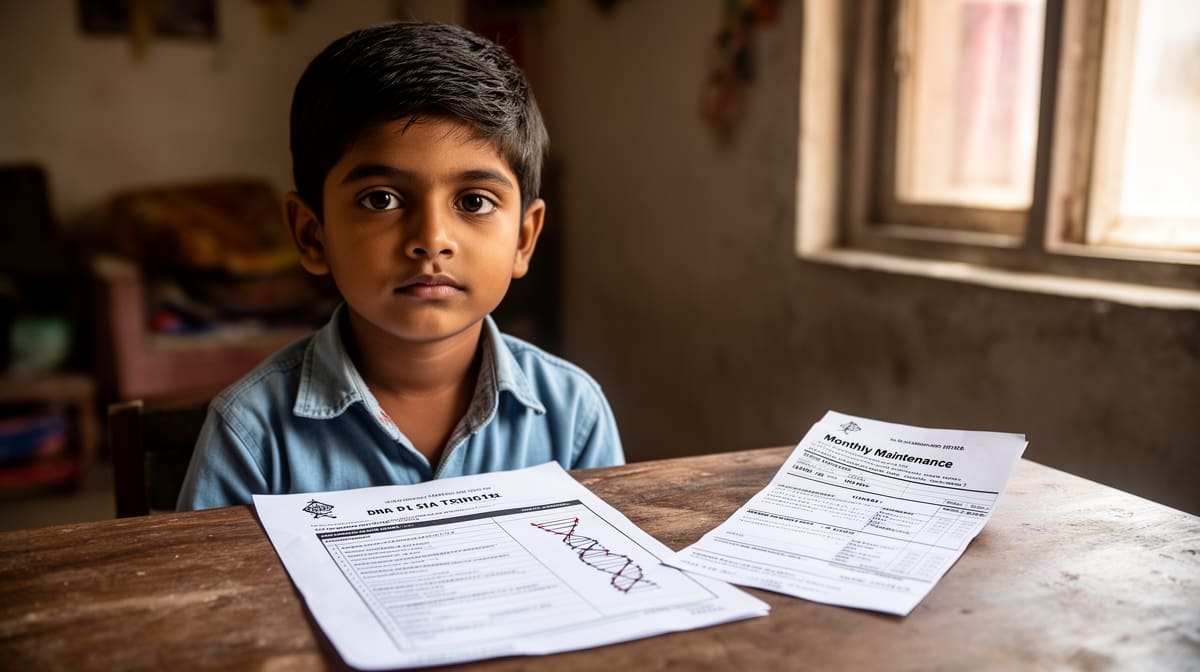
The Court held that Section 125 CrPC does not require a valid marriage to impose liability for child maintenance. The provision applies to any person who, though not necessarily married to the mother, is the biological father of a minor child unable to maintain himself. The DNA report, obtained under the Court’s direction and accepted without objection by the petitioner, was deemed conclusive and binding.
The Court further distinguished cases requiring proof of marriage from those involving paternity, emphasizing that the latter is a factual determination amenable to scientific verification. The Family Court’s order was not perverse, nor was it based on speculation - it was grounded in evidence now irrefutably confirmed.
The Verdict
The petitioner’s revision application was dismissed. The Court held that biological paternity established by DNA test is sufficient to invoke maintenance under Section 125 CrPC, regardless of marital status. The maintenance order of Rs. 10,000 per month for the minor son was affirmed.
What This Means For Similar Cases
Paternity Trumps Marital Status
- Practitioners must now treat Section 125 CrPC claims for child maintenance as independent of marital validity
- Even in cases where marriage is unproven or void, a DNA-confirmed biological father cannot evade maintenance liability
- Courts may proactively direct DNA testing when paternity is contested, as this case demonstrates
Scientific Evidence Is Conclusive
- DNA reports admitted under Court order carry decisive weight in maintenance proceedings
- Oral denials or circumstantial objections are insufficient to rebut a positive DNA result
- Legal teams should prioritize securing DNA testing early in contested paternity cases to avoid prolonged litigation
Maintenance Is a Child’s Right, Not a Spousal Privilege
- The child’s entitlement under Section 125 CrPC is absolute and non-negotiable
- Courts will not permit fathers to withhold support by challenging the legitimacy of the mother’s claim
- This judgment reinforces the principle that the welfare of the child is paramount under both statutory and constitutional law