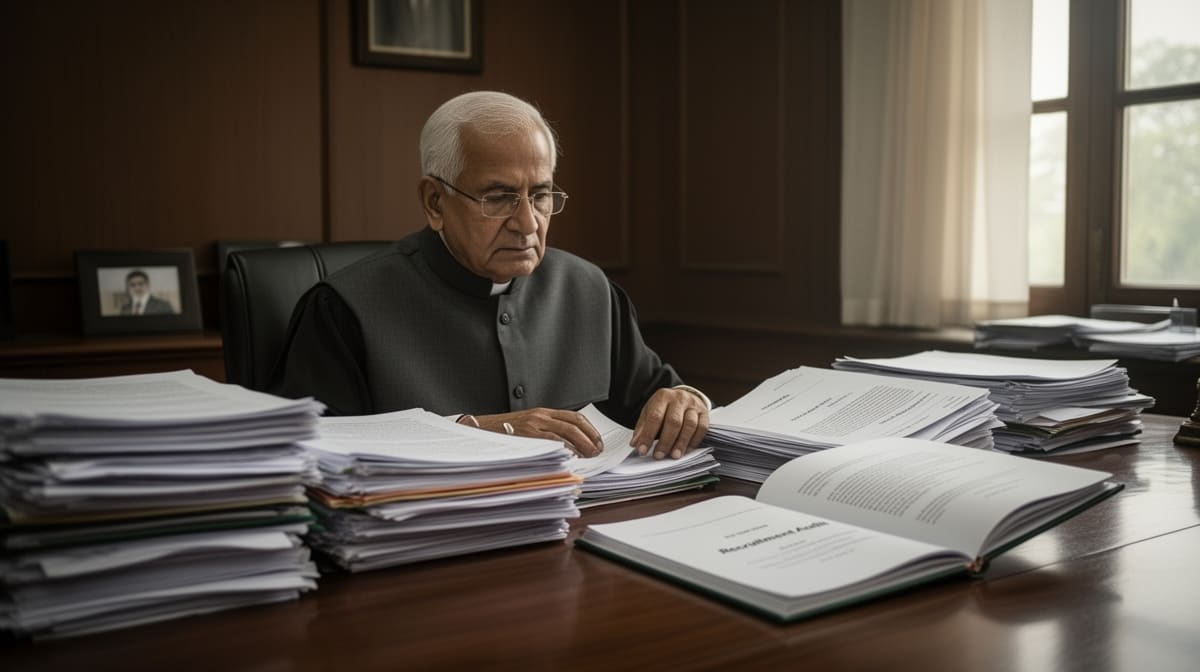
The Meghalaya High Court has clarified that legislative committees cannot shield themselves from judicial scrutiny by invoking Article 212 of the Constitution when their recommendations directly affect individual rights. This ruling establishes a critical boundary between legislative privilege and administrative action, reinforcing that procedural immunity does not extend to decisions with tangible civil consequences.
Background & Facts
The Dispute
The petitioners, all former employees of public sector undertakings under the Government of Meghalaya, were denied retirement benefits, additional retirement benefits, and commuted leave encashment following a recommendation by the Committee on Public Undertakings. The Committee, constituted under Rule 242-A of the Meghalaya Legislative Assembly’s Rules of Procedure, examined the Comptroller and Auditor General’s (CAG) report and recommended discontinuation of these benefits. The petitioners challenged this outcome as arbitrary and violative of their fundamental rights under Articles 14 and 21.
Procedural History
- The petitioners filed writ petitions (WP(C) No. 196 of 2025 and WP(C) No. 197 of 2025) before the Meghalaya High Court.
- The Committee on Public Undertakings was arrayed as respondent No. 12, despite no specific relief being sought against it.
- The Committee moved to be struck off as a party, arguing immunity under Article 212.
- The petitioners opposed the application, citing the Committee’s direct role in depriving them of benefits.
Relief Sought
The petitioners sought restoration of their retirement benefits and a declaration that the Committee’s recommendation was illegal, arbitrary, and violative of constitutional rights. They also sought directions to the State to implement the benefits retroactively.
The Legal Issue
The central question was whether the Committee on Public Undertakings, acting under legislative rules, can claim immunity under Article 212 of the Constitution when its recommendations result in the denial of statutory benefits to individuals, even in the absence of a formal legislative resolution.
Arguments Presented
For the Appellant/Petitioner
The applicant argued that Article 212 protects only the internal proceedings of the Legislature - such as debates, voting, or procedural irregularities - and not administrative outcomes that directly affect individual rights. Relying on Dr. Sunil Kumar Singh v. Bihar Legislative Council, they contended that the Supreme Court had distinguished between legislative decisions and recommendations with executive consequences. The Committee’s recommendation, they submitted, was not a legislative act but an administrative determination that triggered financial consequences for the petitioners.
For the Respondent/State
The Committee contended that its functions were constitutionally protected under Article 212, as it was a statutory committee of the Legislature constituted under the Rules of Procedure. It argued that its examination of CAG reports and submission of recommendations were integral to legislative oversight and thus immune from judicial review. It further asserted that no relief was claimed against it, making its presence redundant and legally impermissible.
The Court's Analysis
The Court examined the nature of the Committee’s recommendation and its operational impact. It noted that while Article 212 bars courts from inquiring into the validity of legislative proceedings, it does not confer blanket immunity on all actions taken by legislative bodies. The Court emphasized that the Committee’s recommendation was not a legislative decision but an administrative recommendation that was acted upon by the State’s departments to deny benefits.
"The Committee’s recommendation, though made under legislative rules, operated as a de facto executive order affecting vested rights of individuals, and cannot be cloaked in legislative privilege merely because it originated in a parliamentary committee."
The Court distinguished Dr. Sunil Kumar Singh, noting that the Supreme Court had held that immunity under Article 212 does not extend to recommendations that result in adverse consequences for citizens. The Court further observed that the Committee’s actions lacked transparency, procedural fairness, and an opportunity of hearing - elements essential to natural justice. The Court concluded that the Committee’s role in this context was not legislative but quasi-administrative, and therefore subject to judicial review.
The Verdict
The petitioners prevailed. The Court held that Article 212 does not protect administrative recommendations by legislative committees that directly deprive individuals of statutory benefits. The application to strike off the Committee as a party was dismissed, and the matter was allowed to proceed with the Committee remaining as a respondent.
What This Means For Similar Cases
Legislative Recommendations Are Not Automatically Immune
- Practitioners must now challenge administrative outcomes stemming from legislative committees on grounds of arbitrariness, even if the recommendation itself is not a statute.
- The mere fact that a body is constituted under legislative rules does not confer constitutional immunity.
- Courts will examine the functional impact of the recommendation - not its origin - to determine justiciability.
Procedural Fairness Is Required in Quasi-Administrative Functions
- When legislative committees make recommendations that affect individual rights, they must follow principles of natural justice.
- Affected parties must be given notice and an opportunity to be heard before adverse recommendations are made.
- Failure to do so renders the recommendation vulnerable to judicial invalidation under Article 14.
State Entities Cannot Hide Behind Committees
- Government departments acting on committee recommendations cannot evade accountability by claiming the decision was "legislative."
- The State remains liable for implementing recommendations that violate constitutional rights.
- Petitioners may now name such committees as respondents to ensure transparency and accountability in the decision-making chain.