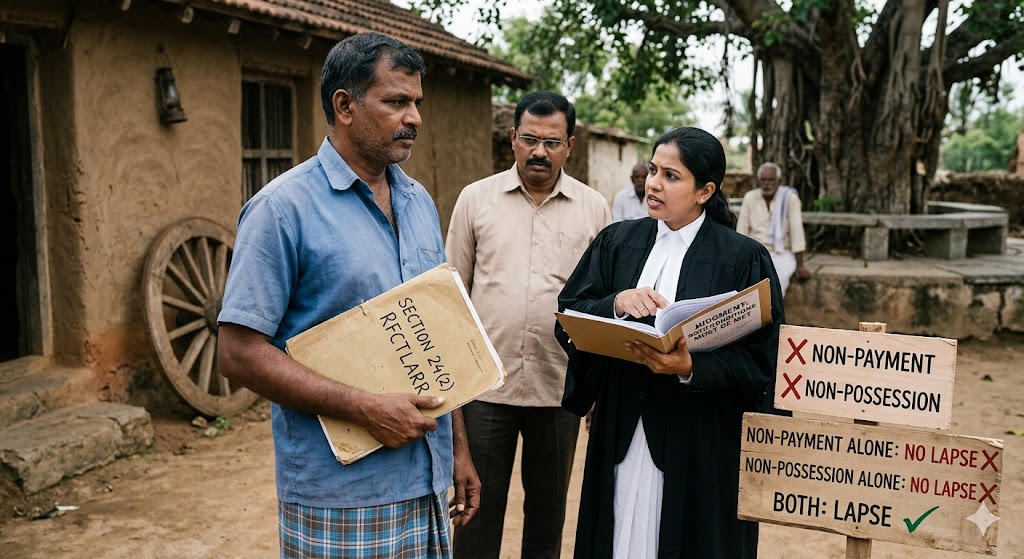
The Madras High Court has clarified that the lapse provisions under Section 24(2) of the Right to Fair Compensation and Transparency in Land Acquisition, Rehabilitation and Resettlement Act, 2013, do not extend to acquisitions made under special statutes like the Adi Dravidar and Tribal Welfare Act, 1978, where no statutory mechanism for re-conveyance exists. This ruling reinforces the principle that statutory context governs the applicability of general land acquisition norms.
Background & Facts
The Dispute
The petitioner, a deaf and dumb woman, claims ownership of land in Survey No. 78/1-C, Meenanthotti Village, Krishnagiri District, acquired by the Tamil Nadu government in 1997 under the Adi Dravidar and Tribal Welfare Act, 1978 (Act 31 of 1978). She asserts that the land was originally intended for allotment to 33 beneficiaries from the Adi Dravidar community, but all pattas issued to them were cancelled in 2018 due to ineligibility. She contends that the acquisition has become unworkable and seeks a declaration that the proceedings have lapsed under Section 24(2) of the 2013 Act.
Procedural History
- 1997: Land acquired under Act 31 of 1978 for a Harijan Welfare Scheme
- 1998: Compensation of Rs. 52,904/- deposited in the Sub Court, Hosur
- 2018: Pattas issued to all 33 beneficiaries cancelled due to ineligibility
- 2023: Writ petition filed under Article 226 seeking de-notification of acquisition
Relief Sought
The petitioner seeks a declaration that the acquisition proceedings have lapsed under Section 24(2) of the 2013 Act, or alternatively, that the land be de-notified due to the failure of the intended welfare scheme.
The Legal Issue
The central question was whether Section 24(2) of the Land Acquisition Act, 2013, applies to acquisitions made under special statutes like Act 31 of 1978, and whether cancellation of pattas to original beneficiaries triggers automatic lapse or de-notification in the absence of a re-conveyance clause.
Arguments Presented
For the Petitioner
Learned Senior Advocate V. Raghavachari relied on K.N. Ramachandran v. Muthumari to argue that when the intended beneficiaries of a welfare scheme are found ineligible and pattas are cancelled, the acquisition becomes unworkable. He contended that unlike general land acquisition laws, Act 31 of 1978 permits no alternative public use of the land, making de-notification the only remedy. He emphasized the petitioner’s dependence on the land for livelihood and the absence of any alternative allocation.
For the Respondent
Government Pleader U. Baranidharan countered that Section 24(2) is inapplicable to special statutes like Act 31 of 1978, which operate under their own framework. He submitted that compensation was deposited in 1998, well before the 2013 Act came into force, and that the statute does not require identification of specific beneficiaries at the time of acquisition. He further argued that the scheme remains viable as long as the land is used for any Harijan Welfare purpose, not limited to the originally identified individuals.
The Court's Analysis
The Court examined the language of Section 4(1) of Act 31 of 1978, which empowers the District Collector to acquire land "for the purpose of any Harijan Welfare Scheme." The Court found no requirement in the statute for the identification of specific beneficiaries at the time of notification. The judgment in K.N. Ramachandran was distinguished on its facts: in that case, the acquisition was explicitly for 50 identified poor and homeless individuals, and their disqualification rendered the scheme inoperative. Here, no such identification existed on record.
"There is nothing in the language of Section 4(1) which indicates that the beneficiary should be identified before the scheme is framed or that the land should be used only for the purpose of identified and specific beneficiaries."
The Court emphasized that Act 31 of 1978 lacks a re-conveyance provision, unlike the 2013 Act, and therefore cannot be subjected to its lapse mechanism. The deposit of compensation in 1998 further negated any claim of lapse under Section 24(2), which applies only where payment has not been made or possession not taken within five years. The Court concluded that the cancellation of pattas, without evidence of a specific beneficiary list tied to the acquisition, does not invalidate the entire scheme.
The Verdict
The petitioner’s writ petition was dismissed. The Court held that Section 24(2) of the 2013 Act does not apply to acquisitions under special statutes like Act 31 of 1978, and that cancellation of pattas to ineligible beneficiaries does not trigger de-notification in the absence of a statutory re-conveyance mechanism. The petitioner was left open to claim compensation in accordance with law.
What This Means For Similar Cases
Special Statutes Are Not Subject to General Lapse Provisions
- Practitioners must first determine whether an acquisition falls under a special statute with its own framework
- Section 24(2) applies only to acquisitions under the 1894 Act or the 2013 Act, not to schemes governed by separate legislation
- Any claim of lapse must be grounded in the specific statutory regime under which acquisition occurred
Beneficiary Cancellation Alone Does Not Invalidate Acquisition
- Cancellation of pattas or disqualification of intended beneficiaries does not automatically render an acquisition void or lapsed
- The scheme remains valid if the land can still be used for any purpose under the statutory objective (e.g., "Harijan Welfare Scheme")
- Petitioners must prove the scheme was tied to specific individuals, not merely a general welfare objective
No Re-conveyance Means No Automatic Remedy
- Where a special statute lacks a re-conveyance clause, courts cannot imply one
- Remedies must be sought under the statute’s own provisions or through compensation claims
- Practitioners should advise clients to pursue compensation, not de-notification, in such cases